

When most people encounter a new token, they reach for familiar categories. Is it equity? Is it a utility token? Does it pay yield? Can you stake it?
These questions are not wrong. They are simply borrowed from a financial vocabulary built for a different world — and when applied to the Business Token introduced in the InterLink Foundation Whitepaper, every one of them misses.
That mismatch is worth examining.
Because the failure to categorize something correctly is usually the first sign that something genuinely new has arrived.
The Categories That Don’t Fit
Start with equity.
Equity grants ownership, dividend rights, board representation, and a legal claim on the issuing entity’s assets. A Business Token grants none of these.
The whitepaper is unambiguous: holding a BT does not make you a shareholder. The on-chain token and the off-chain company are legally and structurally distinct.
Move to bonds or yield instruments.
These promise periodic cash distributions tied to a fixed obligation. BT holders receive no direct revenue distributions — no stablecoin, no cash, no scheduled payout. The protocol explicitly does not pay dividends.
Try utility tokens.
These derive value from access rights within a specific platform. BT does not grant access to services. Its value is not gated by platform usage. Staking, similarly, involves locking a native token to earn protocol rewards generated from inflation or fee redistribution. BT operates on an entirely different logic.
None of the existing categories hold.
This is not a categorization problem to be solved by choosing the closest approximation. It is a signal that the InterLink whitepaper has introduced something the existing vocabulary cannot accurately describe.

What BT Actually Is
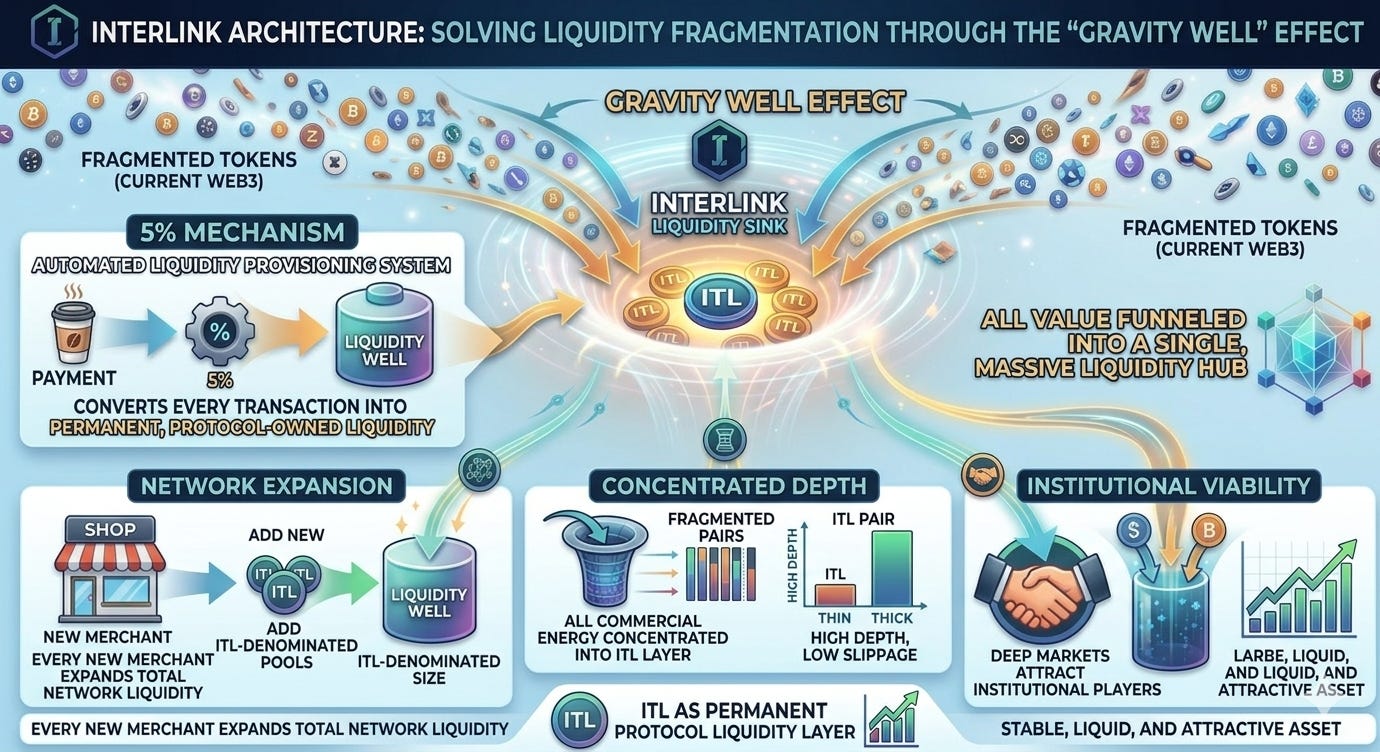
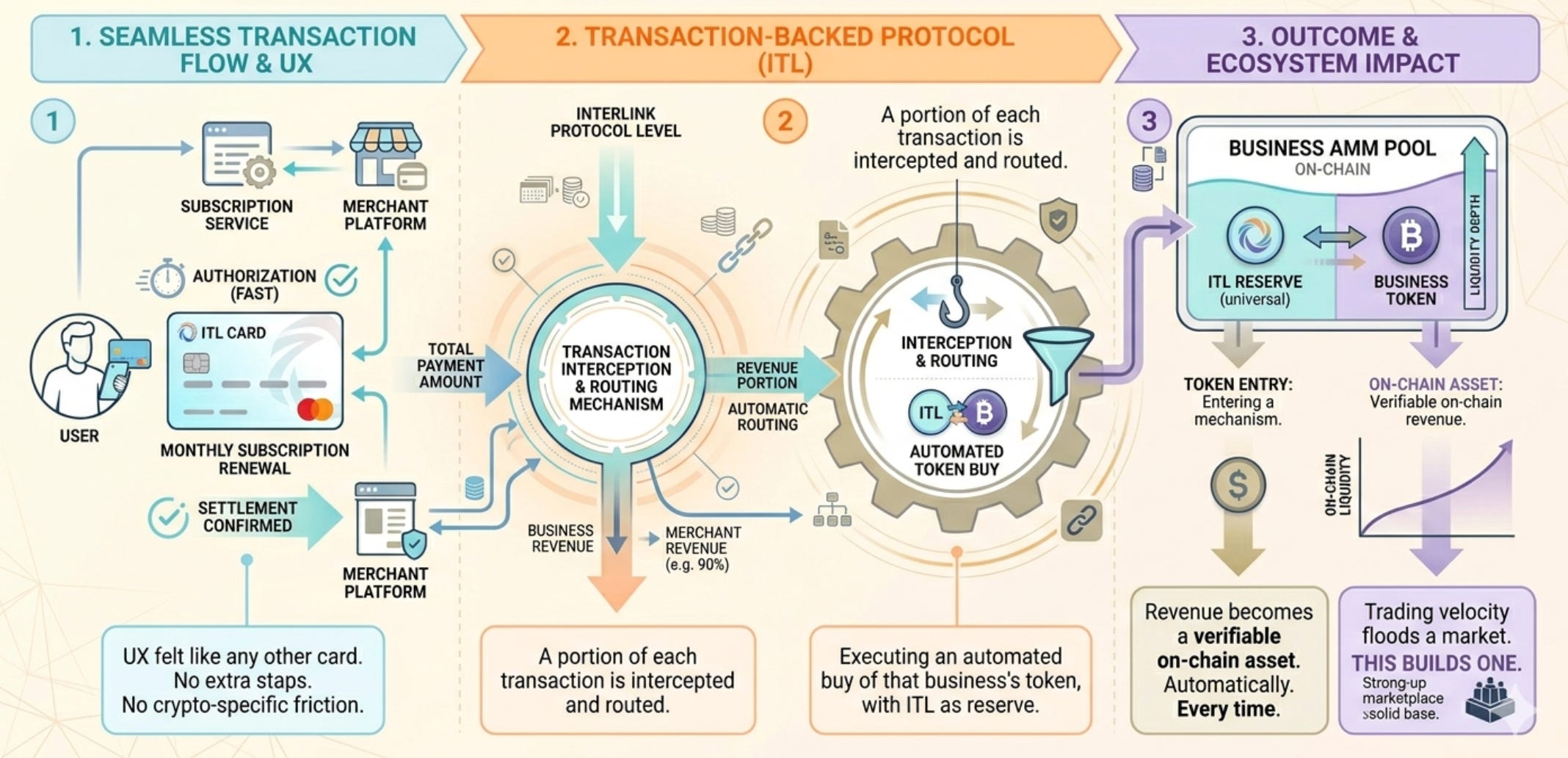
The Business Token is an IRC-20 token issued through a process the whitepaper calls Business Initialization. At issuance, it is paired with ITL in a protocol-embedded AMM liquidity pool.
From that point forward, its economic behavior is governed by a single structural rule:
every payment processed through the InterLink Payment Infrastructure for the issuing business automatically triggers an on-chain market buy of that business’s BT from the AMM pool.
This is the mechanism the whitepaper calls Value Capture. A defined percentage of each transaction is split between a direct market buy of BT and a paired liquidity deposit into the pool. The holder does not receive cash. Instead, real commercial activity generates persistent buy-side demand on the token, while simultaneously deepening the liquidity pool that makes exit possible.
The economic rights of a BT holder are therefore not income rights.
They are structural position rights: exposure to the buy-side pressure generated by a specific business’s real transaction volume, with liquidity that scales as that commerce grows.
The value input is exogenous — it comes from actual commerce in the physical world, not from token price movements or protocol inflation.
The whitepaper calls this non-circular tokenomics: circular incentive designs, where token price drives token demand, produce reflexive collapse under stress. BT is structurally insulated from that failure mode because its demand source sits outside the token economy entirely
The Closest Analogy — And Why It Still Falls Short
If pressed to find a comparison in traditional finance, the closest instrument might be a revenue-linked tradeable certificate: a liquid asset whose market demand is mechanically tied to the operating revenue of a specific business, with no fixed maturity and no issuer buyback obligation.
That description captures the general shape. But it misses the critical detail.
In traditional finance, revenue-linked instruments derive their value from a contractual relationship with the issuer — a promise that can be broken or renegotiated.
BT derives its demand not from a promise but from an on-chain protocol rule. The Value Capture mechanism executes automatically at the Settlement Layer whenever a qualifying transaction occurs. The issuing business cannot disable it unilaterally.
This changes the nature of the asset entirely.
Demand generation is not dependent on issuer behavior after issuance — it is embedded in the protocol infrastructure the business integrated with. The business’s continued commercial activity is the mechanism. Not its goodwill.
No existing financial instrument category captures this combination: protocol-enforced, commerce-driven, AMM-mediated, and structurally liquid by design rather than by market discretion.
What the Whitepaper Actually Declared
The InterLink Foundation Whitepaper is being read primarily as a technical document. Most commentary focuses on the protocol mechanics, the tokenomics parameters, the AMM design.
These matter. But the more significant declaration sits underneath the mechanics.
The whitepaper introduced a new asset class.
Not a new token standard. Not a new DeFi primitive. A new category of economic instrument — one where the connection between real-world business activity and on-chain asset demand is not approximate, not aspirational, and not dependent on narrative. It is structural, automatic, and mathematically enforced.
Financial history has a pattern: new asset classes arrive before the vocabulary to describe them does. Derivatives existed as instruments before they existed as a recognized category. Securitized assets were traded before the legal and conceptual frameworks caught up.
The Business Token sits in that same early position — a functioning instrument without a settled name.
Traditional assets distribute cash flows.
BT restructures transaction flows.
The whitepaper didn’t announce a new token. It drew the boundary of a new asset class — and quietly waited for the rest of the world to notice.
If you’d like to support my research, you may use my Interlink invitation code below. It also unlocks an instant mining boost ✚︎ Welcome Bonus for new users.
InterLink Referral Code: 905079415
Wallet Invitation Code : HSVZZPEJ (75% Commission Rebate)
❓ How to Join InterLink
The InterLink Sign-up Guide: Secure Your Digital Assets in 5 Minutes

The world moves in complex ways, but growing your assets doesn’t have to.
You don’t need capital. You just need five minutes.
📚 Done.T’s Related Insights
X Money Is Coming. But the Real Question Is Who Gets There First.

The most dangerous thing money can do is announce itself.
Why You Don't Need to Be a Crypto Expert to Participate in Tokenization

We are moving toward a world where real economic activity runs on blockchain infrastructure.
🔎 Search “Done.T Insight” on Google for real data & analysis.
Disclosure: This post contains referral links and reflects my personal research and experience. It is provided for informational purposes only and does not constitute financial advice.