

For the past year, InterLink’s growth strategy was structurally simple.
Mine for free.
No capital required. No technical knowledge needed. The barrier to entry was effectively zero, which is why the network reached 8 million users as quickly as it did.
That model ends with the Open Mainnet.
When Chairman KV announced that free mining would terminate, the community’s anxiety was understandable. But the anxiety was pointed at the wrong problem. The question is not what happens to the people who were mining. The question is how InterLink reaches the next billion users who were never going to mine anything.
That is the real promotional challenge. And it is a fundamentally different problem.
Why Mining Worked — And Why Nothing Like It Exists Anymore
Mining worked for one reason. It was free.
Free eliminates the single biggest barrier to adoption: the cost of trying something new. You did not need to believe in InterLink’s vision. You did not need to understand blockchain. You just needed to open an app. That threshold produced an extraordinarily broad user base.
Post-Open Mainnet, that threshold disappears. InterLink cannot replicate that frictionless entry point through technical explanations about Validators or BFT consensus.
The mainstream does not engage with infrastructure. It engages with outcomes.
The promotional model has to change entirely.

Direction One: The Consumer Play
The most natural replacement for mining-as-onboarding is rewards-as-onboarding.
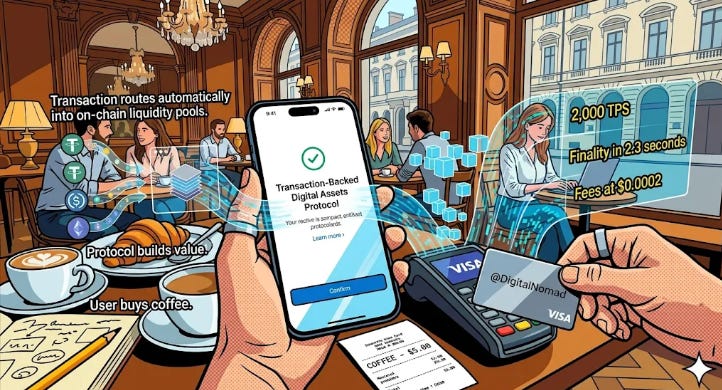
Consumers do not need to understand ITL to accumulate it. They need a reason to use a card or app they already trust, structured so that ITL accrues automatically as a byproduct of normal spending.
This is the model that airline miles and credit card cashback have proven at scale for decades.
InterLink’s partnerships with Visa and MasterCard are the infrastructure for exactly this. A consumer taps their card. The front-end experience is identical to any existing payment. Behind that tap, settlement occurs on-chain in 3 to 5 seconds. A defined portion routes into the consumer’s ITL balance automatically.
Here is where the difficulty lives.
InterLink is not entering an empty market. Visa rewards, Mastercard points, and cashback systems already occupy this space.
The consumer play does not succeed by offering something new. It succeeds only if ITL-based rewards are demonstrably better than what already exists. That case has not yet been made in the market.
Direction Two: The Institutional Play
While the consumer play is visible and fast, the institutional play is quiet and large.
InterLink is positioning ITL not only as a payment medium but as a national reserve asset — engaging directly with governments and central banks to access trillions of dollars in liquidity.
The preparation includes international legal compliance, quantum-resistant cryptography, and an exponential deflationary token model.
This direction moves slowly.
Government negotiations operate in years, not months. Regulatory approval, central bank participation, and legal status confirmation are prerequisites, not assumptions.
But when institutional positioning succeeds, the transaction volumes involved are incomparable to retail. A single sovereign treasury allocation generates more on-chain activity than millions of individual consumer transactions.
The institutional play is not a projection. It is the addressable market — contingent on conditions that have not yet been met.
The Condition That Determines Everything
Both directions converge on three requirements:
No behavioral change for the user
Immediate spendability of accumulated ITL
Zero conversion friction at the point of payment.
InterLink’s architecture addresses the first and third by design. Layer 0 identity verification happens once. The Visa and MasterCard integration abstracts blockchain complexity behind familiar payment interfaces.
The second condition — merchant acceptance depth — remains the open variable.
If ITL accrues in a wallet with nowhere meaningful to spend it, the experience mirrors airline miles expiring unused. Whether the Visa and MasterCard partnerships represent logo-level agreements or fully operational merchant network integrations has not been publicly confirmed.
That confirmation is the real inflection point.
Not the Open Mainnet launch. Not the Validator transition. The moment a consumer can spend ITL as naturally as tapping a card — that is when the promotional challenge either resolves or compounds.
Where the Work Actually Begins
Mining built the crowd.
The Open Mainnet builds the utility.
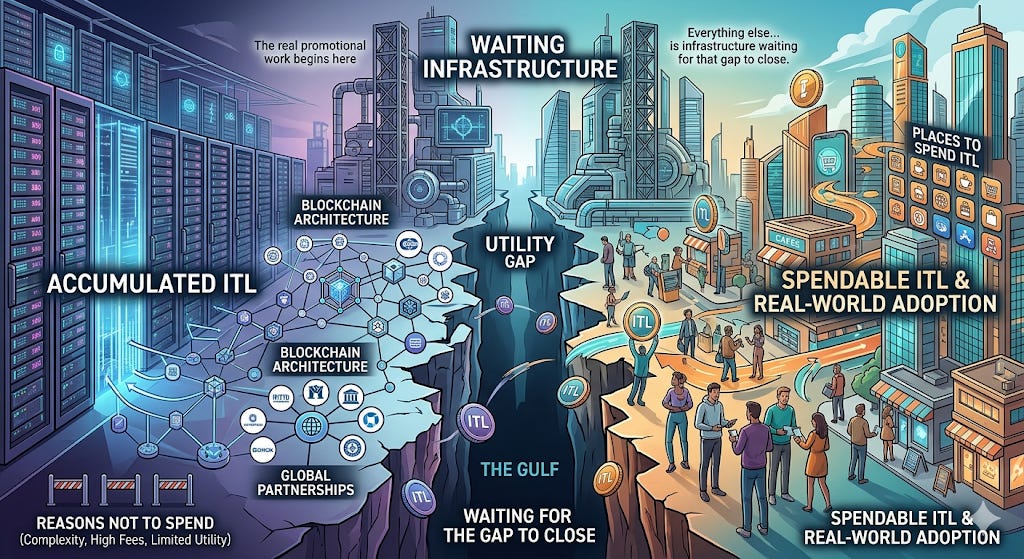
But utility only becomes adoption when the places to spend ITL outnumber the reasons not to.
The gap between accumulated ITL and spendable ITL is where InterLink’s real promotional work begins. Everything else — the architecture, the partnerships, the institutional ambition — is infrastructure waiting for that gap to close.
Why someone chooses ITL over a rewards system they already trust is a question InterLink will have to answer in the market. The answer belongs to them.
If you’d like to support my research, you may use my Interlink invitation code below. It also unlocks an instant mining boost ✚︎ Welcome Bonus for new users.
InterLink Referral Code: 905079415
Wallet Invitation Code : HSVZZPEJ (75% Commission Rebate)
❓ How to Join InterLink
The InterLink Sign-up Guide: Secure Your Digital Assets in 5 Minutes

The world moves in complex ways, but growing your assets doesn’t have to.
You don’t need capital. You just need five minutes.
📚 Done.T’s Related Insights
After the Mining Ends: Where Is InterLink Actually Looking?

When InterLink Foundation Chairman KV announced that free mining would end with the Open Mainnet launch, the community’s immediate reaction was predictable.
Why Proof of Personhood Makes You a Validator — No Hardware Required

For more than a decade, participating in blockchain validation meant clearing one of two very high bars.
🔎 Search “Done.T Insight” on Google for real data & analysis.
Disclosure: This post contains referral links and reflects my personal research and experience. It is provided for informational purposes only and does not constitute financial advice.