

When InterLink Foundation Chairman KV announced that free mining would end with the Open Mainnet launch, the community’s immediate reaction was predictable.
Anxiety about token value. Concern about lost income. Questions about what comes next.
Understandable. But structurally incomplete.
Mining termination was not the headline. It was the footnote. The headline is what InterLink is preparing to do after the network stabilizes under Validator consensus:
execute a full-scale drive to position ITLG as a real-world spending currency — not a number inside a mobile app, but a medium of exchange that people use to buy things, settle transactions, and participate in a functioning digital economy.
The Open Mainnet is that infrastructure becoming ready.
This Was Never a Token Project
To understand where InterLink is going, you have to understand what it was designed to be from the beginning.
The InterLink whitepaper opens with a diagnosis most blockchain projects have avoided making explicitly.
The barrier to mainstream blockchain payments has never been demand. It has always been the absence of the right infrastructure. Not the right marketing. Not the right community. The right infrastructure.
Every architectural decision in InterLink’s four-layer design flows from that diagnosis.
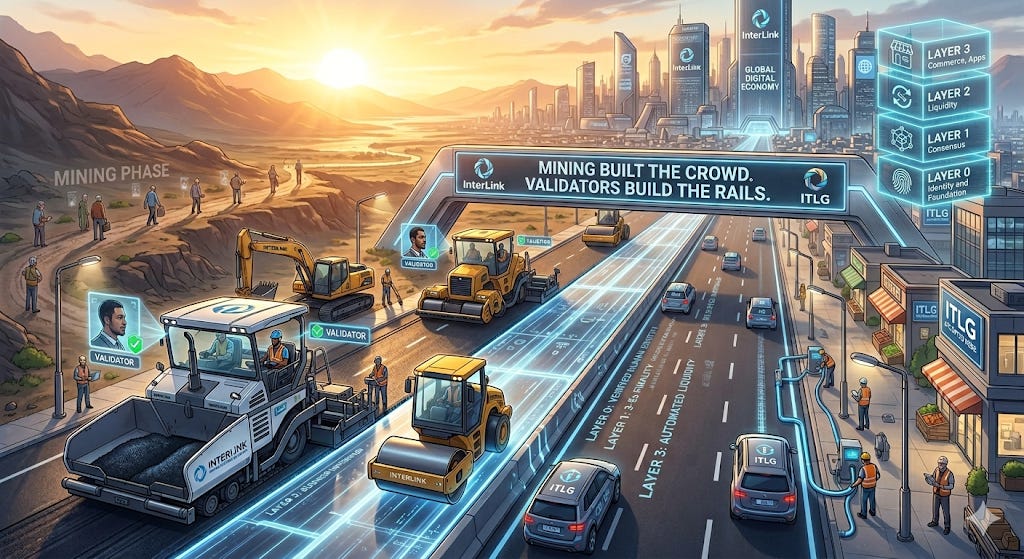
Layer 0 establishes verified human identity at the protocol level — eliminating the bot problem that makes open networks structurally hostile to compliant commerce. Layer 1 delivers deterministic single-block finality within 3 to 5 seconds. Layer 2 embeds automated liquidity mechanics that connect real transaction revenue to on-chain asset formation. Layer 3 provides the interface through which businesses interact with all of it without needing to understand the underlying cryptography.
This is not a token ecosystem with a payment feature bolted on. This is a payment infrastructure with a token economy embedded inside it.
Mining served a specific purpose.
It distributed the network’s native asset across a broad base of participants, creating the initial liquidity and community density any payment network requires before it can function at scale.
But a payment ecosystem cannot function if its infrastructure is operated by anonymous participants optimizing for individual extraction. It requires operators with verified identity, demonstrated reliability, and accountable participation in network consensus.
Mining built the crowd.
Validators build the rails.
The Structural Problem Existing Payments Cannot Solve
Visa processes authorizations in milliseconds. That speed is real. But authorization and settlement are not the same event.
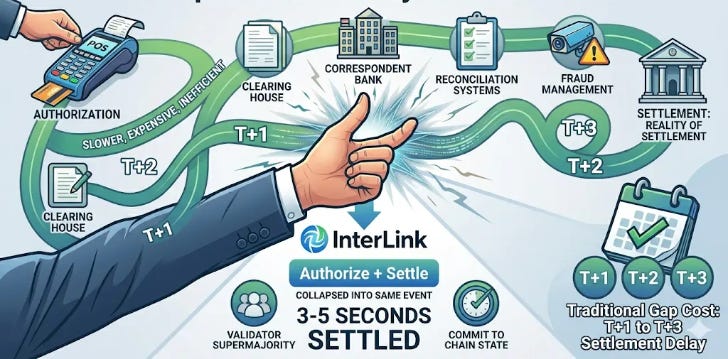
When a customer taps their card and walks out of a store, the merchant has received a promise — not money. The actual movement of funds happens days later, somewhere between T+1 and T+3.
The perception of finality and the reality of settlement are separated by a gap that the entire financial intermediary industry exists to bridge.
That gap has a cost.
Clearing houses. Correspondent banks. Reconciliation systems. Fraud management infrastructure. It is why cross-border payments remain slow and expensive. It is why the global payments industry is one of the most profitable and least efficient sectors in the economy.
Traditional finance separates authorization from settlement. InterLink collapses them into the same event.
When a transaction is confirmed by a supermajority of Validators and committed to chain state, it is irrevocably settled. Not authorized. Not pending. Settled — within 3 to 5 seconds of submission.
No clearing window.
No counterparty risk in the interim.
No reconciliation required.
Visa and MasterCard: Infrastructure, Not Competition
If InterLink is building payment infrastructure, is it competing with Visa and MasterCard?
No. And the distinction matters.
Visa and MasterCard are network operators — they maintain the rails, set the standards, and manage relationships between issuing banks, acquiring banks, and merchants.
The actual movement of money runs through correspondent banking relationships they coordinate but do not own.
InterLink’s partnership positions it as a settlement layer within that existing ecosystem, not a replacement for it.
Visa owns the front-end relationship with the consumer. InterLink provides the back-end settlement infrastructure that makes that relationship faster, cheaper, and more transparent.
This is not a marketing arrangement. It is an infrastructure integration.
When a consumer pays with an InterLink-connected card, the front-end experience is identical to any existing card payment. What happens behind that tap is structurally different.
The Moment the Number Becomes Real Money
When does a number inside a mobile app become a spending currency?
It is designed to become one when the infrastructure exists to support it — when merchants accept it, when settlement is instantaneous, when the friction of conversion disappears.
The Validator network provides the consensus stability that enterprise-grade payment infrastructure requires. The Visa and MasterCard integrations provide the merchant acceptance network. The 3 to 5 second finality provides the settlement speed that makes point-of-sale payment viable.
Mining built the initial distribution.
The Open Mainnet is designed to build the utility.
And utility is what positions a speculative asset to become a spending currency.
The people who accumulated ITLG during the mining phase were not just earning tokens. They were becoming the initial holders of a currency that had not yet found its real-world use case.
The Open Mainnet is that use case arriving — if the infrastructure performs as designed.
Where InterLink Is Actually Looking
Free mining ends. That part is settled.
What replaces it is not a void. It is the activation of everything the mining phase was building toward — payment infrastructure capable of supporting real-world commerce at scale, backed by Validator consensus, integrated with existing card networks, and settled with a finality that traditional finance has structurally never been able to deliver.
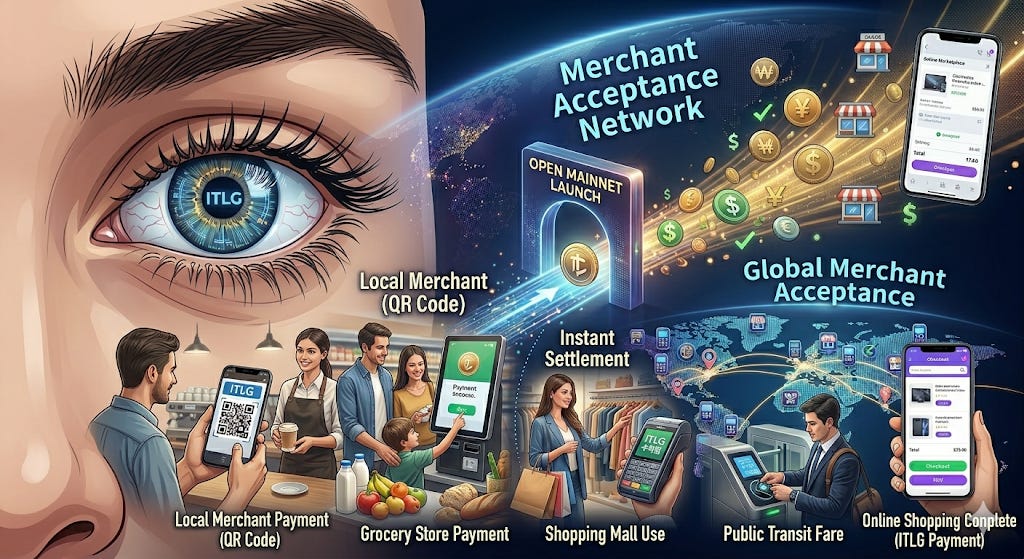
InterLink’s post-mining ambition is not to be another blockchain with a token.
It is to be the settlement layer of a new payment economy — one where the distinction between crypto and conventional currency becomes operationally irrelevant because the infrastructure handles the translation invisibly.
The mining phase asked: how many tokens can you accumulate?
The next phase asks a different question entirely: what can you actually do with them?
The Open Mainnet is not the end of the story.
It is the moment the story becomes real.
If you’d like to support my research, you may use my Interlink invitation code below. It also unlocks an instant mining boost ✚︎ Welcome Bonus for new users.
InterLink Referral Code: 905079415
Wallet Invitation Code : HSVZZPEJ (75% Commission Rebate)
❓ How to Join InterLink
The InterLink Sign-up Guide: Secure Your Digital Assets in 5 Minutes

The world moves in complex ways, but growing your assets doesn’t have to.
You don’t need capital. You just need five minutes.
📚 Done.T’s Related Insights
The Compliance Code Hidden Inside InterLink's Verification System

InterLink calls it verification. The regulatory references inside it suggest something else entirely.
The Open Mainnet Era: The Role of Validators and the Vision Behind InterLink's Blockchain

Since InterLink Foundation Chairman KV announced that free mining will end with the Open Mainnet launch, the community has been unsettled. People who recommended mining feel a sense of responsibility. People who have been mining feel lost. The mood oscillates between suspicion and anxiety.
🔎 Search “Done.T Insight” on Google for real data & analysis.
Disclosure: This post contains referral links and reflects my personal research and experience. It is provided for informational purposes only and does not constitute financial advice.