

Most crypto projects reward growth.
InterLink taxes it.
That single design choice separates InterLink’s Human Hash Power mechanism from every mobile mining model that came before it — and it is worth understanding precisely, because the logic embedded in this system is not metaphor.
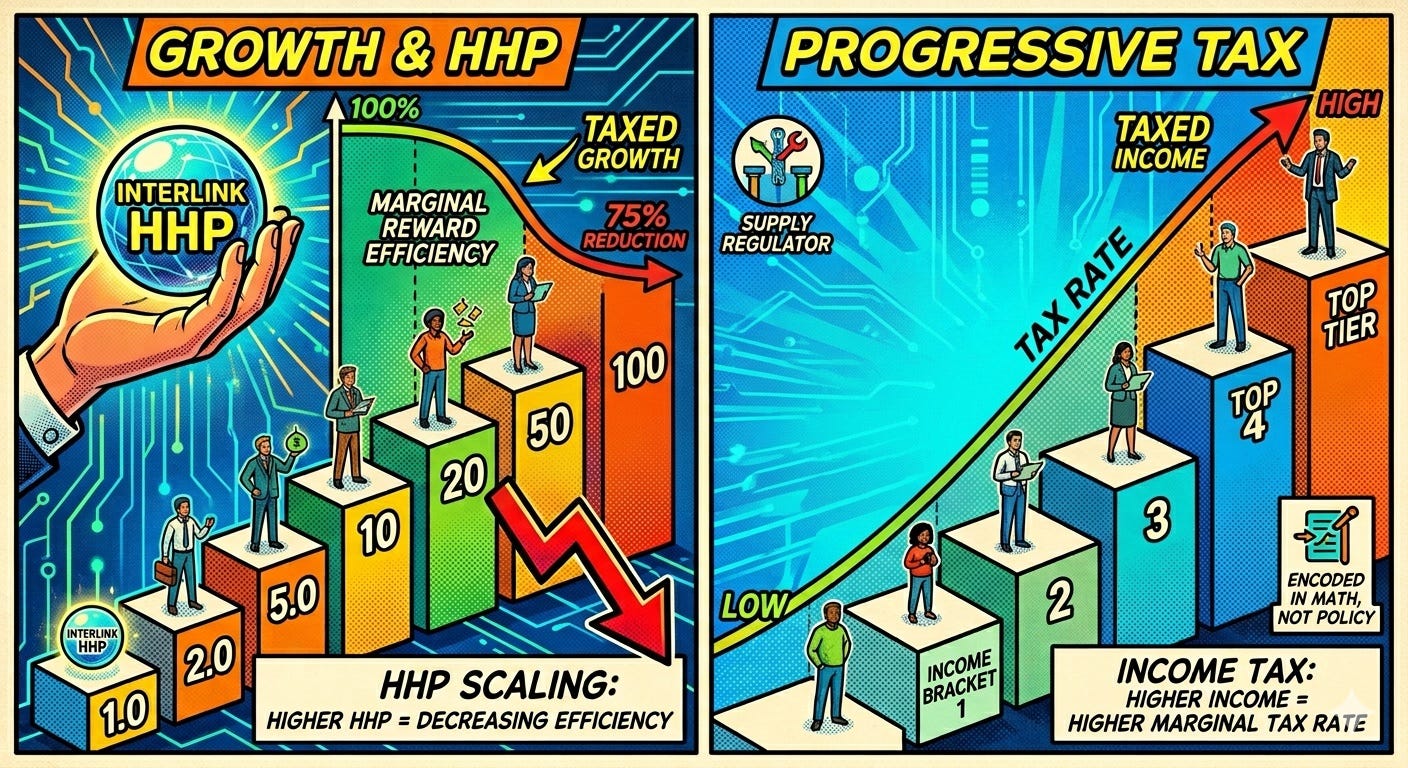
It is, structurally, a progressive tax.
💸 The Tax Bracket Built Into the Code
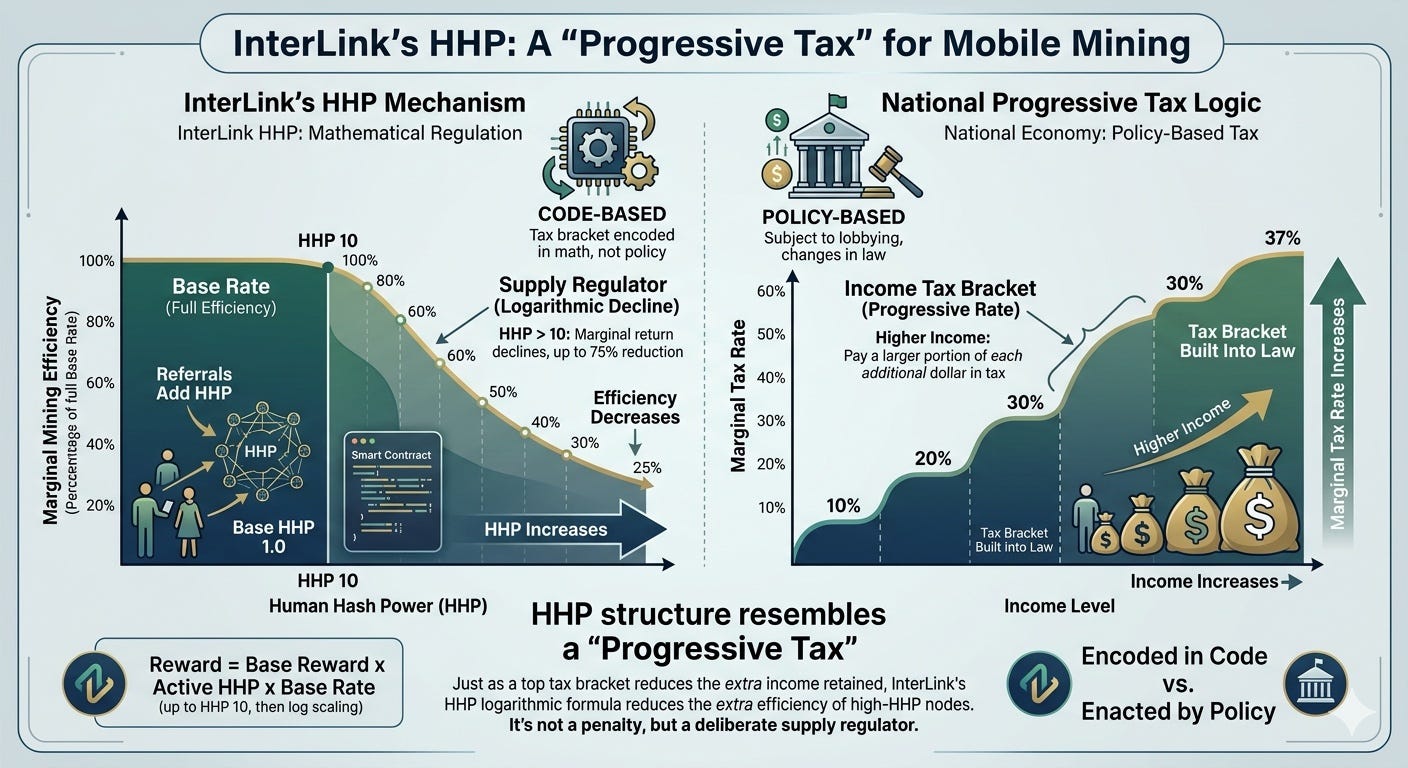
Every InterLink user begins with a Base HHP of 1.0. Direct referrals add 0.2 each; their referrals add 0.1.
Your four-hour reward is calculated as Base Reward × Active HHP × Base Rate, and until your HHP reaches 10, that Base Rate runs at full efficiency.
Then the logarithmic formula activates.

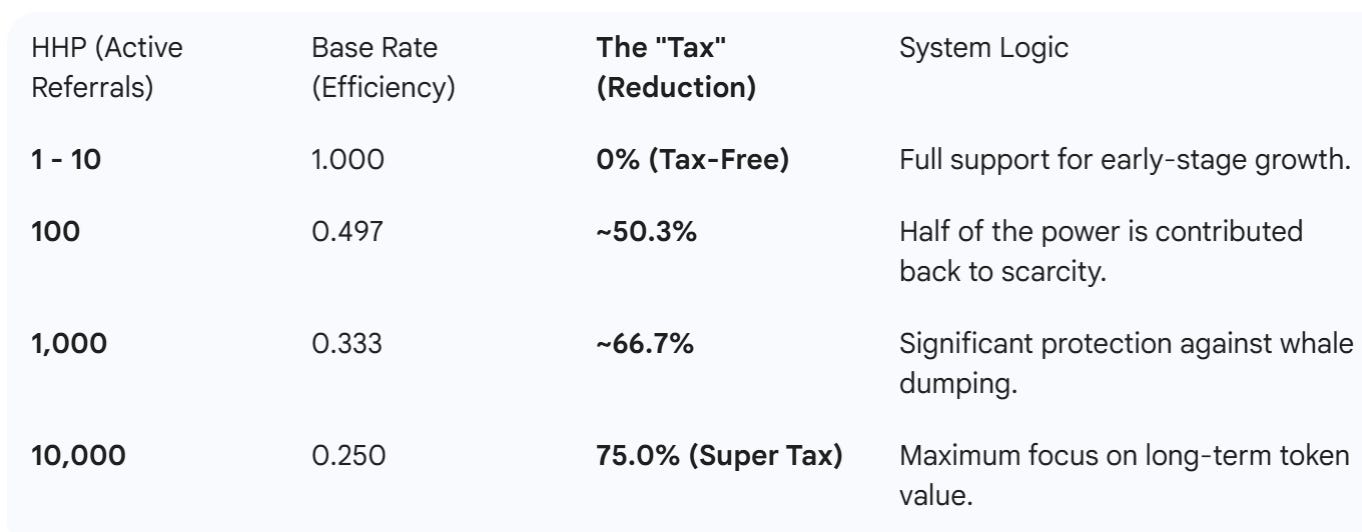
Once your HHP exceeds 10, marginal efficiency begins declining — and it does not stop until it reaches 25% of its original rate.
That is a 75% reduction on the highest-output nodes.
Any economist would recognize the structure: the more you accumulate, the lower your marginal return.
This is not a design flaw or a penalty. It is, deliberately, a supply regulator — the same function a top income tax bracket serves in a national economy.
The difference is that this tax is encoded in math, not policy. It cannot be lobbied away.
🤷 The Tax-Free Bracket — and What It Actually Means
Every progressive tax system has a threshold below which the highest rates do not apply. InterLink’s is HHP 10.
To understand what that means in practice, work backwards from the formula. With a Base HHP of 1.0, reaching 10 requires 9 additional points from your referral network. At 0.2 per F1 referral and assuming an average of two F2 connections per F1, each direct referral contributes approximately 0.4 HHP in total.
That puts the tax-free bracket at roughly 22 to 30 active referrals — a network small enough to build meaningfully, large enough to matter.
Below that threshold, every point of HHP you generate works at full efficiency. Above it, the logarithmic formula begins compressing your returns — gradually, but persistently.
This is the number the whitepaper does not give you directly, but the math delivers cleanly: 25 to 30 active referrals is InterLink’s tax-free ceiling.

Start InterLink in 5 minutes.
🔗 [Step-by-step setup guide]
⚡ Why Activity Alone Is Not Enough
A progressive tax only functions if the income being taxed is real. InterLink enforces this through the 24-hour activity rule: referrals who have not mined within the past 24 hours do not count toward your HHP.
This part is not unique to InterLink. Pi Network applies the same logic — inactive referrals stop contributing to your mining speed.
The difference is what happens after the activity check passes.
In Pi Network, every active referral contributes equally, at a flat rate, with no ceiling. A node with 100 active referrals simply multiplies its speed by 100 at the same coefficient.
In InterLink, those same 100 active referrals still trigger the logarithmic formula — and the marginal return on each additional point of HHP keeps compressing.
The 24-hour rule filters out the dead weight. The Base Rate formula taxes what remains.
Both mechanisms are necessary. Neither one alone is sufficient.
🏗️ What This Means for How You Build
The system’s logic points toward a specific strategy, not as advice but as a consequence of the mathematics.
The first 25 to 30 active referrals are your most efficient investment. Each one contributes HHP at full rate, inside the tax-free bracket, backed by the 24-hour rule that keeps the network honest. Beyond that threshold, additional nodes still generate value — but at diminishing marginal returns, by design.
You are not trying to build the largest network. You are trying to build the most active one, up to the point where efficiency peaks.
That is a different goal than any mobile mining project has asked of its users before.
🎯 A System Built to Survive Its Own Success
The most fragile moment in any token economy is the one where it works — when enough people join that supply pressure begins outpacing genuine demand.
InterLink addresses this not at the policy level, but at the architectural level. The tax is in the formula. The activity requirement is in the protocol.
Whether that is sufficient to sustain a digital economy at scale remains an open question. What is not in question is the intent:
this is a system designed to slow its own acceleration before the acceleration breaks it.
That is a rarer design principle than it sounds.
If you’d like to support my research, you may use my Interlink invitation code below. It also unlocks an instant mining boost ✚︎ Welcome Bonus for new users.
InterLink Referral Code: 905079415
Wallet Invitation Code : HSVZZPEJ (75% Commission Rebate)
❓ New to InterLink?
The InterLink Sign-up Guide: Secure Your Digital Assets in 5 Minutes

The world moves in complex ways, but growing your assets doesn’t have to.
You don’t need capital. You just need five minutes.
📚 Done.T’s Related Insights
From Invisible to Measurable: The Economic Architecture Behind InterLink's Human Credit System

Most crypto systems reward what they can count. Hash rate. Transaction volume. Wallet size. These are legible variables — easy to measure, easy to game.
ITLG — Not Meant to Be Sold. Meant to Be Held.

Most people misread InterLink from the very first screen.
🔎 Search “Done.T Insight” on Google for real data & analysis.
Disclosure: This post contains referral links and reflects my personal research and experience. It is provided for informational purposes only and does not constitute financial advice.