

InterLink Foundation Chairman KV recently announced that free mining will end with the launch of the Open Mainnet. No specific date has been confirmed, but the structural signal is clear: the accumulation phase is closing.
What comes next is a different game entirely.
The Game Has Changed
The game until now was simple.
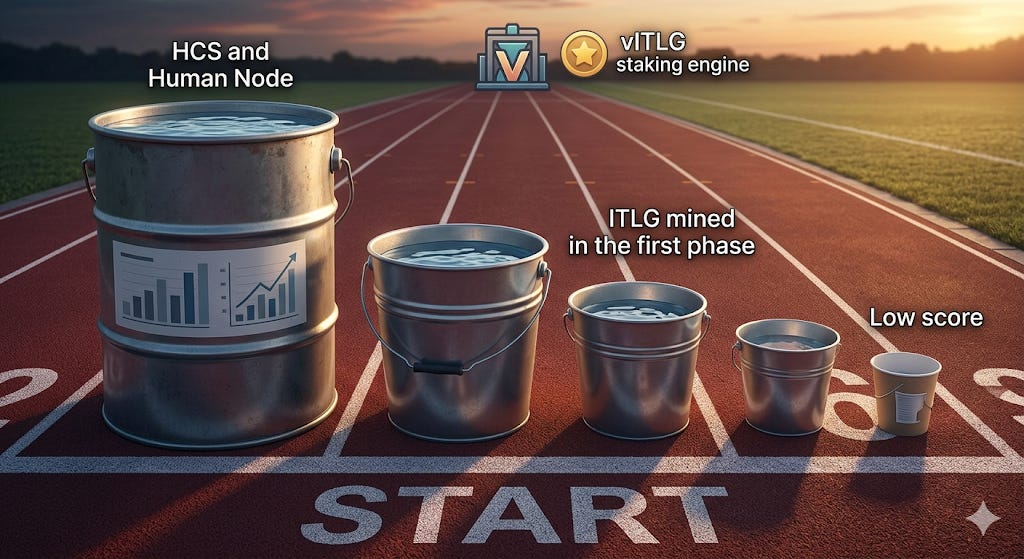
Fill your tank. Mine as much ITLG as possible before the window closes. Every day you ran the app, every referral you brought in, every group mining session — all of it was water flowing into your tank.
That game is nearly over.
The next game is not about filling.
It is about how fast you can move what you have into vITLG — a staked, productive form of ITLG that positions you inside the network’s economic engine rather than outside it waiting to sell.
Here is where it gets interesting. Not everyone moves water with the same bucket.
One person transfers 1 liter at a time. Another transfers 100ml. The bucket size is not random. It is determined by two things: your HCS score — the Human Credit Score that measures your verified behavior and contribution within the InterLink ecosystem — and your Human Node metrics, which track your network activity and reliability over time.
The people who spent the accumulation phase building score, not just balance, are about to discover they were playing the right game all along.
The people still mining today are not late. They are standing at the starting line of the next game — with water already in their tanks.
The Validator and the Question of Trust
When the Open Mainnet launches, mining stops. Block production passes entirely to Validators.
A Validator in InterLink’s architecture is not a mining rig. It is not a server farm running 24 hours optimizing hash rates. It is a network operator whose participation is grounded in verified identity and demonstrated reliability.
The whitepaper describes Layer 1 as a Byzantine Fault Tolerant consensus engine delivering deterministic single-block finality within 3 to 5 seconds.
BFT consensus does not reward raw computation. It rewards trusted participation. A supermajority of Validators must confirm each block before it is irrevocably committed to chain state — no fork risk, no probabilistic deepening, no confirmation window.
This means the selection criteria for Validators will not be measured in terahashes. It will be measured in trust.
What constitutes that trust has not been fully disclosed. The official Validator qualification criteria remain unpublished. What the whitepaper makes structurally clear is this: every transaction on InterLink must first clear the identity gate at Layer 0. A Validator operating at Layer 1 sits directly above that gate.
The implication is that verified identity, network contribution history, and behavioral consistency are not peripheral qualifications. They are the foundation.
HCS and Human Node metrics exist precisely to make that history legible. The people building those scores now are writing their Validator application before the application process opens.
Identity Is Not the Opposite of Proof of Work. It Is the Next Version of It.
Bitcoin solved a problem that had never been solved before. How do you establish trust between strangers without a central authority?
The answer was hardware. Proof of Work did not ask who you were. It asked what your machine had done. The hardware was the credential.
That was not a flaw. It was a breakthrough.
But it had a ceiling. A network built entirely on computational trust cannot distinguish a legitimate participant from an automated extraction engine. It cannot support a payment system that requires accountability, compliance, or identity-bound access. It was never designed to.
InterLink did not discard this architecture. It extended it.
The foundation is still hardware. InterLink’s Layer 0 runs inside the device’s hardware Secure Enclave — the same category of trusted execution environment that makes hardware-level security guarantees possible.
Biometric data never leaves that boundary. The zero-knowledge proof generated inside it is non-transferable, device-bound, and computationally indistinguishable from a random value to any outside observer.
This is not identity bolted onto a blockchain. This is hardware-anchored identity — the same physical trust root that Bitcoin established, extended one layer further.

Bitcoin asked: what has this hardware done?
InterLink asks: who does this hardware belong to?
The shift is not a rejection of Proof of Work’s logic. It is its completion.
Bitcoin: Hardware → Computation → Network Trust
InterLink: Hardware → Identity → Network Trust
The variable that changed is not the hardware. It is what the hardware is asked to prove.
Validators are not replacing miners because computation became irrelevant. They are replacing miners because the network has matured past the point where computation alone is sufficient.
A payment infrastructure serving Visa-grade settlement volumes and identity-bound compliance cannot be secured by anonymous machines. It requires operators whose identity and network standing are verifiable at the protocol level.
Bitcoin trusted the machine.
InterLink trusted the human behind it.
That is not a replacement. That is an upgrade.
Conclusion: The Sorting Has Already Begun
Open Mainnet will not simply separate miners from Validators. It will separate accumulation from qualification.
A wallet with two million ITLG and a low HCS score is not the same as a wallet with one million ITLG and a demonstrated history of verified participation. The network knows the difference. The protocol is designed to act on that difference.
Every day of verified activity, every Human Node metric recorded, every HCS point accumulated — these are not just scores inside an app. They are the criteria by which the next phase will distribute access, weight, and opportunity.
Most participants are still thinking about quantity. The transition ahead is not about how much you accumulated. It is about whether the network recognizes you as infrastructure.
The accumulation phase rewarded presence. The identity phase will reward trust. Those two things overlap — but they are not identical. The gap between them is where InterLink’s next economy will be built.
Open Mainnet does not mark the end of opportunity. It marks the end of undifferentiated opportunity.
If you’d like to support my research, you may use my Interlink invitation code below. It also unlocks an instant mining boost ✚︎ Welcome Bonus for new users.
InterLink Referral Code: 905079415
Wallet Invitation Code : HSVZZPEJ (75% Commission Rebate)
❓ How to Join InterLink
The InterLink Sign-up Guide: Secure Your Digital Assets in 5 Minutes

The world moves in complex ways, but growing your assets doesn’t have to.
You don’t need capital. You just need five minutes.
📚 Done.T’s Related Insights
Why You Don't Need to Be a Crypto Expert to Participate in Tokenization

We are moving toward a world where real economic activity runs on blockchain infrastructure.
The Stack That Cannot Be Unbuilt: Why InterLink's Layer Order Is the Argument

When blockchain projects describe their architecture, they typically present layers as capabilities — things the system can do. A smart contract layer. A scalability layer. A privacy layer.
🔎 Search “Done.T Insight” on Google for real data & analysis.
Disclosure: This post contains referral links and reflects my personal research and experience. It is provided for informational purposes only and does not constitute financial advice.