

There is a question that nearly every token project asks at some point: how do we get liquidity? The answers tend to follow a familiar pattern — liquidity mining incentives, market maker agreements, exchange listings, community-funded pools.
Each of these is a supply-side intervention applied after the fact, a patch attached to a system that was not designed with liquidity in mind from the beginning.
The InterLink Foundation Whitepaper asks a different question.
Not how to acquire liquidity, but how to make liquidity a structural property of the asset itself. The difference between those two questions is not rhetorical. It produces an entirely different architecture.
Built In, Not Bolted On
When a business initializes on the InterLink protocol, the process does not end with token issuance. Every Business Token is paired with ITL in a protocol-embedded AMM liquidity pool at the moment of creation.
This pool is created as part of the Business Initialization process and cannot be removed by the issuing business unilaterally.
That detail deserves attention. The liquidity pool is not a voluntary commitment the business makes and can later revoke. It is a structural condition of participation in the protocol.
The business cannot issue a BT without simultaneously creating the liquidity infrastructure through which that BT will trade.
This changes the fundamental relationship between an asset and its liquidity. In conventional token design, liquidity is external to the asset — something provided by third parties, maintained by incentives, and subject to withdrawal when those incentives diminish.
In the InterLink protocol, liquidity is internal to the asset’s existence. It arrives with the token and cannot be structurally separated from it.
A BT holder does not need to ask whether there will be a market for their position. The market is embedded in the protocol that issued the token.
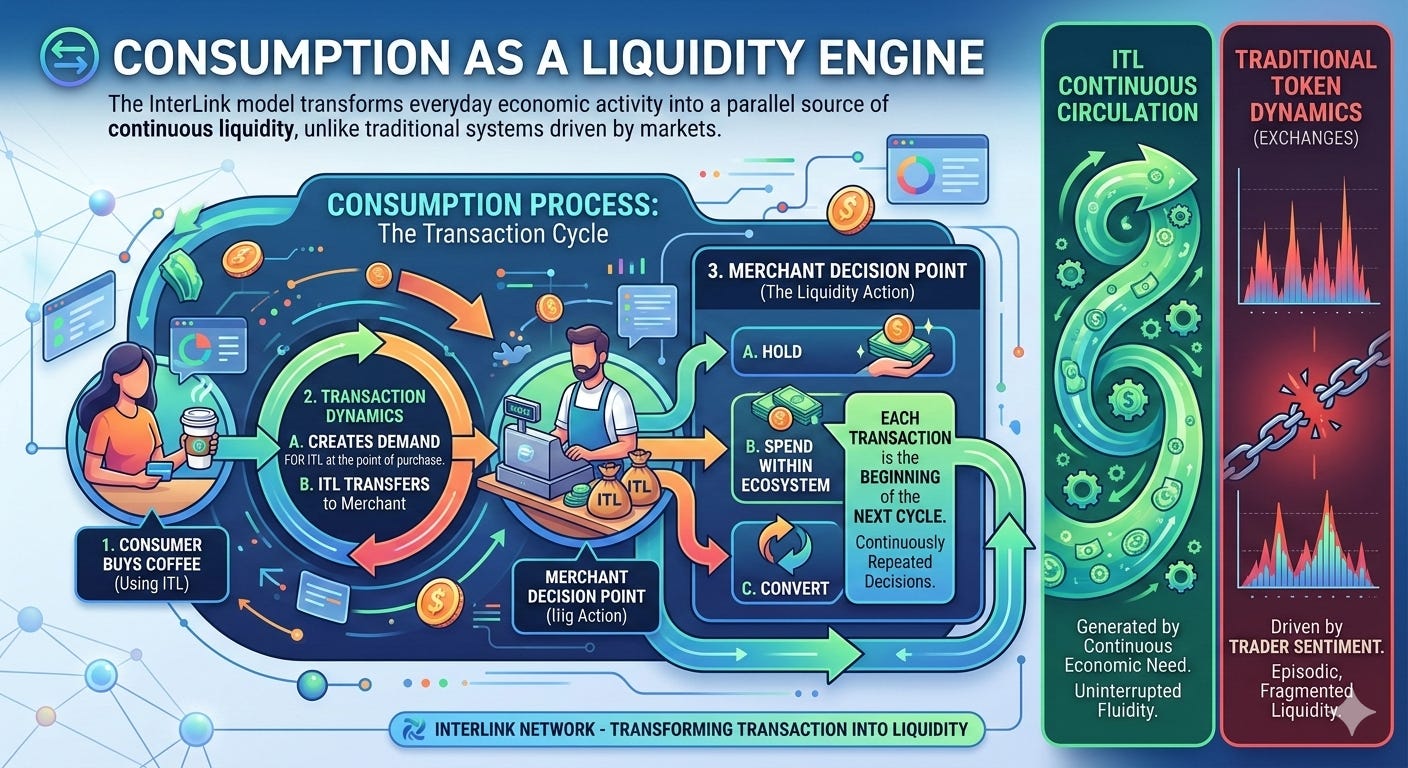
The Self-Deepening Pool
The more consequential design element is what happens after initialization.
Every payment processed through the InterLink Payment Infrastructure for a given business automatically triggers the Value Capture mechanism. A defined portion of that transaction is split two ways:
one part executes a market buy of the business’s BT from the AMM pool, and the remainder is deposited as paired liquidity directly into that same pool.
Every commercial transaction the business conducts therefore does two things simultaneously. It generates buy-side demand for the BT. And it deepens the liquidity pool through which that BT trades.
The implication is structural rather than incidental.
A business with high transaction volume does not merely produce more revenue — it produces a progressively deeper AMM pool, which reduces slippage for holders, improves exit conditions, and makes the asset more resilient to large position movements over time.
Liquidity scales with commerce.
Not with fundraising rounds. Not with market maker contracts. Not with community incentive programs. With the actual economic activity of the business itself.
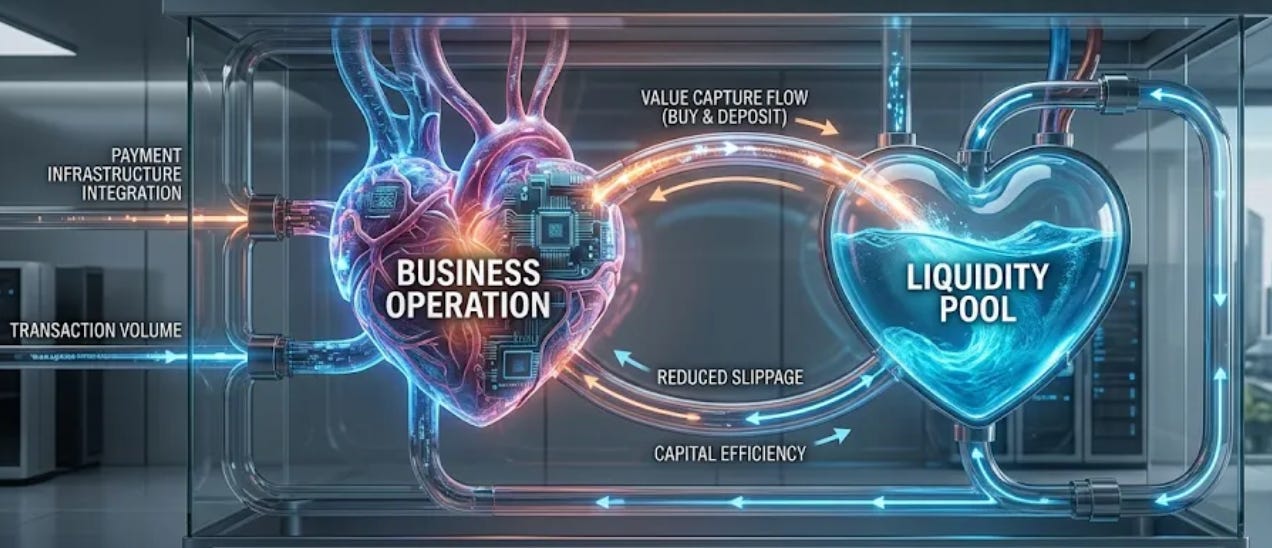
The pool grows because the business operates, and the business operates because it has integrated with the payment infrastructure. The two functions reinforce each other without requiring external capital to maintain the relationship.
What the Math Actually Says
The whitepaper specifies the constant product invariant governing every BT/ITL pool:
𝑥 · 𝑦 = 𝑘
where x represents BT reserves, y represents ITL reserves, and k is the constant that all trades must preserve.
The formula matters less than what it makes impossible. Pool reserves on either side can never reach zero through normal swap activity.
The swap function remains available for any quantity at any time, with execution price determined by current pool depth. This is not a governance promise or a Foundation commitment. It is a mathematical property of the protocol design.
The InterLink Foundation and InterLink Labs explicitly do not provide active market-making, buyback commitments, floor price guarantees, or backstop liquidity of last resort.
This is a deliberate choice — Foundation market-making would distort price discovery, privilege specific tokens over others, and contradict the neutrality principles governing the Foundation’s role.
The protocol does not need a market maker because the architecture itself performs that function. Liquidity is provided by the constant product formula, by continuous Value Capture deposits, and by voluntary third-party liquidity providers who earn 0.3% on every swap. None of these require discretionary human intervention to operate.
A system that requires active management to maintain liquidity is a system whose liquidity is contingent on that management continuing.
A system where liquidity is a mathematical property of the protocol is a system where liquidity persists as long as the protocol runs.
Position Lock
There is a distinction the InterLink Whitepaper makes real through mechanism rather than assertion: the difference between a system that receives liquidity and a system that produces it.
Most token ecosystems receive liquidity. They attract it through yield, through listings, through narrative. When the yield drops or the narrative fades, the liquidity leaves.
InterLink’s Business Token protocol produces liquidity.
Every transaction deepens the pool. Every swap generates fees that incentivize third-party providers.
The architecture feeds itself from commerce, not from capital.
A system where liquidity is the architecture has a different kind of floor — not a price floor, but a structural one.
If you’d like to support my research, you may use my Interlink invitation code below. It also unlocks an instant mining boost ✚︎ Welcome Bonus for new users.
InterLink Referral Code: 905079415
Wallet Invitation Code : HSVZZPEJ (75% Commission Rebate)
❓ How to Join InterLink
The InterLink Sign-up Guide: Secure Your Digital Assets in 5 Minutes

The world moves in complex ways, but growing your assets doesn’t have to.
You don’t need capital. You just need five minutes.
📚 Done.T’s Related Insights
Zero-Capital Tokenization: How InterLink Creates Value Without Investment

Tokenization is one of those words that sounds important but rarely gets explained.
A New Asset Class That Has No Name Yet

When most people encounter a new token, they reach for familiar categories. Is it equity? Is it a utility token? Does it pay yield? Can you stake it?
🔎 Search “Done.T Insight” on Google for real data & analysis.
Disclosure: This post contains referral links and reflects my personal research and experience. It is provided for informational purposes only and does not constitute financial advice.