

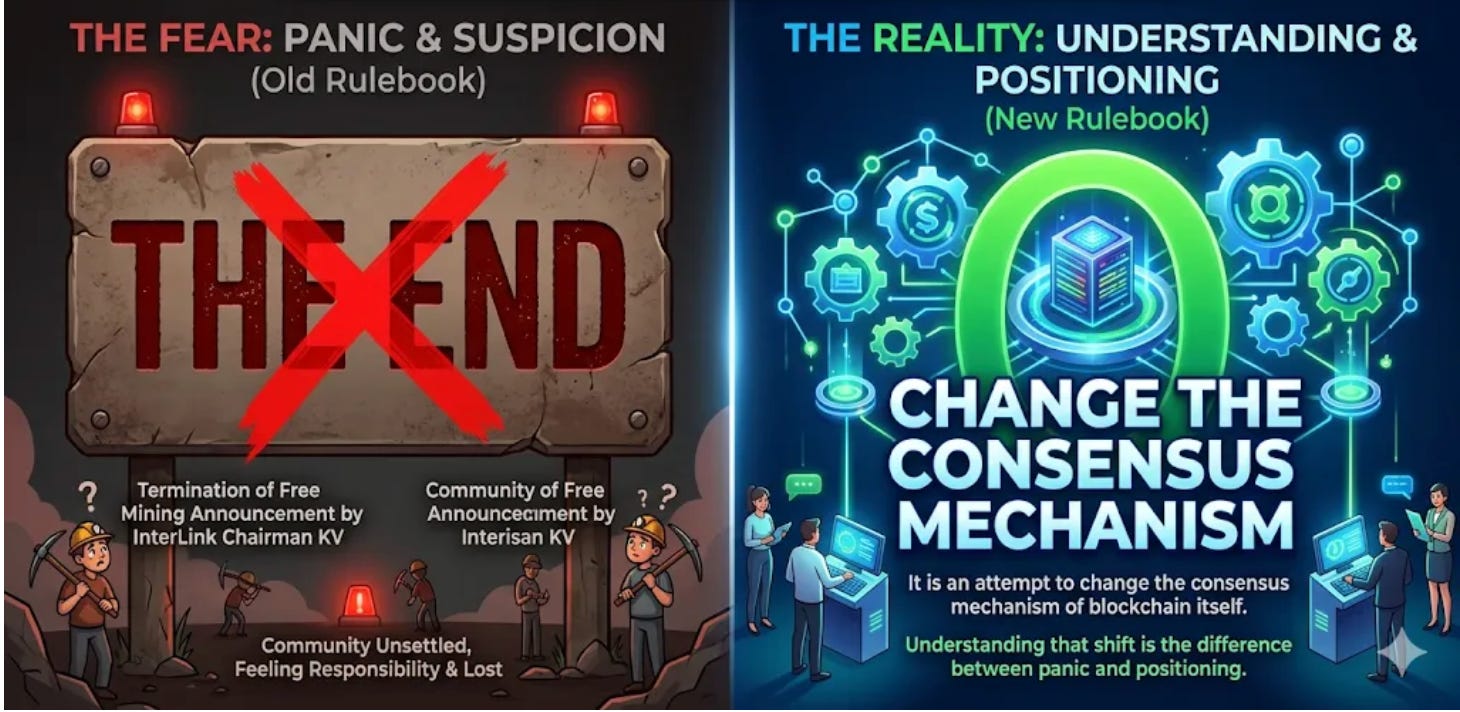
Since InterLink Foundation Chairman KV announced that free mining will end with the Open Mainnet launch, the community has been unsettled. People who recommended mining feel a sense of responsibility. People who have been mining feel lost. The mood oscillates between suspicion and anxiety.
The fear has a single source.
The rules of the game are changing, and nobody has handed out the new rulebook yet.
So let’s read it. What InterLink is designing is not simply the termination of mining.
It is an attempt to change the consensus mechanism of blockchain itself.
Understanding that shift is the difference between panic and positioning.
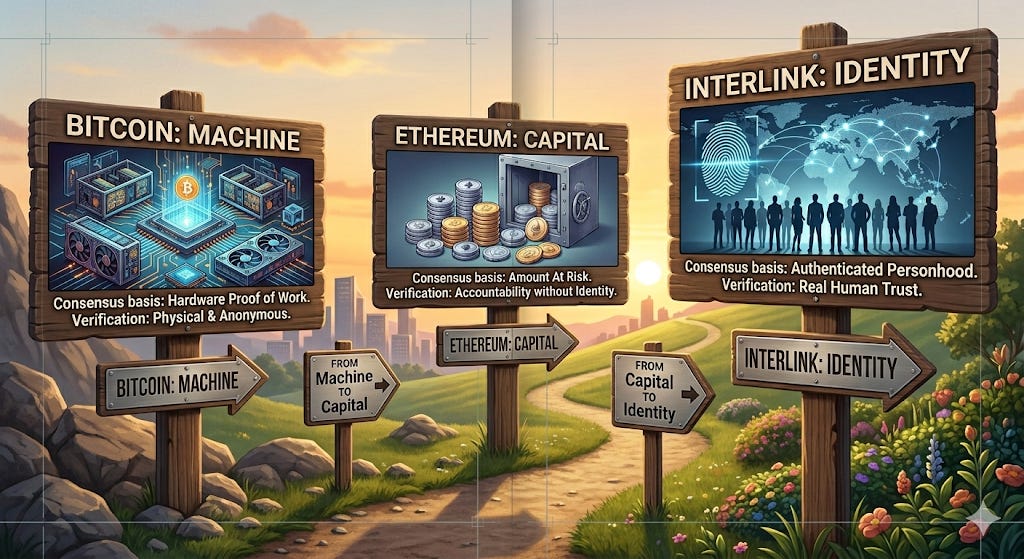
PoW → PoS → PoP: The Evolution of Blockchain Consensus
Every time a major consensus transition has occurred in blockchain history, the underlying question was the same. What do we accept as the basis of trust?
Bitcoin answered with machines. Proof of Work asked: what has your hardware done?
Trust was physical. Trust was verifiable. But trust was anonymous. The network had no way of knowing whether the entity behind the wallet was a human being or an automated system running at scale.
Ethereum answered with capital. Proof of Stake asked: how much do you have at risk?
Accountability entered the picture for the first time. But identity still did not. A wallet with a hundred million dollars staked could belong to a single human, a corporation, or a coordinated bot network. The protocol could not tell the difference.
InterLink is asking a different question entirely. Not what your machine did. Not how much capital you locked. But who you are.
Machine → Capital → Identity.
This is the evolutionary lineage of blockchain consensus. And InterLink is building the third chapter.
Why Identity. Why Now.
We no longer live in an era where only humans conduct financial transactions.
AI-powered systems are being deployed at industrial scale. Algorithmic trading executes millions of transactions per second without human involvement. The economy is no longer a purely human space.

In this environment, the most immediate threat facing any open blockchain network is not a sophisticated exploit. It is a bot farm with ten thousand fake identities — manipulating governance votes, draining liquidity pools, dominating airdrop distributions, and systematically extracting value from a network designed for human participants.
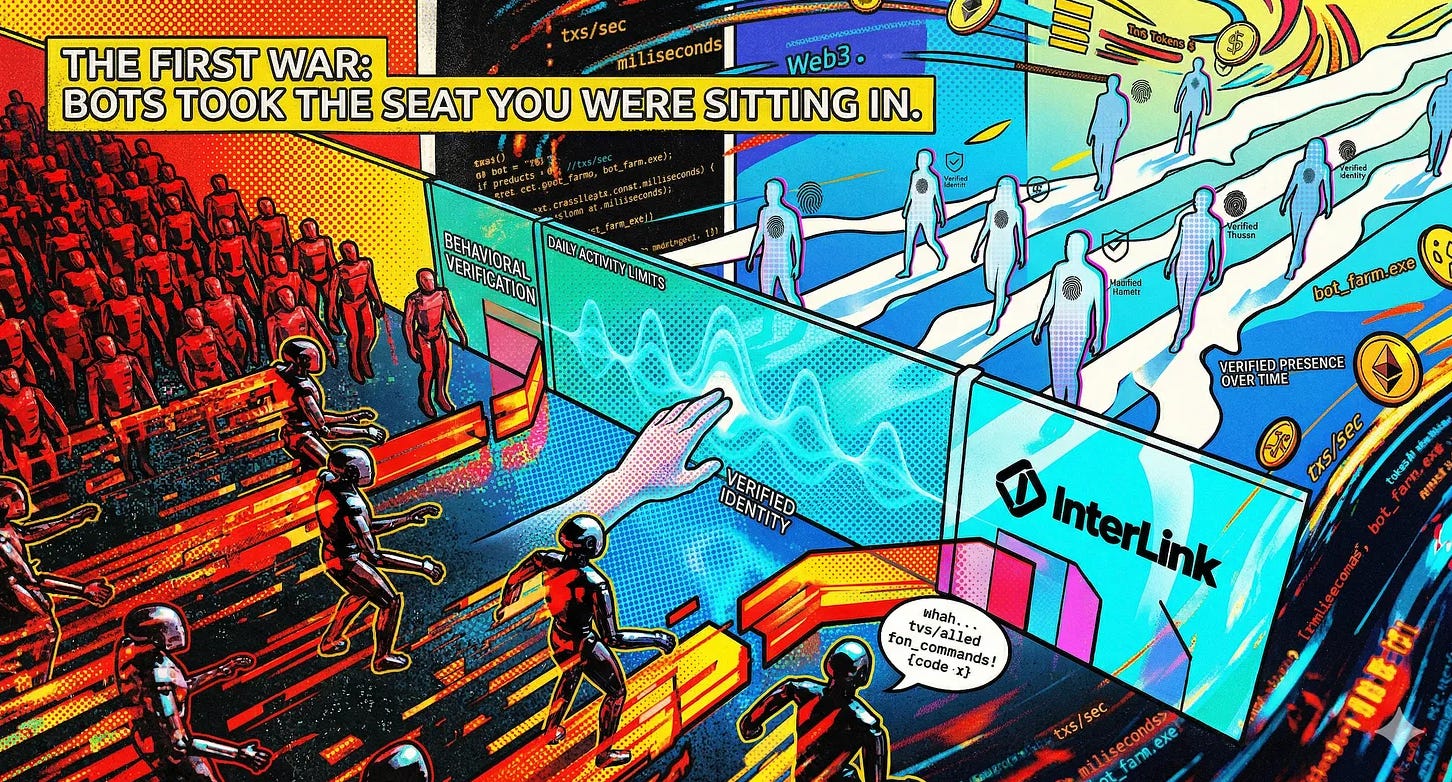
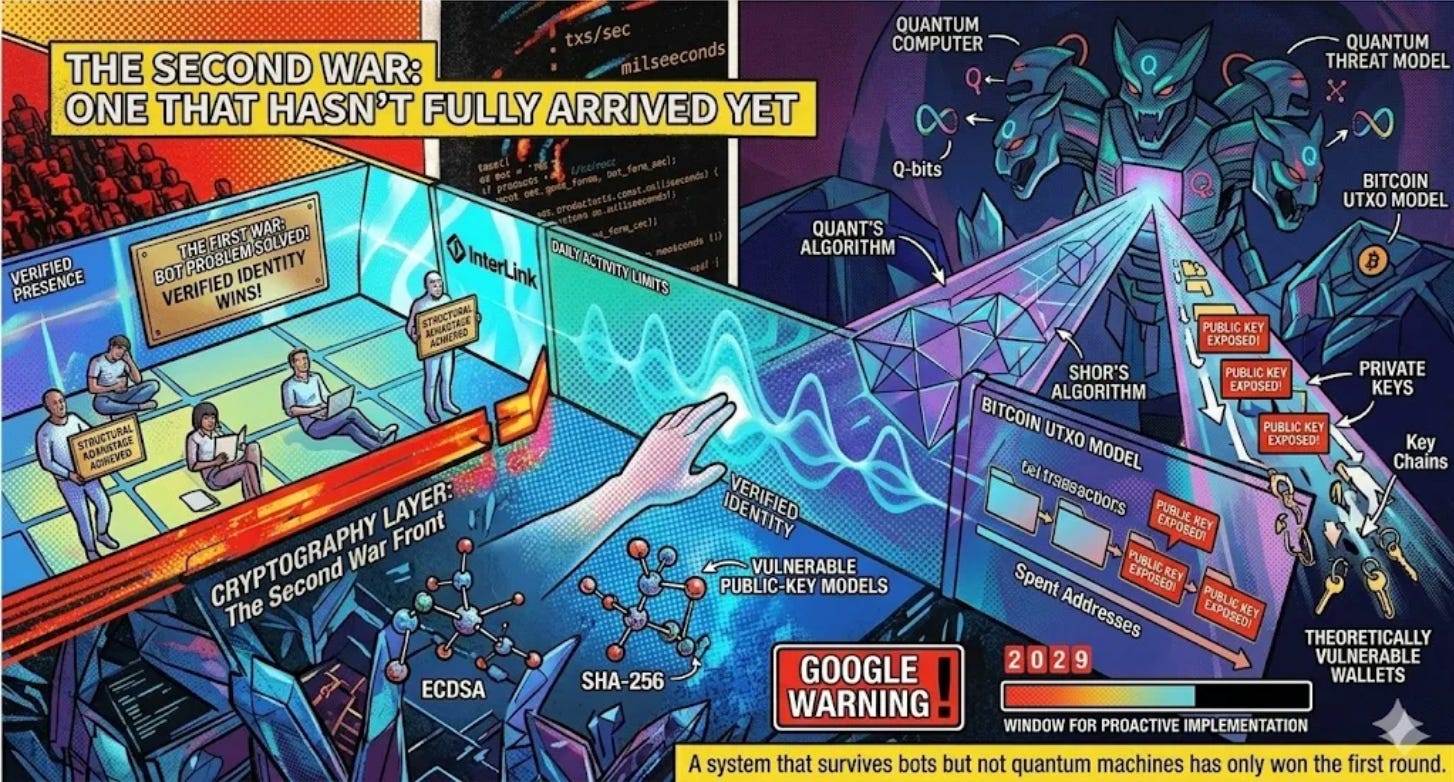
To filter out malicious bots, you need a mechanism that robots cannot replicate. What is that mechanism? Identity.
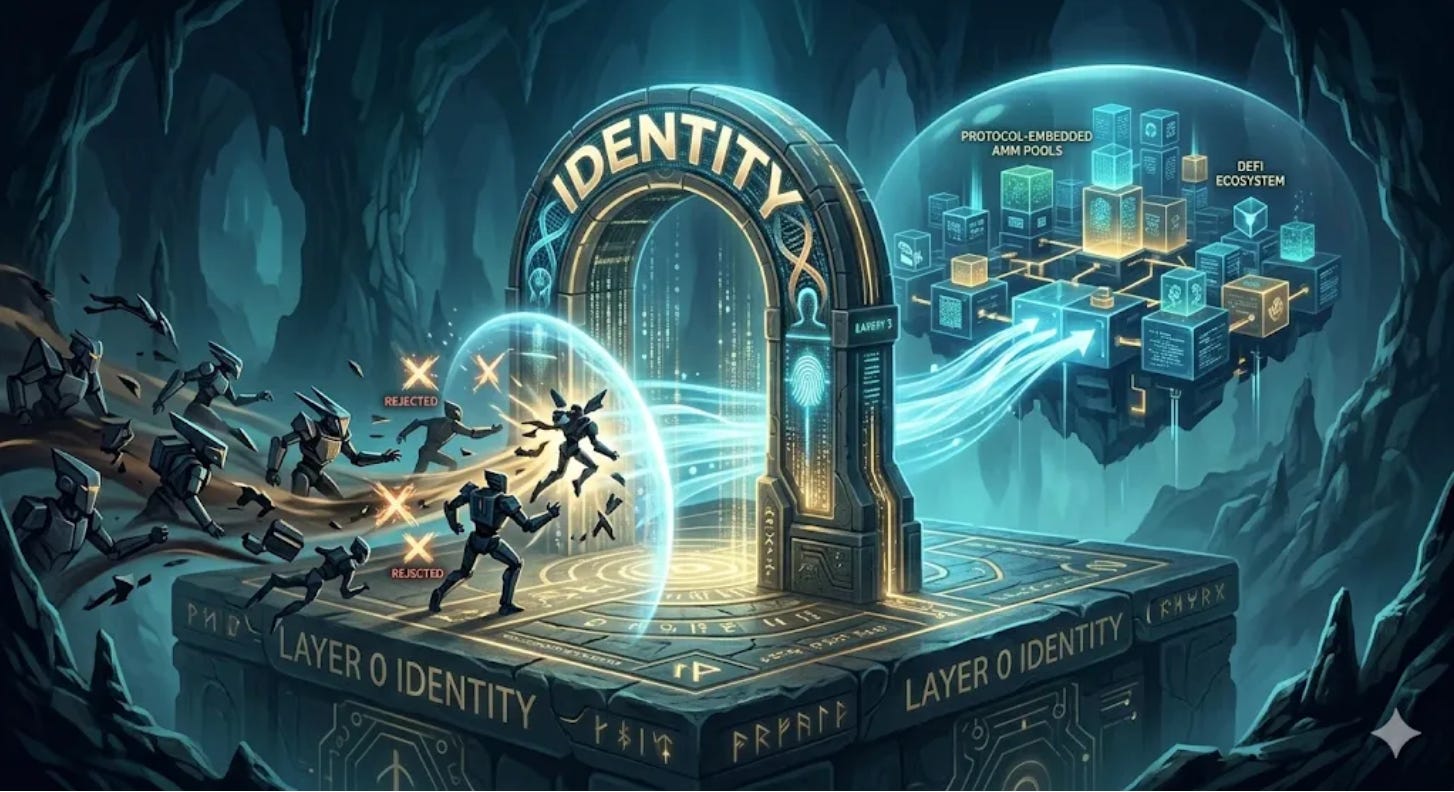
InterLink’s Layer 0 solves this at the protocol level.
On-device biometric verification runs inside the hardware Secure Enclave — the trusted execution environment found in modern smartphones.
Biometric data never crosses that hardware boundary. What gets submitted to the chain is a zero-knowledge proof: a mathematical demonstration that this participant is a real, unique, living human being, without revealing any personal information.
One human. One ID. Non-transferable. Device-bound.
This is not an optional feature layer. It is the precondition for every transaction. No transaction executes at Layer 1 without first clearing the identity gate at Layer 0.
What a Validator Actually Is
When the Open Mainnet launches, mining stops and block production transfers entirely to Validators.
It is not a mining rig. It is not a server farm optimizing hash rates. It is a network operator whose participation is grounded in verified identity and demonstrated reliability.
InterLink’s whitepaper describes Layer 1 as a Byzantine Fault Tolerant consensus engine delivering deterministic single-block finality within 3 to 5 seconds.
BFT consensus does not reward raw computation. It rewards trusted participation. A supermajority of Validators must confirm each block before it is irrevocably committed to chain state. No reversion risk. No fork ambiguity.
Confirmation and settlement are the same event.
InterLink’s Validator is the synthesis of everything that came before — machine, capital, and a third requirement neither predecessor demanded. Verified, hardware-anchored, protocol-enforced identity.
In other words, InterLink is not measuring raw ownership alone. It is measuring whether the network can continuously trust your participation over time.
That trust is made legible through HCS score and Human Node metrics — the on-chain record of verified participation, behavioral consistency, and network contribution built over time. The Validator with the deepest trust record does not just confirm blocks. The network recognizes them as infrastructure.
Nodes are no longer measured by power.
Identity is the performance.
What Is Actually Being Decided Right Now
What is ending is mining.
What is beginning is an identity-anchored economy.
A wallet holding two million ITLG with little verified participation history is not the same as a wallet holding one million ITLG with a deep, demonstrated record of consistent, identity-verified activity.
The protocol is designed to act on that difference. The sorting mechanism is already running.
Every HCS point accumulated, every Human Node metric recorded, every day of verified participation — these are not just numbers inside an app. They are the criteria by which the next phase of this network will distribute access, weight, and opportunity.
InterLink is pursuing a vision on the scale of Bitcoin and Ethereum — not an incremental improvement, but a fundamental shift in what blockchain consensus means.
The keyword of the next era is identity.
And the people building that identity record right now are writing their place in the next network before the application process opens.
The end of mining is not the end of the opportunity. It is the end of undifferentiated opportunity.
The network is already deciding who counts as infrastructure. The question is whether you are among them.
If you’d like to support my research, you may use my Interlink invitation code below. It also unlocks an instant mining boost ✚︎ Welcome Bonus for new users.
InterLink Referral Code: 905079415
Wallet Invitation Code : HSVZZPEJ (75% Commission Rebate)
❓ How to Join InterLink
The InterLink Sign-up Guide: Secure Your Digital Assets in 5 Minutes

The world moves in complex ways, but growing your assets doesn’t have to.
You don’t need capital. You just need five minutes.
📚 Done.T’s Related Insights
I Paid With Crypto. Here’s What Actually Happened Behind That Tap: On the InterLink Visa Card

Most people think paying with crypto means spending a token.
InterLink Airdrop Is Almost Over — And the Real Game Is Just Beginning

InterLink Foundation Chairman KV recently announced that free mining will end with the launch of the Open Mainnet. No specific date has been confirmed, but the structural signal is clear: the accumulation phase is closing.
🔎 Search “Done.T Insight” on Google for real data & analysis.
Disclosure: This post contains referral links and reflects my personal research and experience. It is provided for informational purposes only and does not constitute financial advice.