

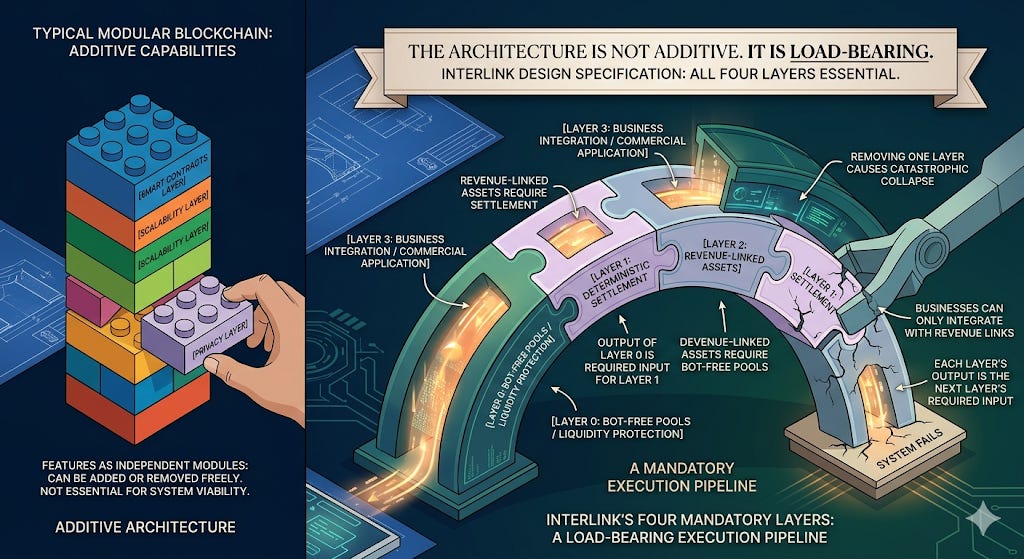
When blockchain projects describe their architecture, they typically present layers as capabilities — things the system can do. A smart contract layer. A scalability layer. A privacy layer.
Each is a feature that can be added, upgraded, or in most cases, removed without collapsing the rest. This is what modularity means in practice: composable components that exist independently of one another.
InterLink’s System Architecture presents four layers.
Read quickly, it looks like the same kind of capability list. It is not. The whitepaper states it plainly: remove any one layer and the system fails.
Without Layer 0, bots infiltrate AMM pools. Without Layer 1, there is no deterministic settlement. Without Layer 2, digital assets have no revenue linkage. Without Layer 3, businesses cannot integrate.
That sentence is not a warning. It is a design specification. The four layers are not independent modules — they are a mandatory execution pipeline where each layer’s output is the next layer’s required input. The architecture is not additive. It is load-bearing.
The Order Nobody Notices
Here is what most readers miss: the layers are numbered from the bottom up, and Layer 0 is identity.
In virtually every general-purpose blockchain, identity is an application-layer concern.
You deploy a contract, you bolt on a KYC provider, you integrate an off-chain attestation service. Identity arrives after execution. It is optional, composable, and revocable. The chain itself has no opinion about who is transacting.
InterLink inverts this entirely. Before a transaction can execute at Layer 1, it must clear the identity gate at Layer 0.
The protocol verifies the sender holds a valid InterLink ID through an on-chain registry check at sub-millisecond latency. If verification fails, the transaction is rejected before execution — not flagged, not reviewed, rejected.
Identity is not a check performed on top of the system. It is the precondition for the system operating at all.
Without Layer 0, protocol-embedded AMM pools are exposed to the same bot-driven extraction that degrades every existing DeFi liquidity environment. Layer 0 is not the foundation beneath the architecture. It is the condition that makes the architecture viable.

What “Purpose-Built” Actually Means
General-purpose chains optimize for flexibility — gaming, DeFi, NFTs, payments — because their value proposition is neutrality toward use case.
This flexibility comes at a specific cost: none of the properties that payments and RWA require can be enforced at the protocol level, because protocol-level enforcement would constrain the generality the chain is selling.
InterLink makes the opposite trade. The sequence is the enforcement model.
It optimizes for one thing done correctly: connecting real business payment activity to on-chain asset formation with payment-grade settlement guarantees.
The four-layer architecture exists because that objective requires identity, finality, economic mechanics, and integration to operate as a unified, mandatory pipeline — not as optional composable modules.
This is what “purpose-built” means in practice. Not a marketing claim. A structural commitment that trades flexibility for invariance — producing protocol-level properties that general-purpose chains cannot replicate through application-layer engineering, regardless of how sophisticated that engineering becomes.
One Payment, Four Layers, Five Seconds
The theory is verifiable. Here is what it looks like in practice.
When a customer pays a tokenized business, the payment intent originates at Layer 3 via Smart Account. It passes through Layer 0, where the protocol verifies InterLink ID — a sub-millisecond check that either clears or rejects before anything else happens.
It executes at Layer 1, where BFT consensus delivers deterministic finality in three to five seconds. Then, in the same block, Layer 2 activates: Value Capture routes a defined percentage into the business’s AMM pool, executing a market buy of the business token and deepening pool reserves simultaneously.
The result: payment settled, revenue verified, liquidity deepened — in a single finalized block, in under five seconds.
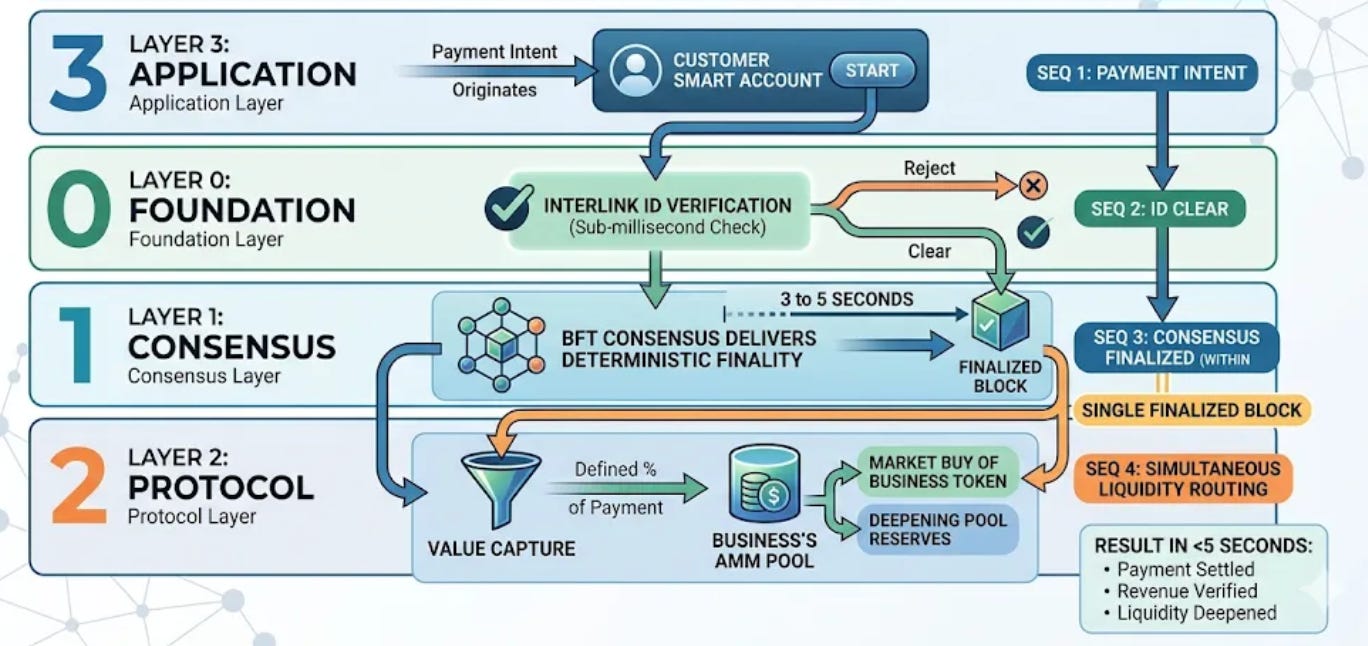
In traditional financial infrastructure, these three outcomes are produced by separate systems on separate timelines. Settlement, revenue recognition, and liquidity maintenance have never been atomic.
The idea that a single transaction produces all three outcomes with mathematical guarantees at each step does not exist in any prior payment architecture.
The Stack That Cannot Be Unbuilt
There is a category of system design where the value proposition and the architecture are the same thing. The design is not a vehicle for delivering the value — it is the value.
InterLink’s four-layer pipeline is that kind of design.
The identity guarantee exists because Layer 0 is mandatory. The finality guarantee exists because BFT consensus produces irrevocable commitment. The revenue-to-asset linkage exists because Value Capture is atomic with the transaction. The liquidity guarantee exists because the AMM pool is created at issuance and deepened by commerce, not bootstrapped by capital.
Each guarantee depends on the layer that produces it remaining in place.
Remove one, and the guarantee disappears — and with it, the guarantees of every layer that depended on it as input.
This is why the layer order is the argument.
The sequence in which these properties are enforced — identity → execution → economic mechanics → integration — is the claim InterLink is making about what it takes to build infrastructure that real commerce can actually run on.
The stack cannot be unbuilt because it was not assembled.
It was derived — from the specific requirements of the problem it exists to solve.
If you’d like to support my research, you may use my Interlink invitation code below. It also unlocks an instant mining boost ✚︎ Welcome Bonus for new users.
InterLink Referral Code: 905079415
Wallet Invitation Code : HSVZZPEJ (75% Commission Rebate)
❓ How to Join InterLink
The InterLink Sign-up Guide: Secure Your Digital Assets in 5 Minutes

The world moves in complex ways, but growing your assets doesn’t have to.
You don’t need capital. You just need five minutes.
📚 Done.T’s Related Insights

Liquidity Is Not a Feature. It Is the Architecture: What the Whitepaper Actually Built

There is a question that nearly every token project asks at some point: how do we get liquidity? The answers tend to follow a familiar pattern — liquidity mining incentives, market maker agreements, exchange listings, community-funded pools.
🔎 Search “Done.T Insight” on Google for real data & analysis.
Disclosure: This post contains referral links and reflects my personal research and experience. It is provided for informational purposes only and does not constitute financial advice.