

There is a rule that has governed crypto markets for the better part of a decade.
Alpha comes from capital velocity.
The logic was simple and, for a long time, correct. The players who moved capital fastest — into listings, into liquidity, into early positions — captured the majority of upside.
Speed of deployment was the primary competitive advantage. Everything else was secondary.
Binance institutionalized this logic at scale.
Its dominance wasn’t accidental; it was the natural endpoint of a capital-first architecture. Every mechanism was designed to accelerate the flow of capital and concentrate the resulting value at the infrastructure layer.
This model produced enormous wealth.
It also produced a specific type of winner.
🏗️ The Structural Problem With Capital-First Alpha
The CEX model follows a predictable internal logic. Listing access is exclusive. Entry costs are high.
Early-stage capital enters at favorable terms, and retail participants absorb volatility at the tail end of the distribution.
The platform compounds.
The individual competes over narrowing margins.
The House doesn’t need to cheat. The architecture does the work.
But the deeper structural problem isn’t the distribution of returns. It’s the separation that makes the whole thing possible.
Payments and capital have always been separated. You spend to consume. You deploy capital to invest.
Crypto, for all its ambition to rebuild finance, largely inherited this separation. Tokens traded in one layer. Commerce happened somewhere else entirely.
That separation is now being structurally challenged.
♻️ Two Announcements, One Architecture
InterLink Labs announced that the InterLink Visa Card will officially launch in the coming days — integrated with the ITLX Super Wallet, enabling payments across more than 50 million Visa and Mastercard merchants in 170+ countries.
Read in isolation, this looks like a product launch. Read alongside the second announcement, the logic changes.
The InterLink Foundation has formally introduced the Transaction-Backed Digital Assets Protocol — an architecture that connects real-world business activity to on-chain digital asset formation through AMM-based liquidity infrastructure.
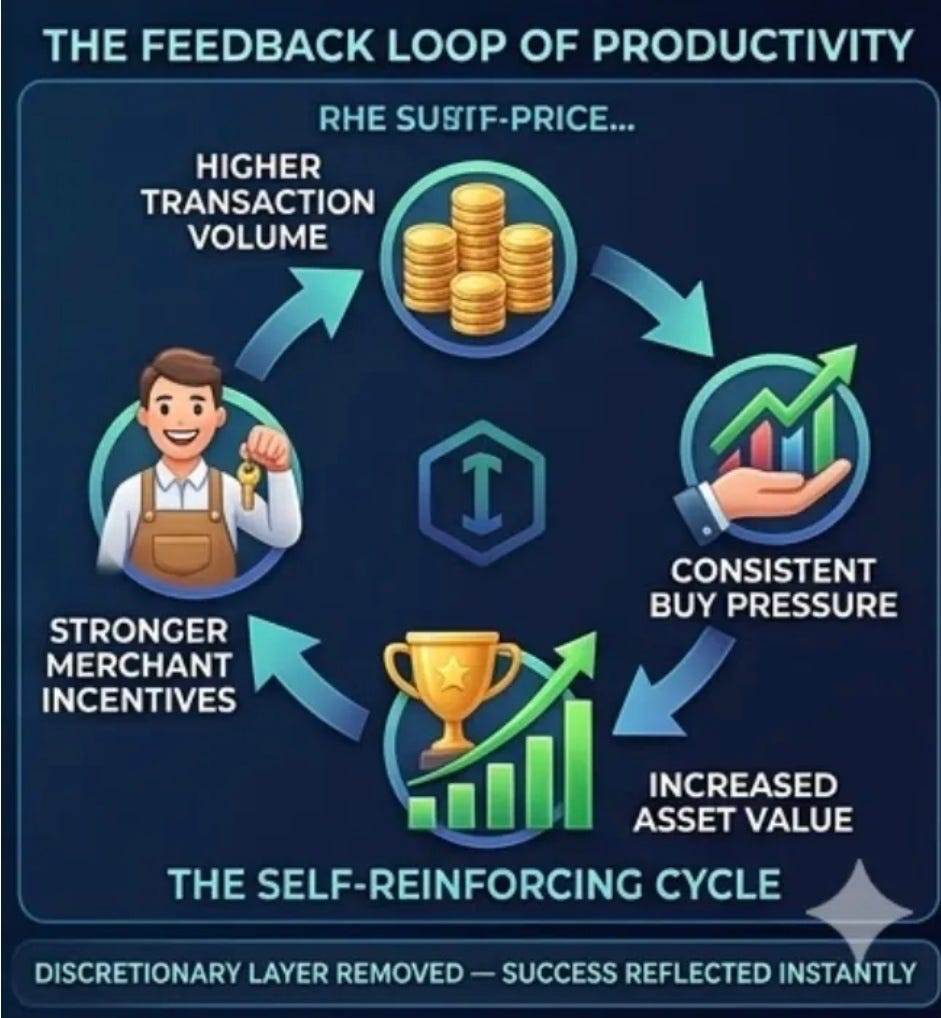
A portion of transaction value generated through payments is automatically routed into liquidity pools, where it purchases tokenized business assets.
This is the mechanism that changes what the Visa Card actually means.
Without it, the card is an exit ramp — digital assets converted to fiat at the point of sale, the transaction ending there. With it, the transaction doesn’t end. It propagates.
This is not being introduced into an empty system.
The network is already scaling, with millions of verified participants and expanding real-world integration points.
Every payment becomes an input to the capital layer.
Commerce and asset structure are no longer parallel systems. They are the same system.
🎯 Every Transaction Strengthens the Layer That Prices All Others
This is what gives the Visa Card its structural meaning.
It is not just enabling spending — it is routing economic activity into the asset layer.
Every business tokenized within the InterLink ecosystem is paired with ITL as the base settlement asset — not optionally, but structurally. This means that as transaction volume flows through the ecosystem, the automated buy pressure created by each transaction is routed through ITL.
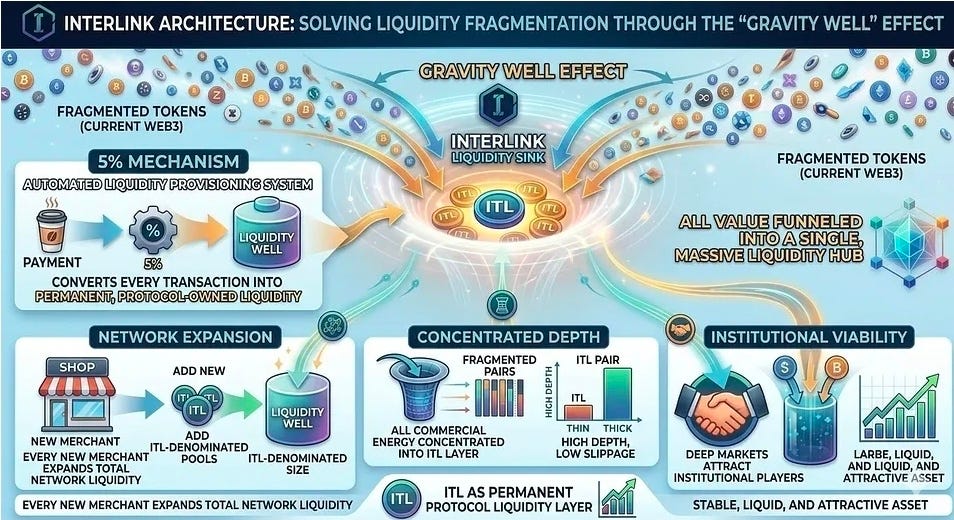
A portion of each transaction’s value continuously enters the liquidity pool, purchasing the business token and reinforcing the settlement layer beneath it.
Every new merchant adds a new ITL-denominated pool. Every new transaction deepens the network’s liquidity. Instead of fragmenting across thousands of disconnected token pairs — the defining failure of current Web3 — all commercial energy concentrates into a single unified layer.
ITL is not a payment coin with a settlement function bolted on. It is the denominator of an entire productive economy.
Every transaction strengthens the layer that prices all others.
Start InterLink in 5 minutes.
🔗 [Step-by-step setup guide]
🧪 Speculation Was Never the Goal. It Was the Workaround.
Speculation is not irrational behavior. It is a rational response to an information deficit.
When investors cannot directly observe the economic productivity of an asset in real time, they form expectations. Those expectations get priced into the market. The asset trades not on what it produces today, but on what participants believe it will produce tomorrow.
In crypto, the gap is wider — tokens trade on pure narrative, and the “future” does a lot of heavy lifting.
The Transaction-Backed Digital Assets Protocol is an attempt to solve that problem structurally. Under this architecture, buy pressure is not a function of how many investors believe a business will grow. It is a direct mathematical consequence of how many transactions occurred today.
The information deficit that made speculation necessary begins to close.
The asset no longer trades on what people believe. It trades on what actually happened.
Of course, this architecture still faces execution risk.
Merchant adoption, liquidity depth, and regulatory integration will determine whether this system can operate at scale.
📡 Final Signal
Payments are no longer just consumption. They are becoming inputs to the capital layer.
And once value begins to flow this way, the question is no longer what you hold.
It becomes: what system your activity is feeding.
In a capital-first market, price follows capital.
In a transaction-backed market, price follows receipts — and the receipts are being issued right now.
If you’d like to support my research, you may use my Interlink invitation code below. It also unlocks an instant mining boost ✚︎ Welcome Bonus for new users.
InterLink Referral Code: 905079415
Wallet Invitation Code : HSVZZPEJ (75% Commission Rebate)
❓ How to Join InterLink
The InterLink Sign-up Guide: Secure Your Digital Assets in 5 Minutes

The world moves in complex ways, but growing your assets doesn’t have to.
You don’t need capital. You just need five minutes.
📚 Done.T’s Related Insights
Why You Don't Need to Be a Crypto Expert to Participate in Tokenization

We are moving toward a world where real economic activity runs on blockchain infrastructure.
Is It Too Late to Join InterLink? Here's What the Numbers Actually Say

There’s a question that stops most people before they even start. “I’ve heard about InterLink — but isn’t it already too late?”
🔎 Search “Done.T Insight” on Google for real data & analysis.
Disclosure: This post contains referral links and reflects my personal research and experience. It is provided for informational purposes only and does not constitute financial advice.