

The most dangerous thing money can do is announce itself.
The moment you open a banking app, you are aware. You are transferring, depositing, managing.
The friction is not just in the interface — it is in the consciousness. You know you are doing finance. That awareness is, paradoxically, the last vulnerability of the old system.
This is not a UX problem. It is a structural shift in where finance lives.
The next era of finance is not faster banking. It is banking that disappears. Two systems are already building that world. They just started from different ends.
What Musk Is Actually Building
X Money is not a fintech product. It is a disappearing act. It does not compete with banks. It replaces where banking happens.
The 6% APY and 3% cashback are not the point. They are the entry fee — the number aggressive enough to pull hundreds of millions of X users into a financial layer they will soon stop noticing.
Visa infrastructure, FDIC insurance through Cross River Bank, a metal card engraved with your handle. Every design decision points in the same direction: make this feel like X, not like a bank.

When money moves inside a conversation — when you tip a creator between tweets, settle a bet in a thread, split dinner through a DM — you are not banking. You are just using X.
That is the completion state Musk is engineering. Finance absorbed into social behavior so thoroughly that the user never experiences a moment of financial consciousness.
The bank’s form dissolves.
What remains is the function — running silently underneath everything.
The Other Direction
InterLink is not trying to absorb finance into a platform. It never separated them to begin with.
In April, the InterLink Visa Card launched with USDT, USDC, and ETH — integrated with Apple Pay and Google Pay, compatible with any Visa terminal on earth. The user taps their card. The merchant receives payment. Somewhere underneath, a portion of that transaction routes automatically into on-chain liquidity pools.
The user bought coffee.
The protocol built value.
This is what InterLink calls the Transaction-Backed Digital Assets Protocol. X Money makes financial infrastructure invisible by wrapping it in social experience. InterLink makes it invisible by making every ordinary transaction a financial act that executes without requiring the user to know it.
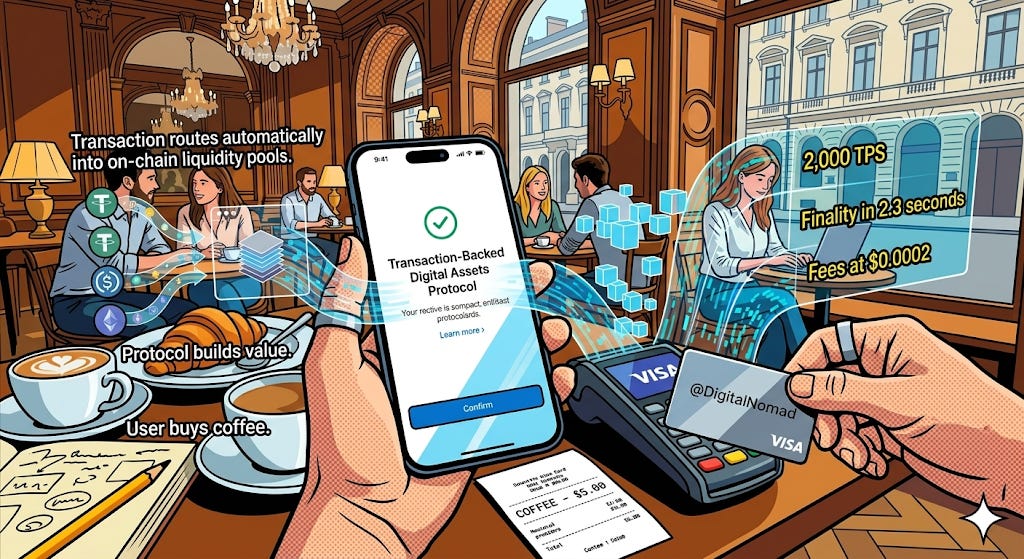
InterLink's infrastructure is already running. Real blocks. Real settlement. The benchmarks — 2,000 TPS, finality in 2.3 seconds, fees at $0.0002 — are not projections. But the number that matters is not the speed. It is the certainty.
Merchants do not need fast. They need to know a payment is settled, not merely probable. This is not speed at scale. This is certainty at scale.
That distinction is what separates infrastructure from a feature.
Same Destination. Opposite Directions.
X Money is walking from the top down.
It takes the existing architecture of institutional finance — regulated, insured, Visa-connected — and dissolves its visible form into the social layer. The trust is borrowed. The disappearance is cosmetic, then real.
InterLink is walking from the bottom up.
Verified participants first. On-chain settlement second. Global payment rails third. Each layer earned before the next was opened. The disappearance was never cosmetic — it was structural from the start.
Both are heading toward the same place: a world where the user engages in financial behavior without experiencing it as financial.
Where money moves the way conversation moves. Where the infrastructure is so embedded it becomes indistinguishable from daily life.
The question is not which vision is more compelling. The question is whether you recognize what is already being built — before it becomes the only infrastructure that exists.
Start InterLink in 5 minutes.
🔗 [Step-by-step setup guide]
What the Destination Actually Means
When finance becomes invisible, the platform that hosts it does not become a bank.
It becomes something with no existing name. It processes value the way roads process movement — not as a service you choose, but as a condition of participation. The entity that achieves this does not compete with banks. It makes the question of banking irrelevant.
X Money, if it scales, becomes that for the 600 million users already inside X.
InterLink, if its mainnet holds, becomes that for every transaction that passes through its payment rails — regardless of what platform the user thinks they are on.
One system is building the layer on top of social. The other is building the layer underneath commerce.
They are not in competition. They are converging on the same structural reality from different angles — and together, they are drawing the outline of what finance looks like when it finally completes.
The bank’s form disappears.
What replaces it is not another bank.
The system that achieves this does not become a bank. It becomes the condition under which value can exist.
The most secure place to store value is somewhere the user never thinks to look. Both X Money and InterLink understand this.
The difference is in where they chose to hide it.
If you’d like to support my research, you may use my Interlink invitation code below. It also unlocks an instant mining boost ✚︎ Welcome Bonus for new users.
InterLink Referral Code: 905079415
Wallet Invitation Code : HSVZZPEJ (75% Commission Rebate)
❓ How to Join InterLink
The InterLink Sign-up Guide: Secure Your Digital Assets in 5 Minutes

The world moves in complex ways, but growing your assets doesn’t have to.
You don’t need capital. You just need five minutes.
📚 Done.T’s Related Insights
Is It Too Late to Join InterLink? Here's What the Numbers Actually Say

There’s a question that stops most people before they even start. “I’ve heard about InterLink — but isn’t it already too late?”
Seven Days That Weren't Random: Users First, Proof Second, Rails Third

Eleven days. Three events. One question worth asking.
🔎 Search “Done.T Insight” on Google for real data & analysis.
Disclosure: This post contains referral links and reflects my personal research and experience. It is provided for informational purposes only and does not constitute financial advice.