

Tokenization is one of those words that sounds important but rarely gets explained.
The standard version goes like this: you own something — real estate, equity, a commodity — and you convert it into a digital token so it can be traded on a blockchain.
The logic is simple. You bring an asset in. The system processes it. Value moves.
That definition assumes one thing from the start. You already own something worth tokenizing.
InterLink starts from a different question. What if you don’t?
InterLink doesn’t tokenize assets.
It tokenizes participation.

🚧 The Wall Most People Hit First
Most people who encounter Web3 for the first time hit the same wall.
The technology feels distant. The terminology is unfamiliar. And underneath all of it is a quieter assumption: that this world was built for people who already have capital.
That assumption is not irrational. It describes most of the crypto industry accurately.
But it does not describe InterLink.
🔄 When Participation Replaces Capital
In the InterLink system, the entry condition is not capital. It is participation.
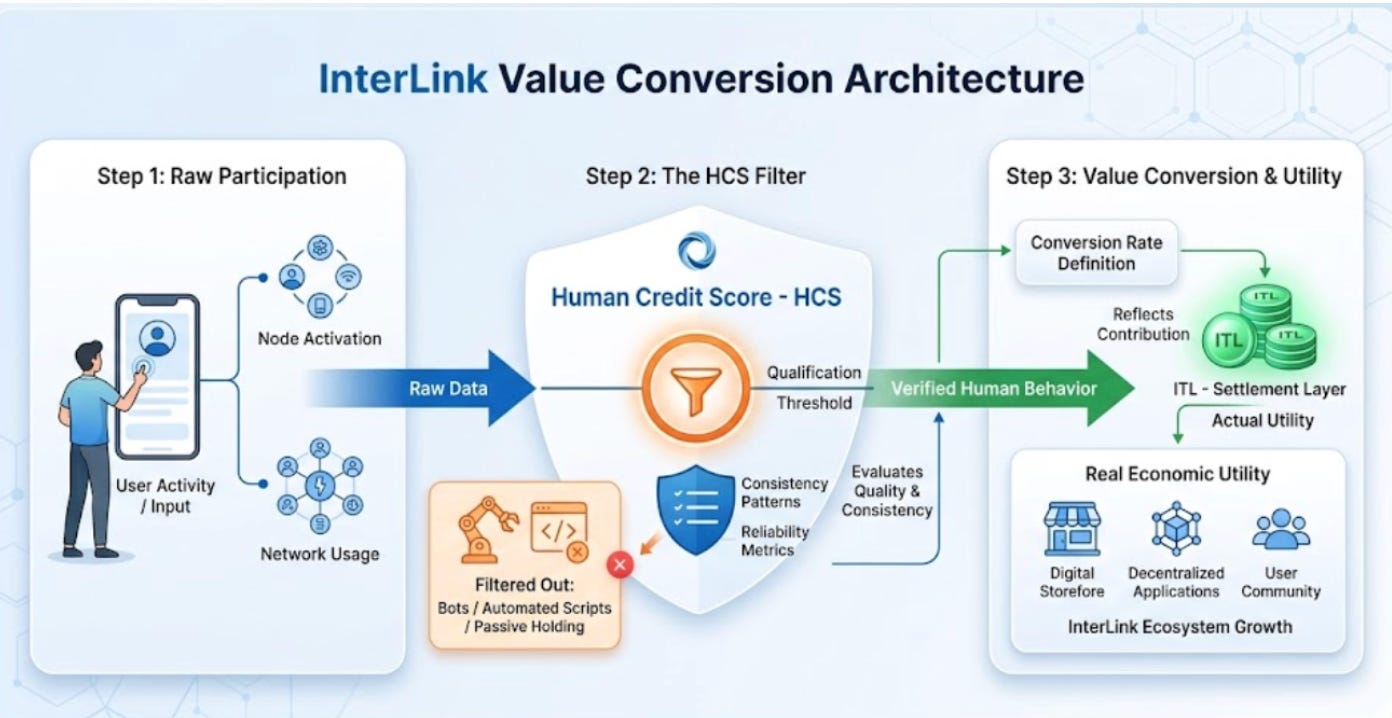
When you join the network and begin engaging — completing activities, staying consistent, contributing to the ecosystem — your actions are recorded as ITLG.
Think of ITLG as a ledger of your presence.
Not what you own.
What you do.
This is where the architecture diverges from everything else in the space.
In a traditional investment model, your position grows because your capital compounds.
In InterLink, your position grows because your participation compounds.
The input has changed.
Time and consistency replace money as the unit of entry.
Start InterLink in 5 minutes.
🔗 [Step-by-step setup guide]
🛡️ The Filter That Makes It Real
But participation alone doesn’t automatically become value. This is the part most introductions skip over, and it matters.
Between your activity and the value it generates sits a filter: the Human Credit Score, or HCS.
HCS evaluates the quality of your participation — your consistency, your patterns, your reliability as a contributor to the network.
Once your activity meets the qualification threshold, it converts into ITL, InterLink’s actual utility and settlement layer.
Your conversion rate is not random. It is a reflection of what you’ve actually done.
This mechanism exists for a reason. InterLink is designed to reward verified human behavior, not automated scripts or passive account holding.
The filter is what gives the system its integrity — and what makes early, genuine participation structurally meaningful.
⚖️ Who Controls the Supply — and Who Doesn’t
Now consider what this means for supply.
In most crypto projects, new tokens enter circulation through team allocations, institutional pre-sales, and unlock schedules.
The people who control the project decide when supply is released and to whom. Early capital gets structural advantage. Everyone else waits.
InterLink removes that layer entirely.
There is no team allocation of ITL. No institutional pre-sale. No unlock schedule.
The only path through which new ITL enters circulation is verified participation converted from ITLG — behavior meeting a qualification threshold, nothing more.
Supply is not managed.
It is earned.
For someone without investment capital, this is not a minor detail. It means the structural advantage that capital typically buys — early access, preferential allocation, insider timing — does not exist here.
The entry condition is the same for everyone: presence and consistency over time.
🛒 Participation Scales — From Individuals to Businesses
This principle doesn’t stop at the individual level.
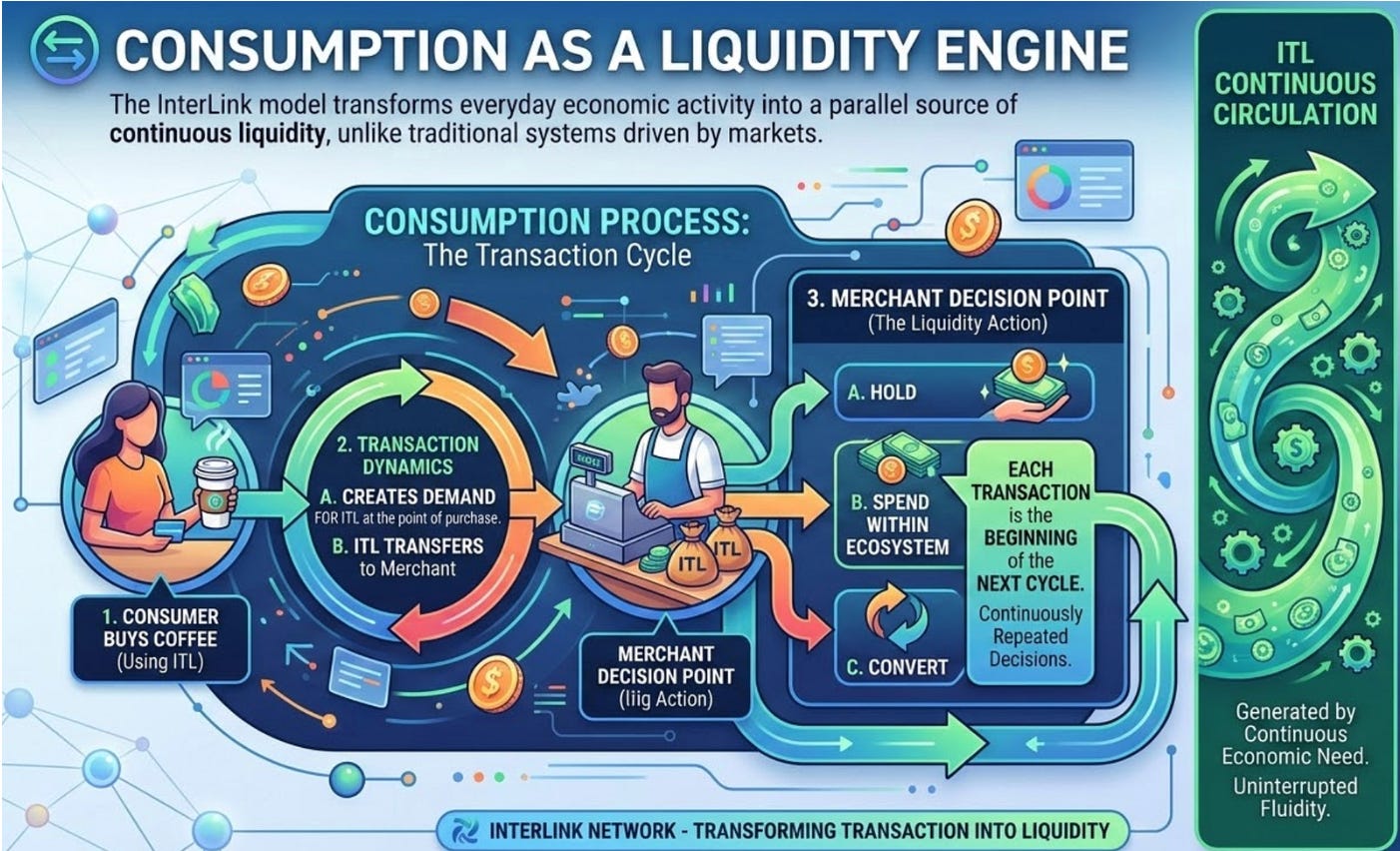
When a business joins the InterLink ecosystem, its transactions don’t just settle payments. A portion of every payment is automatically routed back into the system to purchase tokens — not on a schedule, not by management’s decision, but at the moment of each transaction.
In traditional finance, buybacks are decisions. Scheduled, announced, delayed.
In InterLink, the buyback is built into the payment itself. Every time someone pays for a coffee or a service within the ecosystem, that transaction quietly reinforces the token’s value layer.
No board approval. No quarterly timing. No insider discretion.
The system runs every time someone pays for something. That’s what makes it alive.
🏁 What Zero-Capital Actually Means
This is what zero-capital tokenization actually means.
Not that participation is effortless. Not that results arrive immediately. But that the currency of entry has changed.
Capital is no longer the prerequisite.
Verified human behavior is.
And that is something anyone can bring to the table.
The question this system asks is not “What do you own?”
It is how you show up — and how long you stay.
If you’d like to support my research, you may use my Interlink invitation code below. It also unlocks an instant mining boost ✚︎ Welcome Bonus for new users.
InterLink Referral Code: 905079415
Wallet Invitation Code : HSVZZPEJ (75% Commission Rebate)
❓ How to Join InterLink
The InterLink Sign-up Guide: Secure Your Digital Assets in 5 Minutes

The world moves in complex ways, but growing your assets doesn’t have to.
You don’t need capital. You just need five minutes.
📚 Done.T’s Related Insights
Is It Too Late to Join InterLink? Here's What the Numbers Actually Say

There’s a question that stops most people before they even start. “I’ve heard about InterLink — but isn’t it already too late?”
🔎 Search “Done.T Insight” on Google for real data & analysis.
Disclosure: This post contains referral links and reflects my personal research and experience. It is provided for informational purposes only and does not constitute financial advice.