

There’s a specific feeling every crypto participant knows.
You did everything right. You showed up early, checked the announcement, followed the steps. And still — the mint sold out in one second. The airdrop had already been claimed. The whitelist was full before you clicked the link.
The natural instinct is to blame yourself.
Slow reaction time. Wrong timezone. Not enough connections.
But that instinct is wrong. The problem isn’t your reflexes. The problem is that your opponent changed — and most people never noticed.
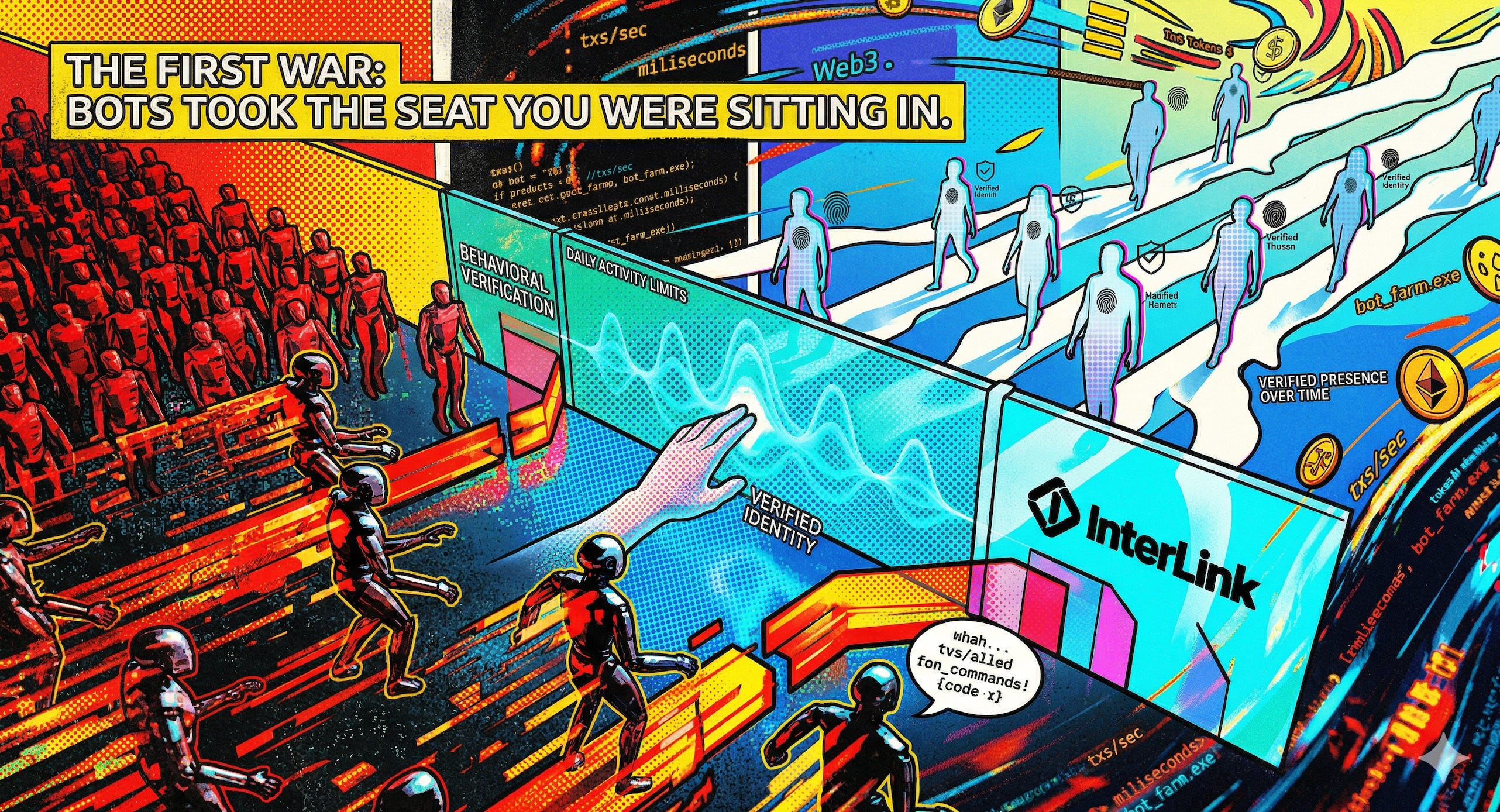
🤖 The First War: Bots Took the Seat You Were Sitting In
In today’s Web3 market, you are not competing against other humans.
You are competing against automation scripts, multi-account farming systems, and bots engineered to execute in milliseconds without hesitation, rest, or error.
This isn’t a fair race that humans happen to be losing. It’s a structurally different contest — one where human biology is the disqualifying factor.
Bots don’t sleep. They don’t misread instructions. They don’t hesitate before clicking. Every system that rewards speed, volume, and parallel execution is, by design, a system that excludes human participation.
The feeling of being perpetually left behind is not weakness. It’s what happens when humans are made to compete on machine terms.
This is the first war — and it has been quietly underway for years.
InterLink’s response to it is structural, not motivational. The network introduced behavioral verification, daily activity limits (six daily pulses), and identity-based participation requirements.
To automation, these are costly inefficiencies.
To a real human being with consistent behavior and a verified identity, they are advantages — possibly the first genuine advantages humans have held in a Web3 context.
The system doesn’t reward the fastest script. It rewards verified presence over time.
That design choice matters. But it is only half the picture.
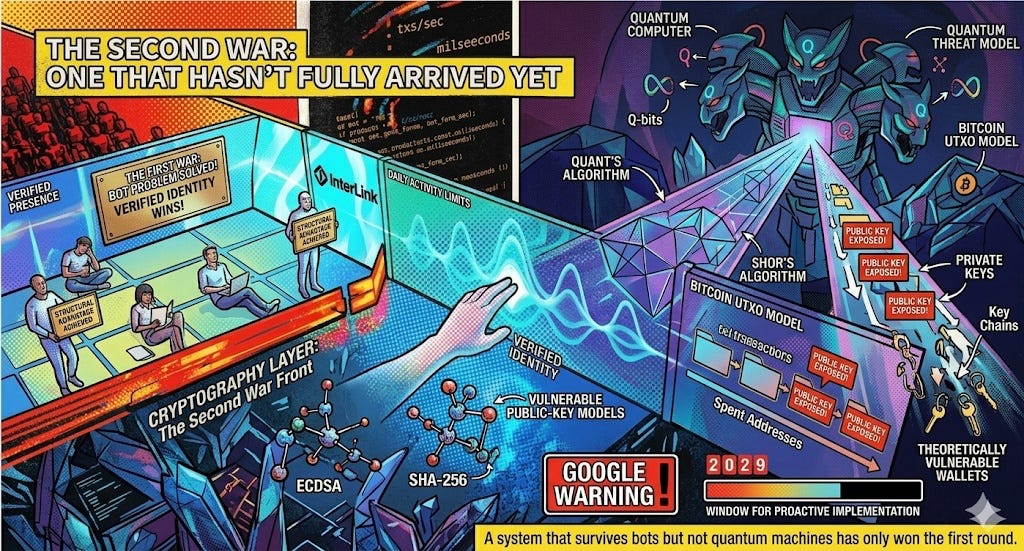
⚛️ The Second War: One That Hasn’t Fully Arrived Yet
Assume InterLink solves the bot problem entirely. Assume verified identity wins. Assume human participants finally hold the structural advantage they’ve been denied.
There is still a second war — one that operates beneath the application layer, at the level of cryptography itself.
Every blockchain rests on a quiet assumption: that public-key cryptography will remain secure. ECDSA. SHA-256.
The systems protecting wallets, validating transactions, anchoring consensus. Against classical computers, they work. They have always worked.
Quantum computers change the threat model entirely.
Quantum does not break systems.
It reclassifies which systems were ever secure.
Shor’s algorithm — mathematically proven, not yet practically deployed — can derive private keys from public keys once quantum machines reach sufficient scale.
For Bitcoin specifically, the UTXO model means that every spent address exposes its public key. Once quantum attacks become practical, those addresses become theoretically vulnerable.
This is not a headline problem. It is a structural one.
Google’s recent warnings place the deadline in sharper focus: existing cryptographic standards may not hold past 2029, and the window for proactive implementation is narrowing faster than most projects are moving.
A system that survives bots but not quantum machines has only won the first round.
🧠 Why Both Wars Share the Same Logic
The surface-level contrast between these two threats looks stark. One is a problem of human versus automation. The other is a problem of mathematics surviving technological regime shifts.
But the underlying logic is identical.
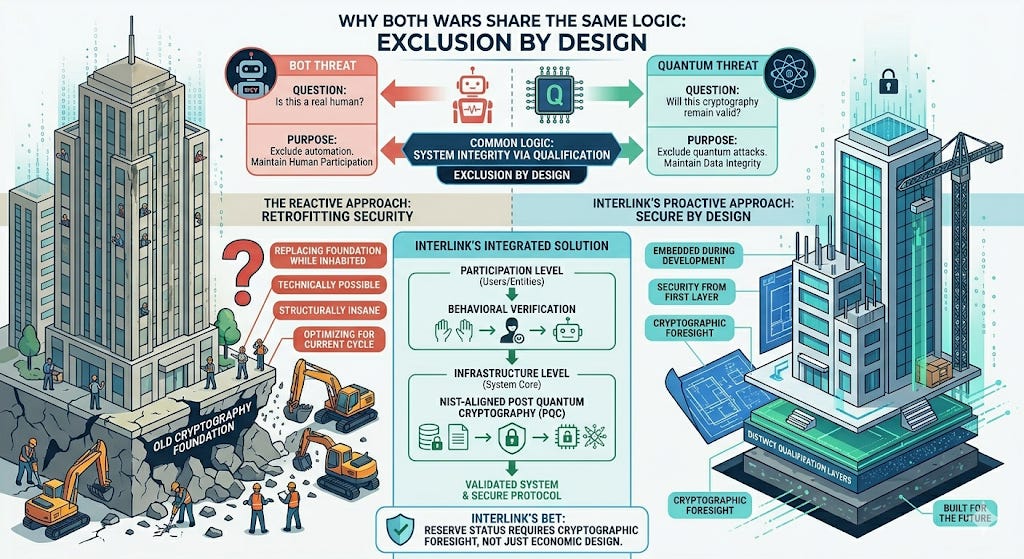
Both are about exclusion by design.
The bot filter asks: is this a real human? The quantum-resistant layer asks: will this cryptography remain valid? In both cases, the answer determines whether the system continues to function as intended — or becomes compromised by something its original architecture never anticipated.
InterLink is not solving bots or quantum separately. It is aligning both as qualification layers.
Behavioral verification at the participation level. NIST-aligned post-quantum cryptography embedded at the infrastructure level — during development, not retrofitted after launch.
Retrofitting post-quantum security onto an established blockchain is not an upgrade. It is replacing the foundation of a 100-story skyscraper while people live inside.
Technically possible. Structurally insane.
Security built from the first layer is categorically different from security added to the last.
Most networks are optimizing for the current cycle, the current threat, the current user base. InterLink is betting that reserve status requires cryptographic foresight, not just economic design.
⚖️ What Remains Unresolved
This is not a declaration of victory. InterLink has not yet published detailed implementation specifications, third-party audits, or quantum-specific performance benchmarks.
Post-quantum algorithms carry real tradeoffs — larger key sizes, higher computational overhead, potential latency on mobile. The security-usability tightrope has not been publicly walked yet.
Ambition and execution are different things. The direction is coherent. The delivery is still pending.
But the direction itself is worth noting — because most projects in this space are not building for both fronts.
📡 The Only Question That Follows
Most participants ask: am I in the right project?
The sharper question is: is this system built to survive the things that will break most systems?
Bots are already here. Quantum capability is approaching. The two wars are running on different timelines, but they converge on the same question — whether a network’s architecture was designed for the conditions it will actually face, or for the conditions that existed when it launched.
What survives entropy becomes reserve.
Not what gets listed.
If you’d like to support my research, you may use my Interlink invitation code below. It also unlocks an instant mining boost ✚︎ Welcome Bonus for new users.
InterLink Referral Code: 905079415
Wallet Invitation Code : HSVZZPEJ (75% Commission Rebate)
❓ New to InterLink?
For a 🔗step-by-step guide, start with the pinned post at the top of my blog — Done.T Insight✨.
You don’t need capital. You just need five minutes.
📚 Done.T’s Related Insights
Why You Don't Need to Be a Crypto Expert to Participate in Tokenization

We are moving toward a world where real economic activity runs on blockchain infrastructure.
Why Crypto's Definition of Alpha Is Quietly Changing

There is a rule that has governed crypto markets for the better part of a decade.
🔎 Search “Done.T Insight” on Google for real data & analysis.
Disclosure: This post contains referral links and reflects my personal research and experience. It is provided for informational purposes only and does not constitute financial advice.