

The question itself is worth asking.
Crypto-backed lending is not a new concept. Using ETH as collateral to borrow stablecoins has been running in DeFi for years.
But the idea of using ITL as collateral to borrow USDT touches a different layer of the question entirely. This is not simply about whether it is technically possible. It is about whether ITL carries the kind of verified, stable value that collateral requires.
The answer is: possibly. But the conditions matter.
What Collateral Actually Requires
Real estate backed lending works for one reason. The collateral value is verifiable and predictable. Banks look at appraisals. They look at comparable transaction prices in the market. Not asking prices. Transaction prices.
ATV is what performs that role for ITL. If ATV functions as designed — if ITL carries an implied value derived from verified transactions rather than speculative sentiment — the logic of collateral holds.
“This ITL was worth X USD in real, validated exchanges.”
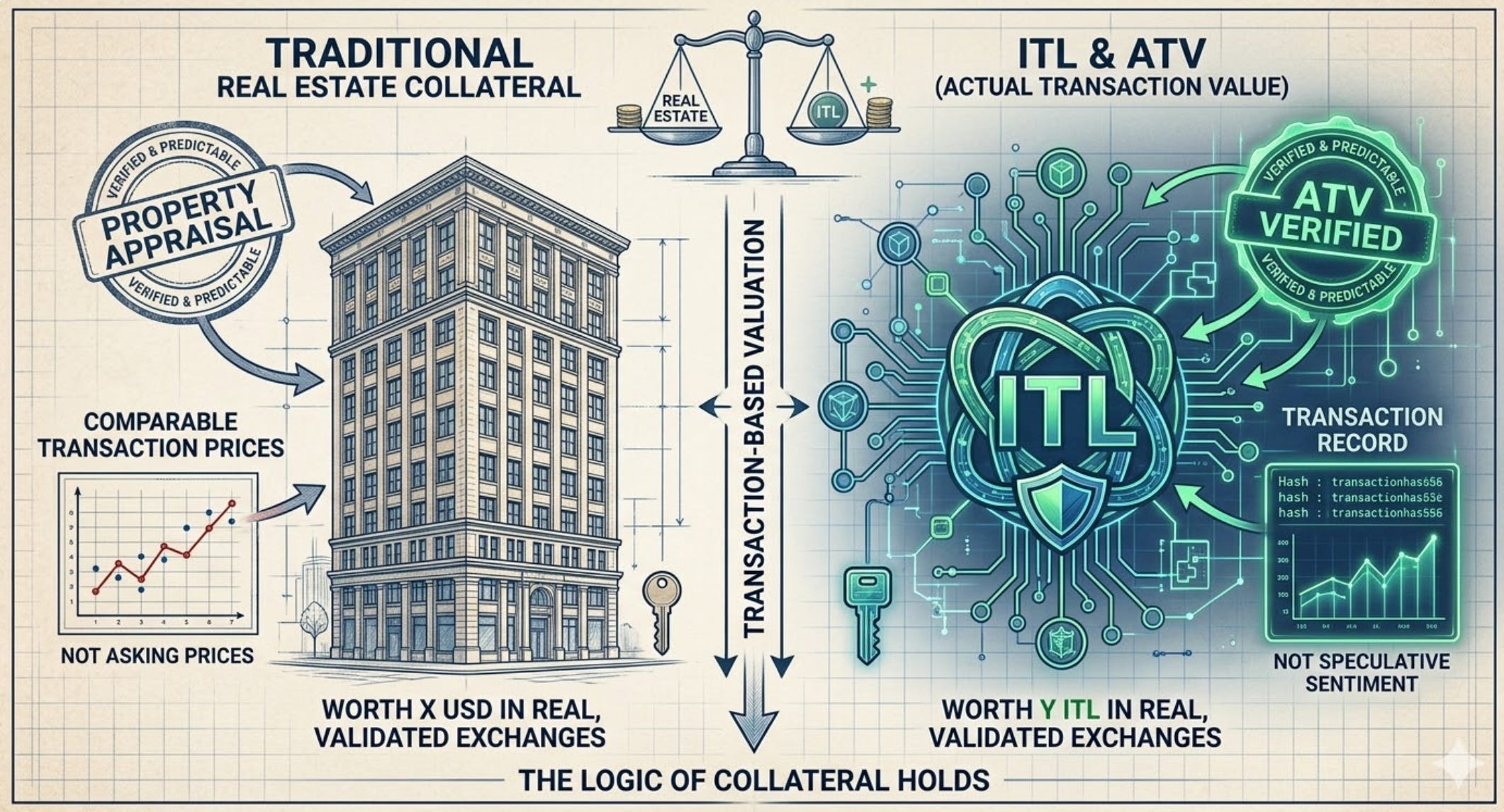
That is a basis for collateral assessment. Not a trader’s conviction. A transaction record.
Three Barriers Standing in the Way
Possibility is not the same as readiness.
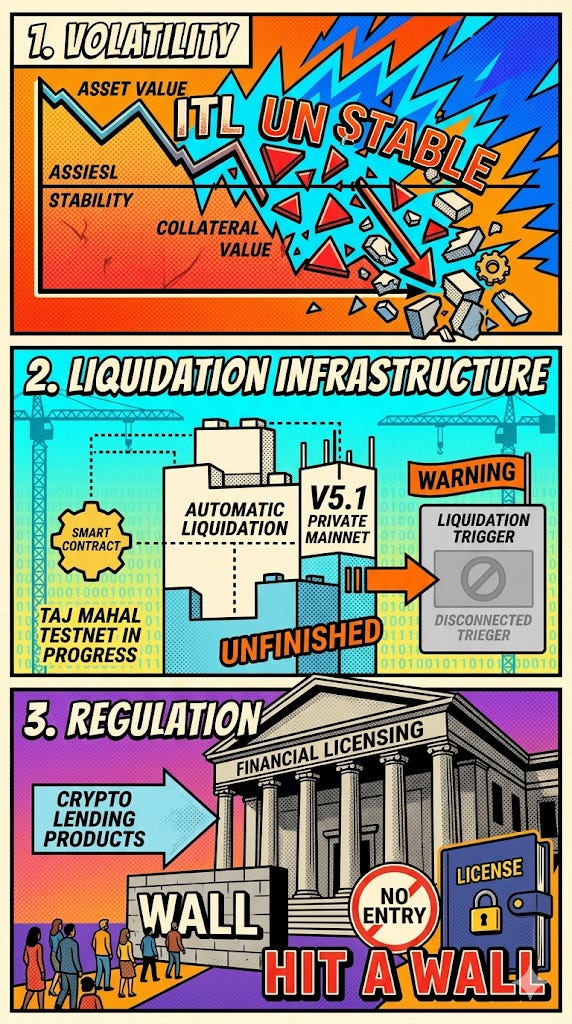
The first barrier is volatility. Real estate rarely collapses in value overnight. ITL has not yet demonstrated that kind of stability. If collateral value drops sharply, the entire lending structure becomes fragile. Even conservative LTV ratios have limits when volatility is extreme.
The second barrier is liquidation infrastructure. When collateral value falls below a threshold, automatic liquidation must trigger. Building that on-chain requires smart contract level infrastructure. InterLink’s Taj Mahal Testnet is in progress and the V5.1 Private Mainnet is on the horizon. The technical foundation is being laid, but it is not complete.
The third barrier is regulation. Lending products backed by digital assets sit squarely inside financial licensing territory. This is where most crypto projects hit a wall.
Where the Third Barrier Inverts
InterLink is starting from a different position.
The KYC verification requirements InterLink has explicitly built into its system include three standards: AMLO — Hong Kong’s Anti-Money Laundering and Counter-Terrorist Financing Ordinance. SFC VASP License — the Securities and Futures Commission’s virtual asset service provider framework. FATF Recommendation 15 — the Travel Rule and international AML standards.
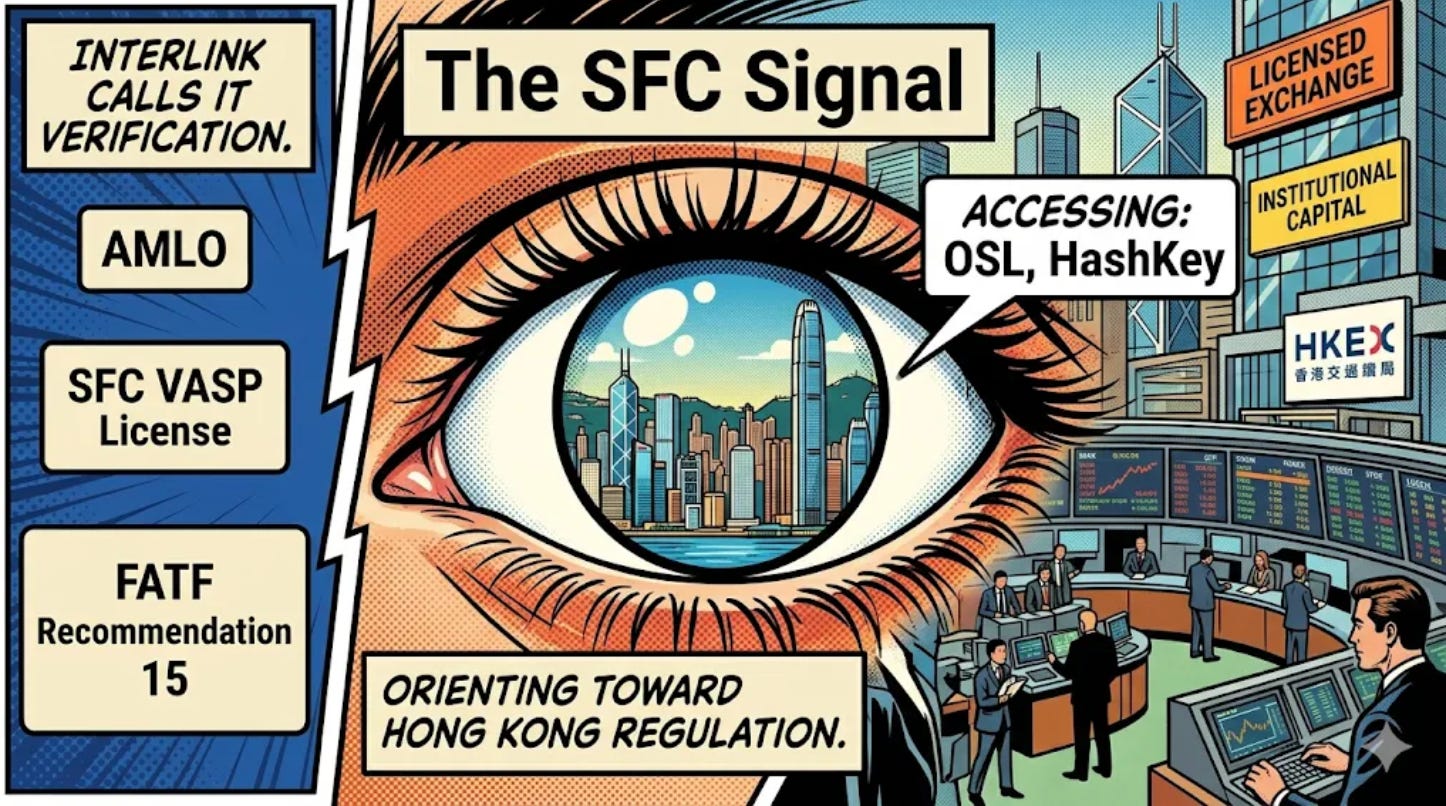
These are not casual onboarding requirements. This is the level of identity verification that financial institutions demand from their customers.
A functioning lending product requires two things simultaneously. Verifiable collateral value, and verifiable borrower identity.
If ATV is building the first, InterLink’s regulatory framework is already designing the second.
For most crypto projects, regulation is the wall. For InterLink, it may already be the foundation.
Beyond ITL: When Business Activity Becomes Collateral
Here is where the logic extends further than most people have noticed.
InterLink’s protocol does something that goes beyond simple payment processing.
When a customer pays a business through InterLink, the protocol automatically routes 5% of that transaction into the business’s own AMM pool on-chain.
That portion executes an automated buy of the business’s token, paired with ITL as the universal reserve. Every payment a business processes builds persistent, non-speculative liquidity for its own token — automatically, in real time.
This means that a business operating on InterLink is not just accepting payments. It is continuously building a verifiable, on-chain record of its own economic activity.
Revenue becomes a liquid asset.
Transaction history becomes a balance sheet that anyone can read.
Now consider what that means for collateral.
A business with a documented on-chain transaction history, a token backed by real revenue flows, and ITL as the reserve pair — that is not a speculative asset asking to be trusted. That is an auditable economic record asking to be assessed. The gap between that and a loan application is narrower than it appears.
The Product May Not Exist Yet. The Logic Already Does.
Whether an ITL-backed USDT lending product launches, and when, remains unknown. Volatility is an unresolved problem. Liquidation infrastructure is incomplete.
These are real constraints.
But that is not what makes this question worth asking. What matters is that the logic for such a product is already embedded in the system InterLink is building.
Verified transaction-based value through ATV. Institution-grade identity verification through AMLO, SFC VASP, and FATF R15. Business-level liquidity built automatically through the 5% AMM protocol. On-chain assets that reflect real economic activity, not speculation.
When these components reach completion inside a single ecosystem, a lending product is not a new invention. It is the natural next step.
If the system is designed to make it possible, the product will follow.
The question is not whether.
It is when.
If you’d like to support my research, you may use my Interlink invitation code below. It also unlocks an instant mining boost ✚︎ Welcome Bonus for new users.
InterLink Referral Code: 905079415
Wallet Invitation Code : HSVZZPEJ (75% Commission Rebate)
❓ New to InterLink?
For a 🔗step-by-step guide, start with the pinned post at the top of my blog — Done.T Insight✨.
You don’t need capital. You just need five minutes.
📚 Done.T’s Related Insights
The Architects of ATV: What InterLink's Power Players Are Actually Designing

Let’s be clear about something before we go further.
ITLG — Not Meant to Be Sold. Meant to Be Held.

Most people misread InterLink from the very first screen.
🔎 Search “Done.T Insight” on Google for real data & analysis.
Disclosure: This post contains referral links and reflects my personal research and experience. It is provided for informational purposes only and does not constitute financial advice.