

📈 User Growth Overview
As of April 30, 2026, InterLink reached a total of 7,899,948 InterLink IDs, up from 7,225,841 at the end of March.
This represents a net increase of 674,107 users, equivalent to approximately 9.3% month-over-month growth.
Verified InterLink IDs rose to 5,313,236, adding 456,358 verified users during the same period — a 9.4% month-over-month increase.
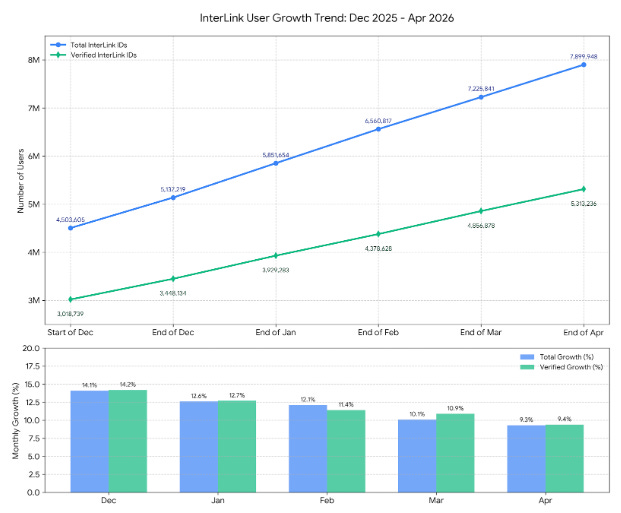
Once again, verification growth tracked total user growth in near-perfect alignment.
The pattern first observed in December has now held for five consecutive months: verified users expand at the same rate as total users, and in April, slightly ahead of it.
Growth is not diluting the network. The structure is holding at scale.
Daily Active Users reached 4,771,930 — representing 60.4% of total IDs. In a network approaching 8 million registered participants, that ratio does not emerge from passive sign-ups. It reflects a system where participation carries consequence.
📋 Monthly Briefing
If March introduced qualification, April proved it was real.
The network no longer announced what it intended to build. It began running what it had built — and the sequence in which it did so was not accidental.
Human Network first. Then Payment Points. Then on-chain settlement. Then global payment rails.
Each layer depended on the one before it. Verified participants are the precondition for credible transaction endpoints. Transaction endpoints are the precondition for meaningful settlement. Settlement is the precondition for external payment connectivity that institutions will trust.
April was the month that sequence became visible — because all four layers moved simultaneously.
The Gate Opens
April began with the official launch of Version 5.0 — not as a roadmap update, but as an operational transition.
The Curator System moved from design into deployment. KYC became a mandatory step, not a future requirement. Users could now initiate identity verification that would determine their eligibility for Verified $ITLG — and for the first time, that eligibility was enforced rather than promised.
Connect Social, upgraded within V5.0, deepened this architecture. Every linked external account — Instagram, X, TikTok, Facebook — contributes to the Human Credit Score. Identity is no longer confirmed once and archived. It is continuously expressed through observable behavior, and continuously measured.
The Curator System, described in March as selective and non-assignable, began operating as designed. Human Curators provide judgment. AI Curators provide scale. Neither replaces the other.
Verification became operational infrastructure.
The Chain Becomes Real
On April 20, Testnet Taj Mahal went live.
This was not a simulation. Real blocks. Real transactions. Real settlement. The infrastructure that millions of users had been mining toward, verifying toward, and positioning within — existed, for the first time, as a running system.
Performance benchmarks from Phase 1 reflected the design priorities: up to 2,000 TPS, deterministic finality under 2.3 seconds, average fees from $0.0002 in ITL, and full EVM compatibility.
The distinction the network emphasized was not raw speed, but finality certainty — the property that matters when merchants need to know a payment is settled, not merely probable.
Speed without certainty is a feature.
Certainty with speed is infrastructure.
Alongside the Testnet launch, InterLink published its full post-quantum cryptography roadmap. The 4-phase migration strategy — from pre-mainnet signature precompiles through full consensus migration — was built into the protocol from the ground up. No retrofit. No reactive upgrade later.
The chain was engineered with the assumption that quantum-capable adversaries will exist within its operational lifetime.
Infrastructure is not just live.
It is built to last.

The Economy Reaches Outside
The third and most structurally significant shift in April was the connection of on-chain value to the real economy.
The InterLink Visa Card launched officially — supporting USDT, USDC, and ETH, integrating with Apple Pay, Google Pay, and any Visa-compatible platform. The onboarding process was designed for efficiency. The spending reach was global.
This is not a feature. It is an activation layer.
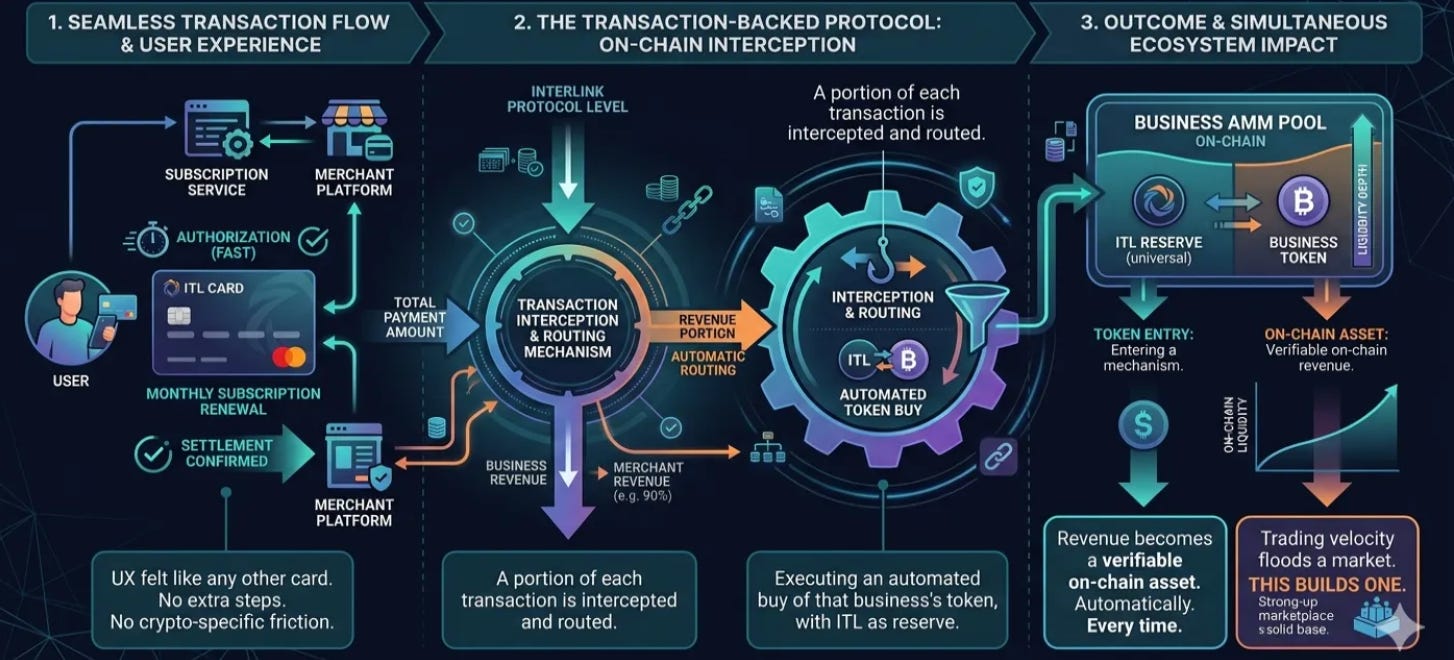
The Transaction-Backed Digital Assets Protocol, introduced in March as a mechanism, now had a surface through which real-world transactions could enter the system. Every payment processed through InterLink infrastructure routes a portion into liquidity pools automatically. Revenue becomes an on-chain asset in real time. The model sources value from outside itself.
The InterLink Foundation simultaneously opened Payment Point applications — inviting merchants and businesses to join the network ahead of mainnet.
The target is 10,000 payment points in 2026. Approved merchants will be supported through integration, testing, and launch across Testnet Taj Mahal and mainnet.
With on-chain settlement live and Payment Points opening, the next layer becomes inevitable: external payment rails.
The preview of the MasterCard partnership is not a separate announcement. It is the extension of that layer — connecting InterLink’s settlement infrastructure to global payment networks already embedded in everyday commerce.
Liquidity is no longer theoretical.
It is being connected, one payment point at a time.
Governance Anchors the Structure
On April 13, KV was officially appointed Chairman of the InterLink Foundation — moving from co-founder and CTO to the governance layer that oversees capital allocation, grants, validator frameworks, and payment point expansion.
The appointment was not ceremonial. It separated execution from governance in practice, not just in design.
InterLink Labs builds and deploys. The Foundation authorizes and stewards. The distinction that was declared in February became a functional reality in April.
On April 29, KV published a direct statement addressing verification speed — the most candid governance communication of the month.
The message was structurally precise: removing the three compliance standards (AMLO, SFC VASP License, FATF Recommendation 15) would increase verification speed by 20x. It would also expose the system to a single AML violation capable of collapsing everything built.
The choice was not made reluctantly.
It was made deliberately, and explained without hedging.
Compliance is not a constraint the network works around. It is the foundation the network is built on.
🧾 Overall Assessment
April reflects a system that crossed from architecture into execution — and in doing so, crossed from network into economy.
Before April, InterLink was a growing network. Verified participants, accumulating data, building position.
After April, the structure behaves differently. It has verified participants with measurable identity, transaction endpoints in the form of Payment Points, settlement infrastructure that runs deterministically, and external payment connectivity through Visa and MasterCard.
These four elements together do not describe a network. They describe an economy.
Every major development of the month — V5.0, the Curator System, Testnet Taj Mahal, the Visa Card, Payment Points, the MasterCard preview — shared a single structural characteristic: they were not announcements of intent. They were deployments of systems that had already been designed, tested, and qualified.
✔︎ Verification became operational, not aspirational.
✔︎ The chain became real, not projected.
✔︎ The economy connected outward, not inward.
✔︎ Governance separated from execution, by design and by appointment.
What the network chose in previous months — legitimacy over speed, structure over momentum, ordering before liquidity, qualification over participation — was not preparatory language. It was load-bearing infrastructure.
April is where that infrastructure started carrying weight.
This is what a settlement-first architecture looks like when it activates. Not speculation leading to utility. Identity leading to qualification, qualification to infrastructure, infrastructure to payments, payments to value.
The sequence was always the point.
April 2026 “The month InterLink stopped being a network — and started behaving like an economy.”
If you’d like to support my research, you may use my Interlink invitation code below. It also unlocks an instant mining boost ✚︎ Welcome Bonus for new users.
InterLink Referral Code: 905079415
Wallet Invitation Code : HSVZZPEJ (75% Commission Rebate)
❓ New to InterLink?
For a 🔗step-by-step guide, start with the pinned post at the top of my blog — Done.T Insight✨.
You don’t need capital. You just need five minutes.
📚 Done.T’s Related Insights
One Year In, InterLink Added KYC. Stop Asking What. Start Asking Why.

When InterLink launched, the headline feature was face verification. A real human, not a bot. That was the promise.
When the Chain Goes Live, the Stakes Change: What V5.1 Is Actually Saying

There is a category difference between a protocol that adds features and a protocol that begins operating. Feature releases expand what a system can do. Operational releases change what the system is.
🔎 Search “Done.T Insight” on Google for real data & analysis.
Disclosure: This post contains referral links and reflects my personal research and experience. It is provided for informational purposes only and does not constitute financial advice.