

When a protocol announces KYC integration, the market reads it the same way every time: regulatory pressure, institutional signaling, onboarding friction dressed as legitimacy.
The assumption is that identity verification is a gate you pass through once, and forget.
V5.0 is not that.
What InterLink has built is a structural prerequisite — the condition under which participation becomes eligible for conversion into real liquidity.
The distinction matters more than it first appears.
🏗️ The Hidden Structure Behind V5.0
The system is structured as a single conversion sequence:
ITLG → Verified ITLG → ITL
ITLG represents raw participation — behavioral data accumulated within the ecosystem. Verified ITLG represents filtered participation — the same data, now attached to a confirmed human identity. ITL represents liquidity itself — the point at which participation becomes exchangeable value.
Most token systems make liquidity the entry point and manage behavior afterward. InterLink reverses the sequence entirely.
Liquidity is not mined. It is granted.
🤝 Curators: Not People, But a Layer

On the surface, Curators appear to be validators: individuals or entities assigned to review submitted documents.
Human Curators handle personal review. AI Curators handle automated processing. Users can choose between them, across regions and types. This reads as flexibility.
It is something more precise. InterLink has created a verification market— a distributed layer in which the responsibility for trust is actively allocated to qualified reviewers operating under Foundation oversight.
The layer is decentralized in selection, but governed in execution.
InterLink doesn’t automate trust.
It distributes the responsibility of trust.
Automated trust creates a single point of failure — distributed trust removes it.
⏳ The KYC Flow Is the System
Each phase is not administrative procedure — it is a filter with structural intent.
Phase 1: Matching. The user selects a Curator from an anonymized list — closer in structure to selecting a financial intermediary than completing an onboarding form.
Only once the Curator accepts does the process move forward.
Phase 2: Submission. The moment a Curator accepts, a 24-hour countdown begins. Submit within the window, or the process resets entirely.
The timer is not a UX decision. It removes passive participants and rewards intentional engagement.
Phase 3: Outcome. Approved or rejected.
The system does not reward presence. It rewards qualification.
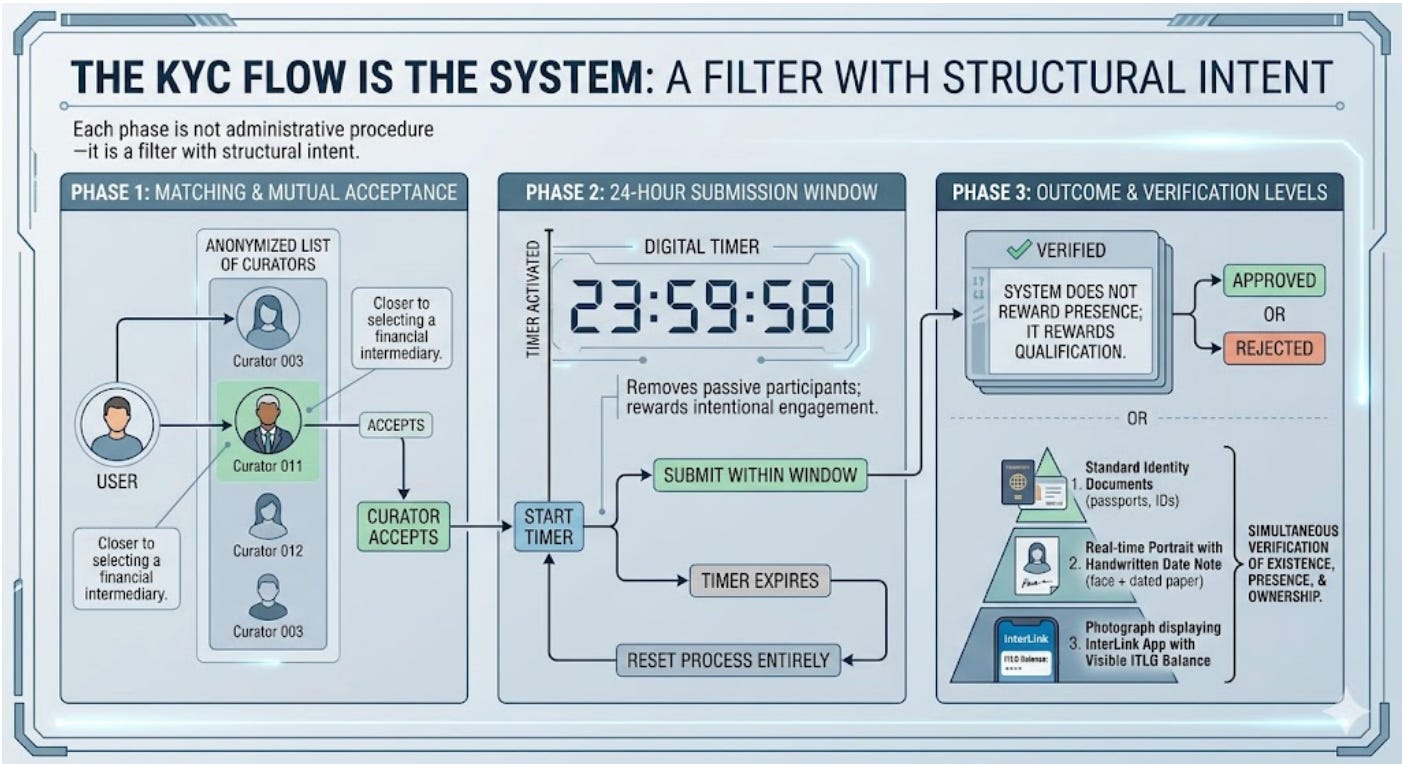
The submission escalates across three levels: standard identity documents, a real-time portrait with a handwritten date note, and a photograph displaying the InterLink app with visible ITLG balance.
Taken together, these are simultaneous verification of existence, presence, and ownership.
This is not identity verification.
It is behavioral verification under constraints.
⚖️ Identity, Rewritten
Most systems treat identity as a static input submitted once and stored.
Web3 pushed further — pseudonymous wallets, anonymous participation, no requirement to connect behavior to a real human.
InterLink moves in a different direction.
Identity here is not a fixed attribute. It is a dynamic process evaluated across multiple dimensions by a structured network of reviewers whose own conduct is continuously monitored by the Foundation.
In InterLink, identity is not proven once. It is continuously evaluated.
💎 Qualification Before Liquidity
Most token ecosystems attract capital first.
Liquidity pools open, participation is broad, and filtering — if it happens — is applied retroactively through vesting or governance mechanisms.
InterLink operates on an inverted logic. Capital cannot enter the liquidity stage until qualification is confirmed.
The population of ITL holders is, by design, a filtered population. This is not a restriction on participation. It is a definition of who participates in value.
Most systems compete for capital.
InterLink competes for qualified humans.
A capital-first system is as strong as its market conditions. A qualification-first system is as strong as its verification standards — and those, unlike market sentiment, can be governed.
⚠️ The Risk Layer
The most significant concern is Curator centralization.
The initial pool is Foundation-appointed and limited. If expansion doesn’t keep pace with user growth, verification bottlenecks emerge — and with them, the possibility of geographic or demographic bias.
Evaluation criteria transparency is a related risk.
Human Curators introduce subjectivity. Without published standards for passing or failing review, fairness might depend on individual integrity rather than protocol integrity.
The fairness of the system depends entirely on how Curators are governed.
The same layer that protects value
can also control it.
🏁 Final Signal
The conversion from ITLG to ITL is now conditional. The condition is not capital. It is not tenure.
It is qualification.
This is not the start of KYC.
This is the start of qualification-driven liquidity.
And once that gate is locked, not everyone who mined will be able to exit.
What the ecosystem looks like when only qualified participants hold liquid positions — and what that does to the value of qualification itself — is the question V5.0 has just opened.
The question is open.
The outcome won’t be.
If you’d like to support my research, you may use my Interlink invitation code below. It also unlocks an instant mining boost ✚︎ Welcome Bonus for new users.
InterLink Referral Code: 905079415
Wallet Invitation Code : HSVZZPEJ (75% Commission Rebate)
❓ New to InterLink?
For a 🔗step-by-step guide, start with the pinned post at the top of my blog — Done.T Insight✨.
You don’t need capital. You just need five minutes.
📚 Done.T’s Related Insights
From Invisible to Measurable: The Economic Architecture Behind InterLink's Human Credit System

Most crypto systems reward what they can count. Hash rate. Transaction volume. Wallet size. These are legible variables — easy to measure, easy to game.
Zero-Capital Tokenization: How InterLink Creates Value Without Investment

Tokenization is one of those words that sounds important but rarely gets explained.
🔎 Search “Done.T Insight” on Google for real data & analysis.
Disclosure: This post contains referral links and reflects my personal research and experience. It is provided for informational purposes only and does not constitute financial advice.