

InterLink did not just announce a new feature or a routine roadmap update. It announced something far more fundamental: a division of powers.
In a recent strategic clarification by KV, the ecosystem’s future was mapped out through three distinct pillars: InterLink Labs, the ITLX Super Wallet, and the InterLink Foundation.
To the casual observer, this might look like corporate restructuring.
But to those watching the evolution of digital monetary systems, this is a “Constitutional Moment.”
It is the separation of concerns — the essential architectural move any infrastructure must make before it can support global scale.
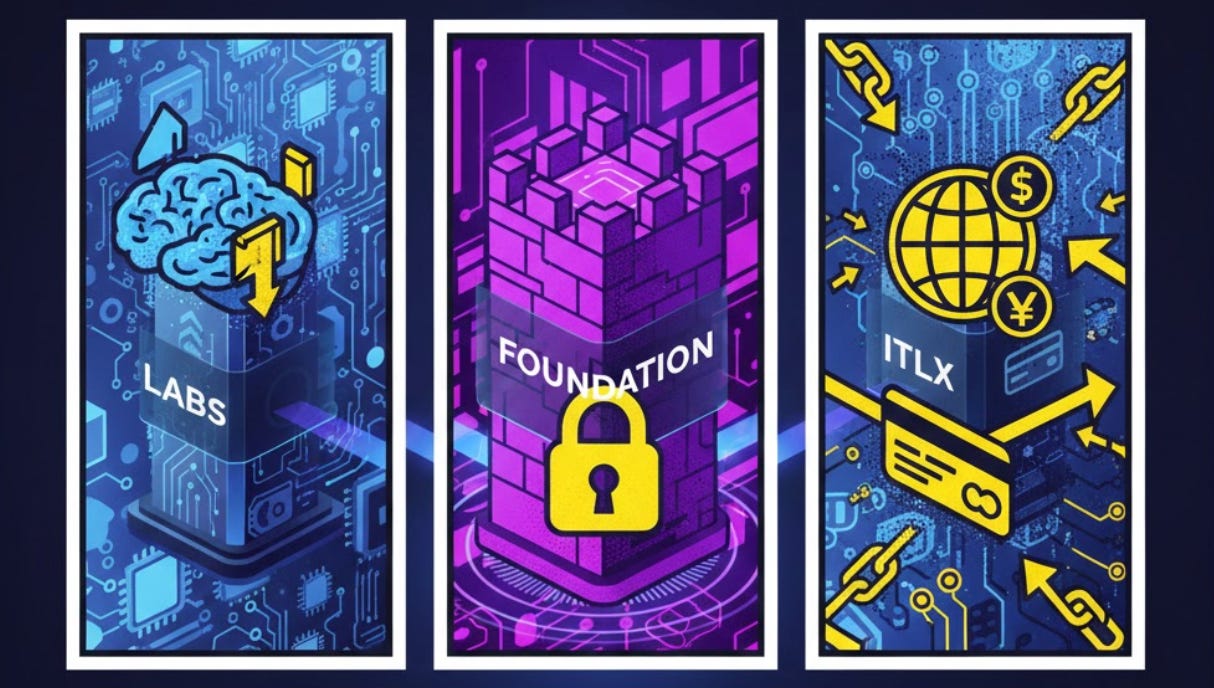
🏛️ The Three Pillars: Defining the Boundaries
1️⃣ InterLink Labs: The Engine of Scalability ⚙️
InterLink Labs is the “Execution Layer.”
It is the core unit responsible for the technical heavy lifting: developing the InterLink App, refining the Human Node verification process, and integrating new features.
Its mandate is operational velocity.
The role of Labs is to ensure that the infrastructure is prepared to support millions and eventually billions of users. By focusing on “Human-Centric” blockchain applications, Labs acts as the execution engine that moves fast and iterates constantly.
However, notice the boundary:
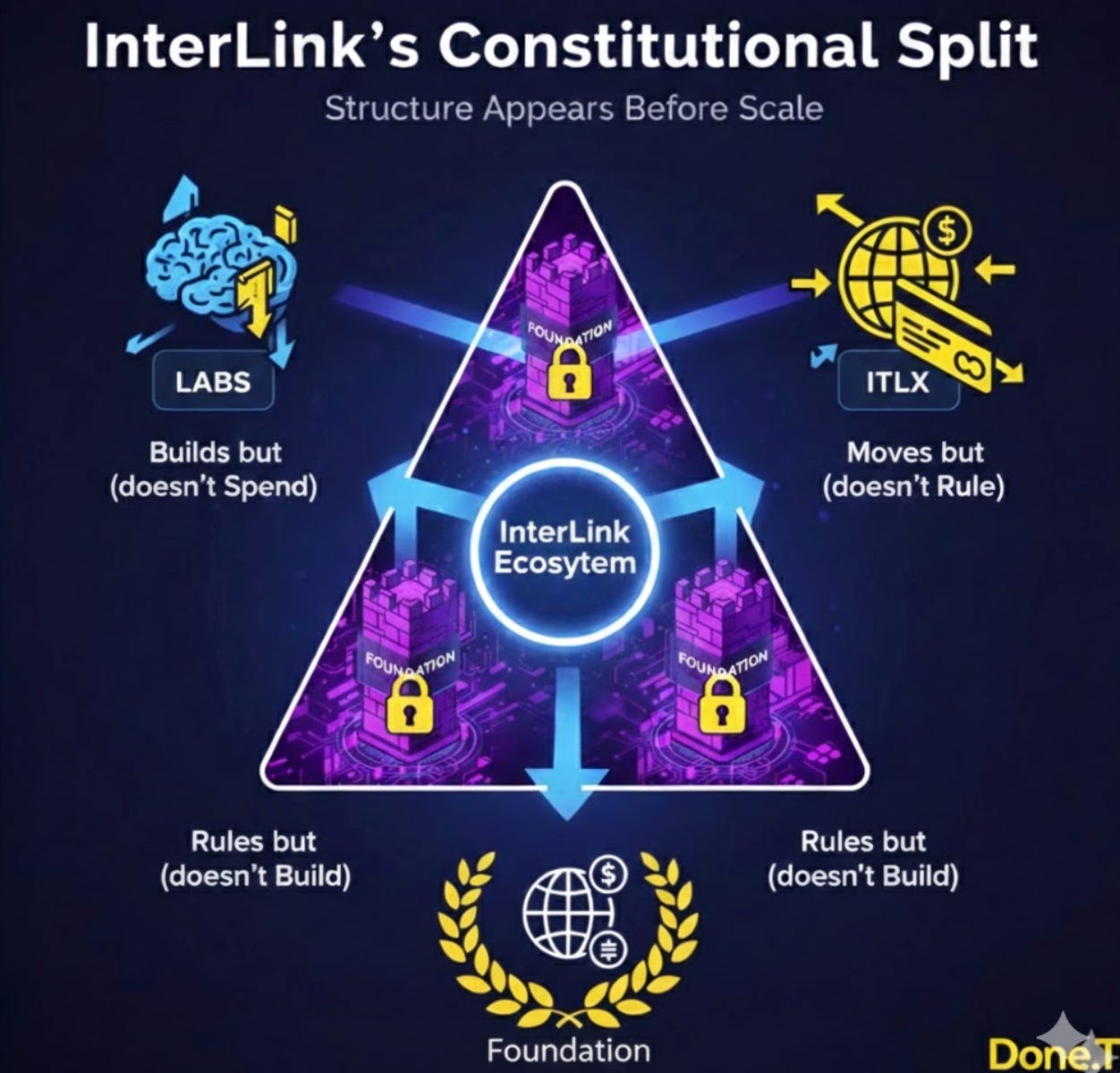
Labs is the operator, not the owner of the economy.
By isolating the technical development from the monetary approval process, InterLink ensures that the “builders” cannot unilaterally alter the economic rules of the game.
2️⃣ ITLX: The Interface of Liquidity 💱
If Labs is the engine, the ITLX Super Wallet is the financial interface.
Its focus is on the user experience and the movement of value. This includes a multichain strategy, the InterLink Visa Card, and robust on-ramp/off-ramp solutions.
ITLX is the bridge.
It connects the InterLink ecosystem to the legacy financial world and other blockchain networks. Its mission in version 5.0 is to optimize the dApp ecosystem and provide the “payment rails” that make the token usable in daily life.
ITLX moves value and facilitates utility, but it does not have the authority to create or distribute funds.
This separation ensures that liquidity tools remain neutral gateways rather than centers of power.
3️⃣ The Foundation: The Legitimacy Layer ⚖️
The most critical addition to this structure is the InterLink Foundation.
This is the “Governance Layer.”
While Labs builds and ITLX moves, the Foundation authorizes.
It is responsible for approving all expenditures, distributing Verified ITLG, and conducting rigorous audits of ecosystem activities.
The Foundation operates under a strict code of ethics: its board members must remain independent, prioritizing InterLink’s long-term interests over short-term gains. The Foundation claims a strict independence standard, separating monetary approval from operational execution.
This isn’t a technical mandate;
it is a legitimacy mandate.
When the power to “spend” is separated from the power to “build,” a project stops behaving like a volatile crypto startup and begins to resemble a structured monetary framework.
🤷 Centralization or Strategic Discipline?
The immediate critique in the decentralized world is predictable:
“Is this too much control?”
However, this interpretation confuses power concentration with architectural discipline.
In most early-stage crypto projects, execution, liquidity, and governance are all managed by the same small group of founders.
This “blended” model works for speed, but it fails at scale. It creates a system where the rules can be changed on a whim to suit growth targets.
By splitting these roles now, InterLink is signaling that stabilization precedes expansion.
True decentralization cannot be achieved by starting in a state of chaos. It requires a stable, rule-bound framework that can eventually be handed over to a broader community.
InterLink is building that framework now.
📡⚡The Signal of a Reserve Asset
InterLink has explicitly stated its goal: to position itself as a global reserve asset. This is not a marketing slogan; it is a structural requirement.
A global reserve asset demands three things that speed alone cannot provide:
Auditability: The ability for the world to see where every token goes (The Foundation).
Utility: The ability for the asset to be spent and moved anywhere (ITLX).
Scalability: The capacity to handle global demand without breaking (Labs).
These conditions do not emerge from raw growth. They emerge from boundaries. The activation of this structural layer suggests a prioritization of discipline over acceleration.
🏁 Conclusion: Structure Absorbs Scale
A startup scales with speed, but infrastructure scales with structure.
Speed attracts speculators;
structure absorbs global institutions.
InterLink is moving away from the “move fast and break things” phase and into the “build to last” phase. By drawing these lines today, they are preparing the vessel for the next wave of global liquidity.
Whether these boundaries withstand scale will determine the system’s institutional credibility.
For now, the structure is in place.
Scale will test it.
If you’d like to support my research, you may use my Interlink invitation code below. It also unlocks an instant mining boost ✚︎ Welcome Bonus for new users.
InterLink Referral Code: 905079415
Wallet Invitation Code : HSVZZPEJ (75% Commission Rebate)
❓ New to InterLink?
For a 🔗step-by-step guide, start with the pinned post at the top of my blog — Done.T Insight✨.
You don’t need capital. You just need five minutes.
📚 Done.T’s Related Insights
Who Decides Where the Money Goes?- The Hidden Role of Foundations

Most discussions about blockchain start with technology.
Why Crypto's Definition of Alpha Is Quietly Changing

There is a rule that has governed crypto markets for the better part of a decade.
🔎 Search “Done.T Insight” on Google for real data & analysis.
Disclosure: This post contains referral links and reflects my personal research and experience. It is provided for informational purposes only and does not constitute financial advice.