

Anyone who studies the InterLink architecture eventually arrives at the same question.
If ITL is not distributed by the team and only enters the market when Verified ITLG holders choose to convert — won’t the market suffer from limited liquidity and price instability?
At first glance, the concern seems reasonable.
But the question itself carries a hidden assumption: that ITL is supposed to behave like a standard exchange token. And that assumption is precisely where the misunderstanding begins.
ITL was never designed as a trading token first.
It was designed as a reserve-grade digital asset. And that single distinction changes everything about how its supply structure should be evaluated.
🏦 Financial Systems Always Begin With Structure
Before examining the architecture, it helps to understand the moment InterLink is building into.
Any macroeconomic system tends to move through recognizable stages — initiation, development, saturation, decline.
During transition periods, existing liquidity infrastructures begin to fragment. And historically, that fragmentation is exactly when new financial corridors emerge.
InterLink positions itself within that moment.
Not as a trading platform, but as infrastructure — a layer connecting Web2 and Web3 economic flows at a point when traditional cross-border systems are beginning to show their limits.
This context is not decorative. It explains why the design choices around ITL supply look the way they do.
When you are building infrastructure for a transition period, the priority is structural integrity — not maximum early liquidity.

🧭 ITL Does Not Follow the Standard Token Distribution Model
Most cryptocurrencies enter the market through a familiar sequence.
Teams hold allocations. Investors receive pre-sale tokens. Exchange listings generate initial trading volume. Unlock schedules determine how much supply reaches the market over time.
In this model, liquidity is a product of distribution. Supply expands when insiders decide to release it.
ITL removes that structure entirely.
The InterLink architecture operates on a different rule:
the team does not sell ITL, institutions are not pre-allocated ITL, and there is no unlock schedule.
The only path through which new ITL enters circulation is Verified ITLG conversion — an outcome that depends on verified human participation, time-based activity, and HCS qualification.
This means ITL is not a token that can be minted and released at management’s discretion. It is an asset that emerges only when real network behavior meets qualification thresholds.
Supply becomes behavior-dependent rather than management-dependent.
🔐 Why This Matters for Treasury Holders
For institutions evaluating digital reserve assets, the question is rarely about short-term price volatility. The deeper concern is structural.
Who controls supply expansion?
Are there hidden unlock schedules?
Can the project team release large quantities at will?
These are the questions that determine whether a digital asset is viable as a treasury holding — and they are the questions ITL is structured to answer.
Because supply expansion is tied to verified participation and network qualification rather than to internal wallets or scheduled releases, the supply curve is governed by the network itself.
No single entity can accelerate it.
No insider event can flood the market.
This creates a meaningful trade-off.
ITL may not be easy to predict in price. But its supply dynamics become far more predictable than most crypto assets. And for treasury evaluation, predictable supply often matters considerably more than deep early liquidity.
Institutions and organizations that position early gain access to an asset whose scarcity compounds over time — while those unaware of this structure may find themselves on the wrong side of a position they did not know was closing.
🔄 The Scarcity–Liquidity Dual Dynamic
This architecture produces an economic dynamic that is unusual in the crypto space.
Scarcity increases as the network grows, because supply expansion is constrained by qualification. At the same time, liquidity is expected to grow through ecosystem usage rather than token emissions.
To understand this, think of a river:
Even if the total volume of water is kept low to maintain its value (Scarcity), the river remains powerful and functional if the current moves fast (Velocity).
In the ITL model, the system prioritize a “fast current” over a “deep, stagnant pool.” Supply compression on one side, circulation expansion on the other.
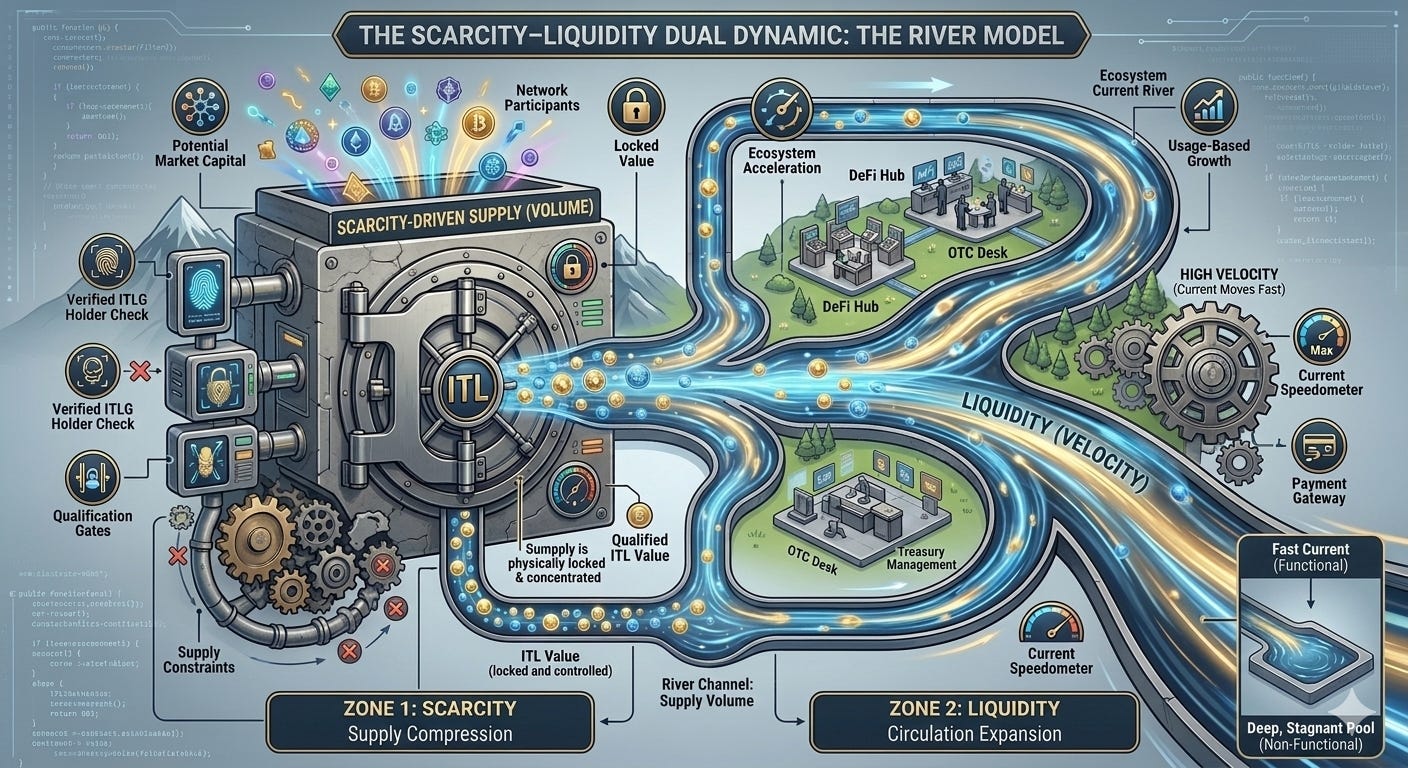
This is not a contradiction. It is a dual-value structure.
And it is the structural reason why early low trading volume is not a sign of failure.
💡 Done.T Insight
ITL was not designed to maximize early exchange liquidity. It was designed to eliminate supply manipulation risk.
That difference defines the architecture.
🏁 Part 1 Conclusion
ITL behaves differently from typical crypto tokens because it begins from a different premise entirely.
It is a digital reserve asset built on verified participation.
A token without insider distribution pressure. An asset whose supply expands through qualification rather than management decisions.
From this perspective, low early liquidity is not a structural weakness. It is simply the expected outcome of a constrained supply model — one designed to remove the risks that make most crypto assets unsuitable for institutional treasury use.
But this raises the next question.
If supply expands slowly and deliberately, how does the ecosystem maintain ongoing circulation?
How does ITL actually move through an economy rather than sitting locked in wallets?
🔜 [That answer belongs to 🔗Part 2.]
If you’d like to support my research, you may use my Interlink invitation code below. It also unlocks an instant mining boost ✚︎ Welcome Bonus for new users.
InterLink Referral Code: 905079415
Wallet Invitation Code : HSVZZPEJ (75% Commission Rebate)
❓ New to InterLink?
For a 🔗step-by-step guide, start with the pinned post at the top of my blog — Done.T Insight✨.
You don’t need capital. You just need five minutes.
📚 Done.T’s Related Insights
When the Chain Goes Live, the Stakes Change: What V5.1 Is Actually Saying

There is a category difference between a protocol that adds features and a protocol that begins operating. Feature releases expand what a system can do. Operational releases change what the system is.
Retail vs. Institutions: Who Actually Holds the Power in InterLink?

In [Part II], we established a critical principle: InterLink’s token numbers are not about price — they are about access, qualification, and time.
🔎 Search “Done.T Insight” on Google for real data & analysis.
Disclosure: This post contains referral links and reflects my personal research and experience. It is provided for informational purposes only and does not constitute financial advice.