

Blockchain has always been a story about trust. The question has never been whether a network can process transactions — the question is what the network ultimately trusts, and why.
For fifteen years, the industry answered that question two ways.
Proof of Work anchored trust in computing power. Proof of Stake anchored it in capital. Both models served their era well — they secured ledgers, prevented double-spending, and built the infrastructure that made the first generation of decentralized finance possible.
But neither was ever designed to answer the question that defines 2026: Is this a human?

In an environment saturated with AI agents and farming scripts, bots can simulate work. Whales can consolidate stake.
The two mechanisms that once guaranteed network integrity now have a shared blind spot — they cannot reliably distinguish a unique person from a well-resourced machine.
This is not a performance problem. It is not something a faster consensus algorithm or a lower gas fee will fix. It is an architectural flaw at the level of the trust primitive itself.
PoP is not a filter. It is a new consensus primitive.
Proof of Personhood — the logic of one person, one identity, one unit of legitimacy — is the architectural response to that flaw. But its implementation reveals a structural question that most projects prefer to avoid.
You cannot enforce genuine Sybil-resistance at the application layer.
A verification system that sits above the consensus layer is, by definition, circumventable at the consensus layer. It becomes a gate you pass through, not a rule the network itself enforces. The distinction matters enormously.
PoP without a base layer is a filter.
PoP as the base layer is a new social contract.
This is why the choice of infrastructure is not incidental to InterLink’s design — it is the design. If the network is to make human identity a first-class consensus primitive, that logic has to be baked into the architecture from the ground up. It cannot be retrofitted onto borrowed infrastructure.
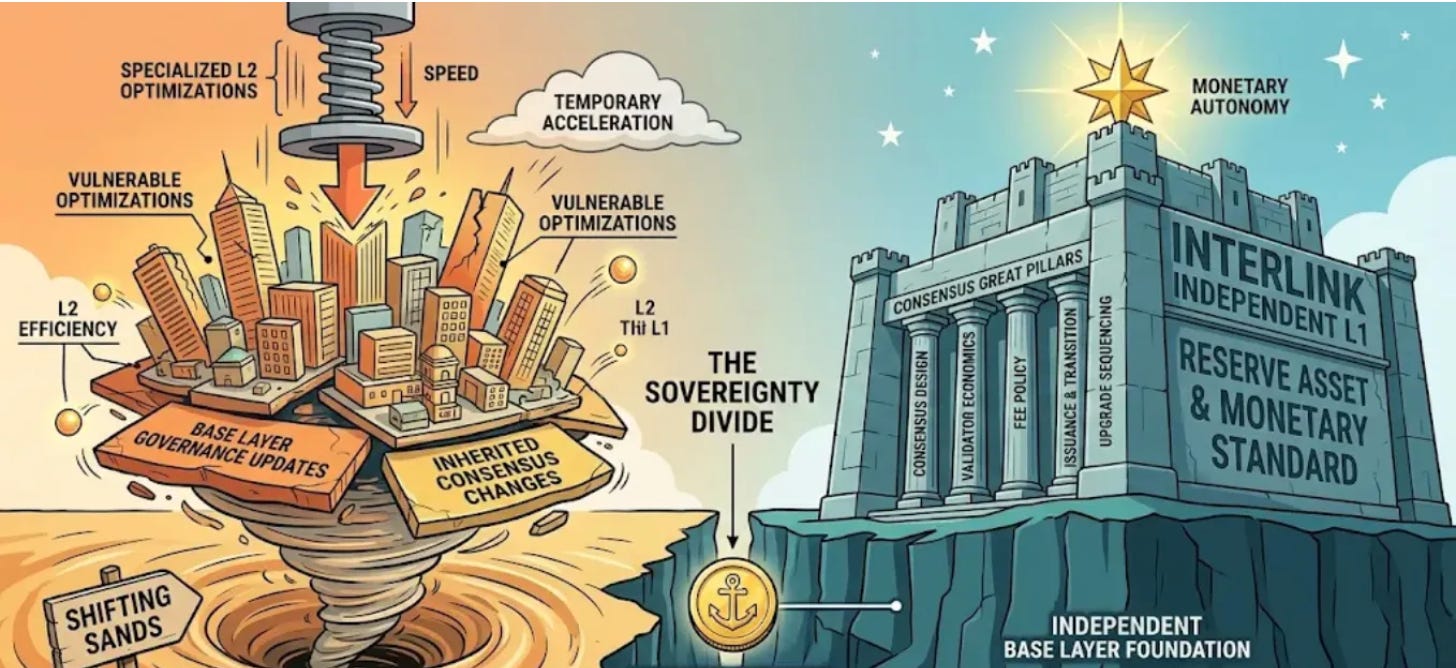
The L2 problem is structural, not operational.
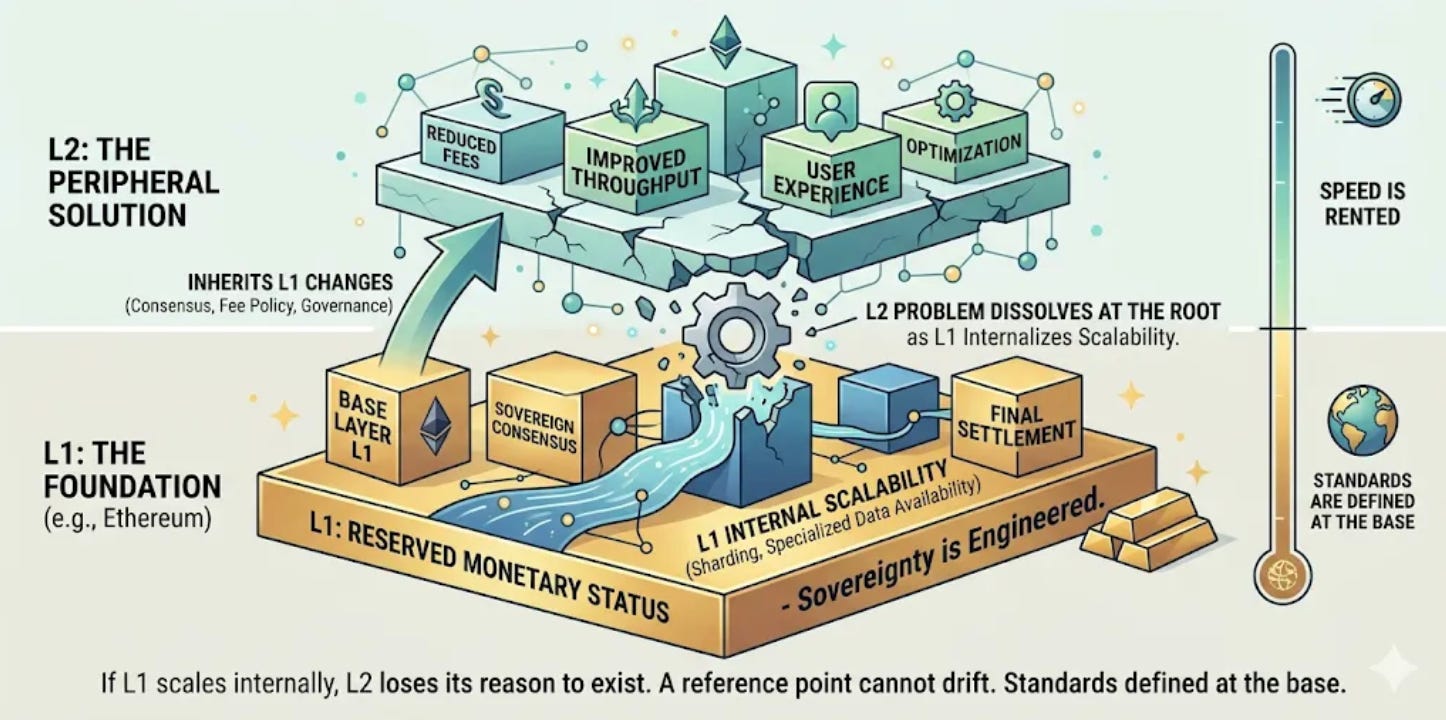
Layer 2 solutions emerged as a necessary response to friction. Reduced fees, improved throughput, better user experience — the contributions are real and were needed.
But optimization always assumes a constant. It assumes the base layer it depends on remains relatively fixed.
When the underlying host upgrades its consensus logic, L2 inherits that change. When fee policy shifts at the base, L2 inherits that too. When governance decisions are made by an external entity, the L2 has no authority over the outcome.
This is not a flaw to be patched — it is the fundamental trade-off of the model.
And here the argument becomes concrete: if Ethereum or any other host L1 continues to internalize scalability through sharding or specialized data availability, the core problem that L2s were built to solve disappears at the root.
The peripheral solution loses its reason to exist.
More critically, a network that aspires to reserve-grade monetary status cannot outsource its final settlement authority.
A reference point, by definition, cannot drift. It cannot be subject to upstream changes it does not control.
No reserve asset in the history of global finance — gold, dollar-denominated sovereign debt, any of them — was built on supplemental infrastructure. Standards are defined at the base.
Speed is rented.
Sovereignty is engineered.
Why InterLink chose the harder path.
InterLink’s decision to build an independent base layer was not about competing on throughput or gas fees. It was about avoiding structural dependency at precisely the moment when the trust primitive was being redefined.
By operating at the base layer, the network retains sovereignty over what might be called the five pillars of a digital monetary system: consensus design, validator economics, fee policy architecture, issuance and transition logic, and upgrade sequencing.
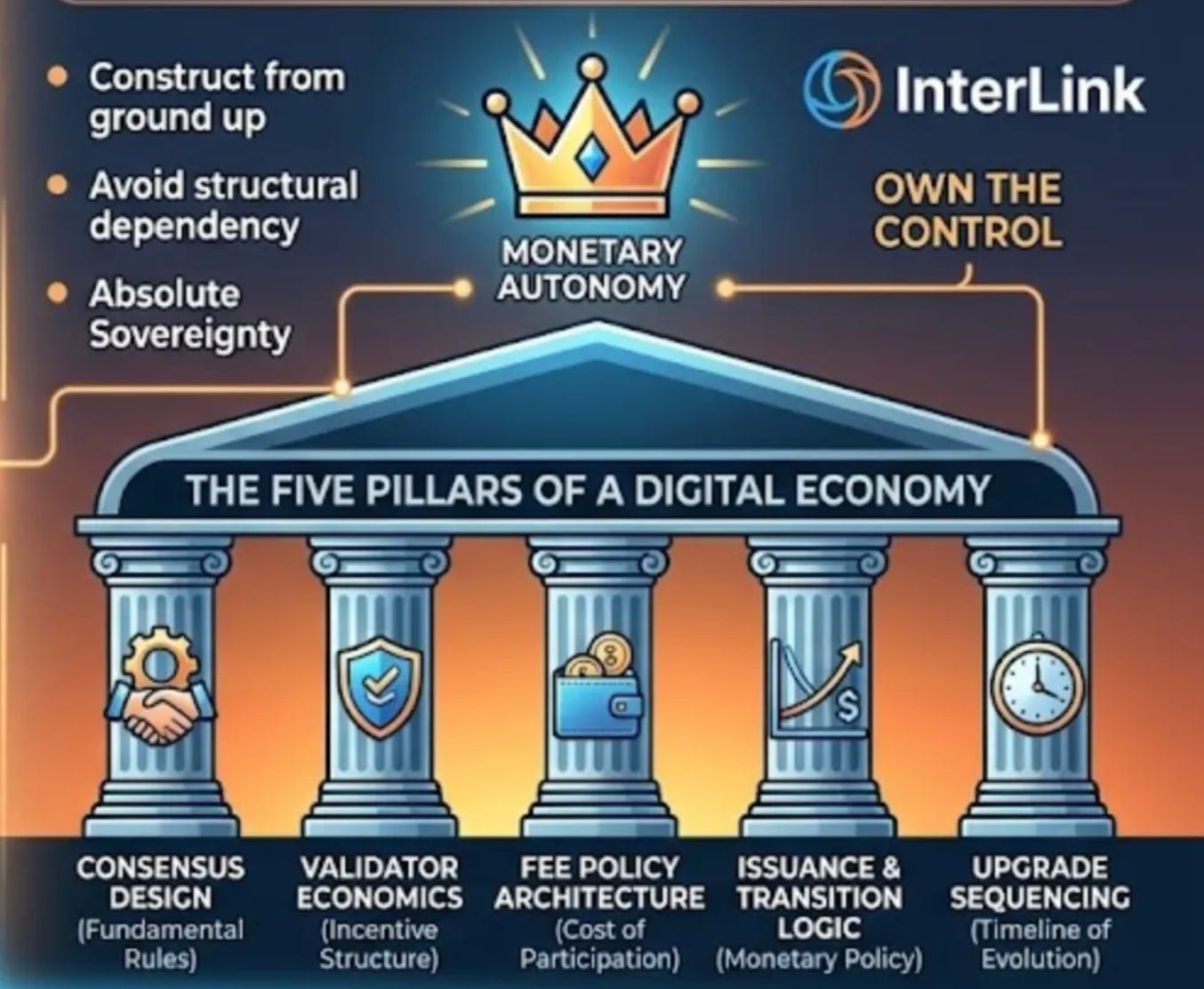
These are not technical details — they are the levers of monetary autonomy. Cede them to a host, and you have built an application, not a financial foundation.
The distinction the market will eventually draw is not between faster and slower networks. It is between networks that control the finality of their own consensus and those that borrow it.
Market capitalization measures attention. Scalability measures efficiency. Consensus sovereignty measures durability.
In the long game of global digital assets, durability is the only metric that compounds.

The architecture of trust is being rebuilt. For the first time, the foundation is not code efficiency or capital concentration — it is verified human presence.
But that foundation only holds if it is built at the base.
You can scale on borrowed infrastructure.
You cannot denominate value on it.
That is the line InterLink drew. And it is the only line that matters.
If you’d like to support my research, you may use my Interlink invitation code below. It also unlocks an instant mining boost ✚︎ Welcome Bonus for new users.
InterLink Referral Code: 905079415
Wallet Invitation Code : HSVZZPEJ (75% Commission Rebate)
❓ New to InterLink?
For a 🔗step-by-step guide, start with the pinned post at the top of my blog — Done.T Insight✨.
You don’t need capital. You just need five minutes.
📚 Done.T’s Related Insights
InterLink's Manifesto: From Speculative Layer 1 to Sovereign Infrastructure

Viewed in the context of the Foundation’s official launch, the accompanying post reads less like a routine announcement and more like a structural declaration.
Zero-Capital Tokenization: How InterLink Creates Value Without Investment

Tokenization is one of those words that sounds important but rarely gets explained.
🔎 Search “Done.T Insight” on Google for real data & analysis.
Disclosure: This post contains referral links and reflects my personal research and experience. It is provided for informational purposes only and does not constitute financial advice.