

There is an assumption so deeply embedded in modern finance that most people never think to question it:
Liquidity comes from investors. Not from customers, not from transactions, and certainly not from the act of buying a cup of coffee.
The people who use a business and the people who fund its market infrastructure have always been two entirely separate populations, operating in two entirely separate systems.
This separation is not accidental; it is structural.
For most of financial history, it has been treated as a law of nature rather than a design choice.
InterLink’s architecture challenges that assumption at its foundation.
🌩️ The Problem That Was Hiding in Plain Sight
In any financial market, liquidity is the invisible infrastructure that makes everything else possible.
Without sufficient depth, demand cannot translate into stable price discovery. A surge of buyers moves the price up sharply; a wave of sellers collapses it just as fast.
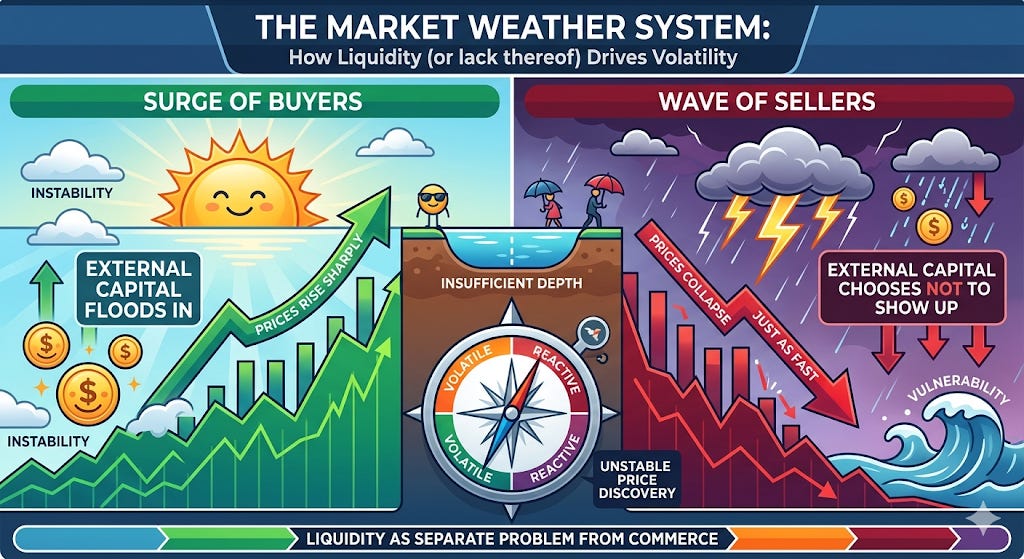
The market becomes a “weather system” — reactive, volatile, and fundamentally dependent on whether external capital chooses to show up.
This is why liquidity has always been treated as a separate problem from commerce.
Businesses generate revenue; markets generate liquidity.
The two activities run on parallel tracks, connected only loosely by intermediaries. The consequence is a structural fragility that most participants simply accept as the “cost of doing business.”
⚙️ What Changes When the Payment Is Also the Infrastructure
InterLink’s Transaction-Backed Digital Assets Protocol introduces a different premise.
When a business joins the ecosystem, it tokenizes its economic performance through a dedicated liquidity pool, structured as a BusinessToken / ITL pair and governed by the constant-product formula:
𝑥 · 𝑦 = 𝑘
The critical shift occurs at the moment of payment. When a customer transacts within the ecosystem, a portion of that payment — the “Protocol Route” — is automatically directed into the liquidity pool.
The AMM(Automated Market Maker) algorithm processes the incoming ITL, purchases Business Tokens from the pool, and adjusts the price equilibrium instantly.
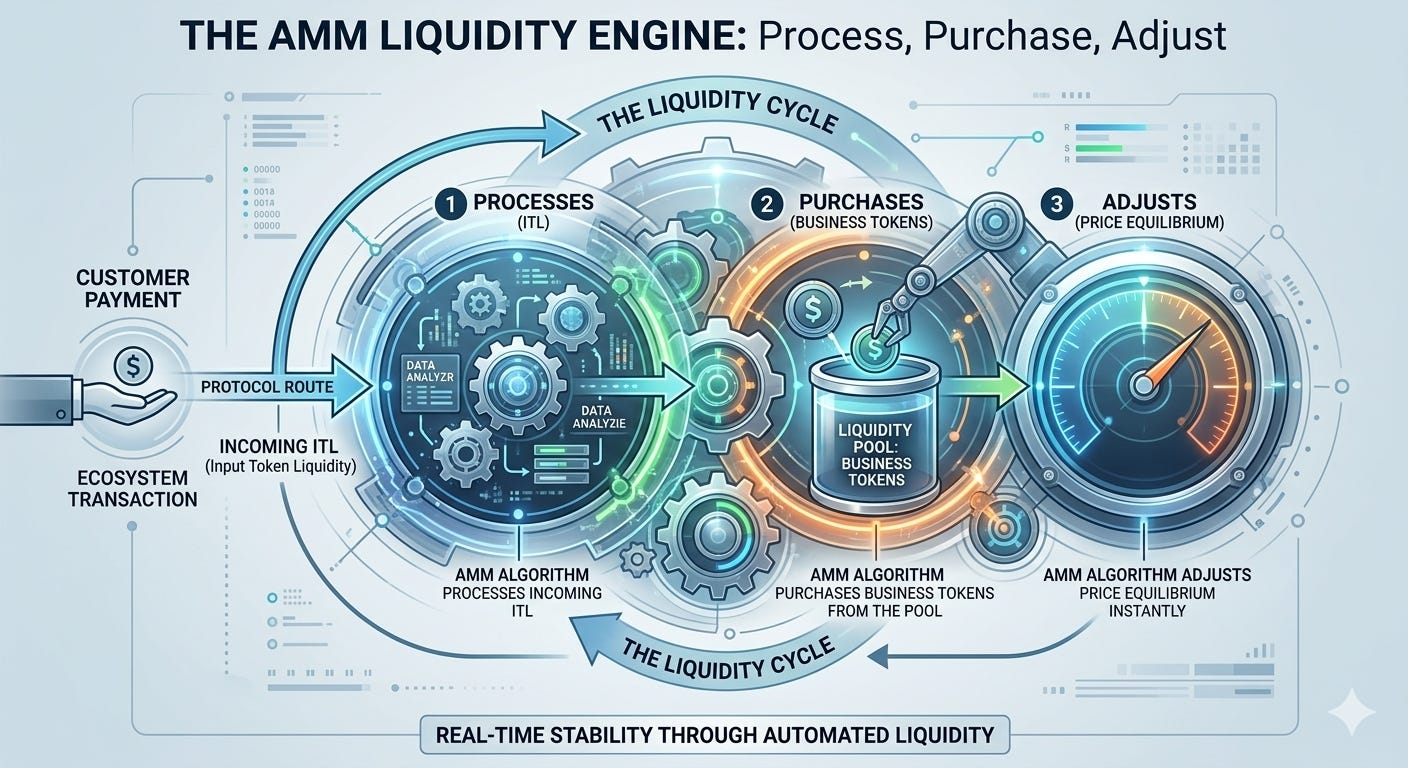
No board approval, no quarterly schedules, and no discretionary human layer.
The payment doesn’t just settle a commercial exchange; it simultaneously deepens the market infrastructure.
Commerce and capital infrastructure become the same event.
🔢 Not a Choice, But an Algorithmic Consequence
Corporate share buybacks have long been used to support equity prices, but they suffer from human limitations.
They are decisions — requiring management to choose when to act and how much to allocate. They are periodic, opaque, and often invisible until announced.
In InterLink, the “buyback” is no longer a decision. It is an algorithmic consequence.
The protocol routes value automatically, and the price adjusts in real-time. The discretionary layer — the space where human judgment and incentive misalignment typically reside — is removed entirely.
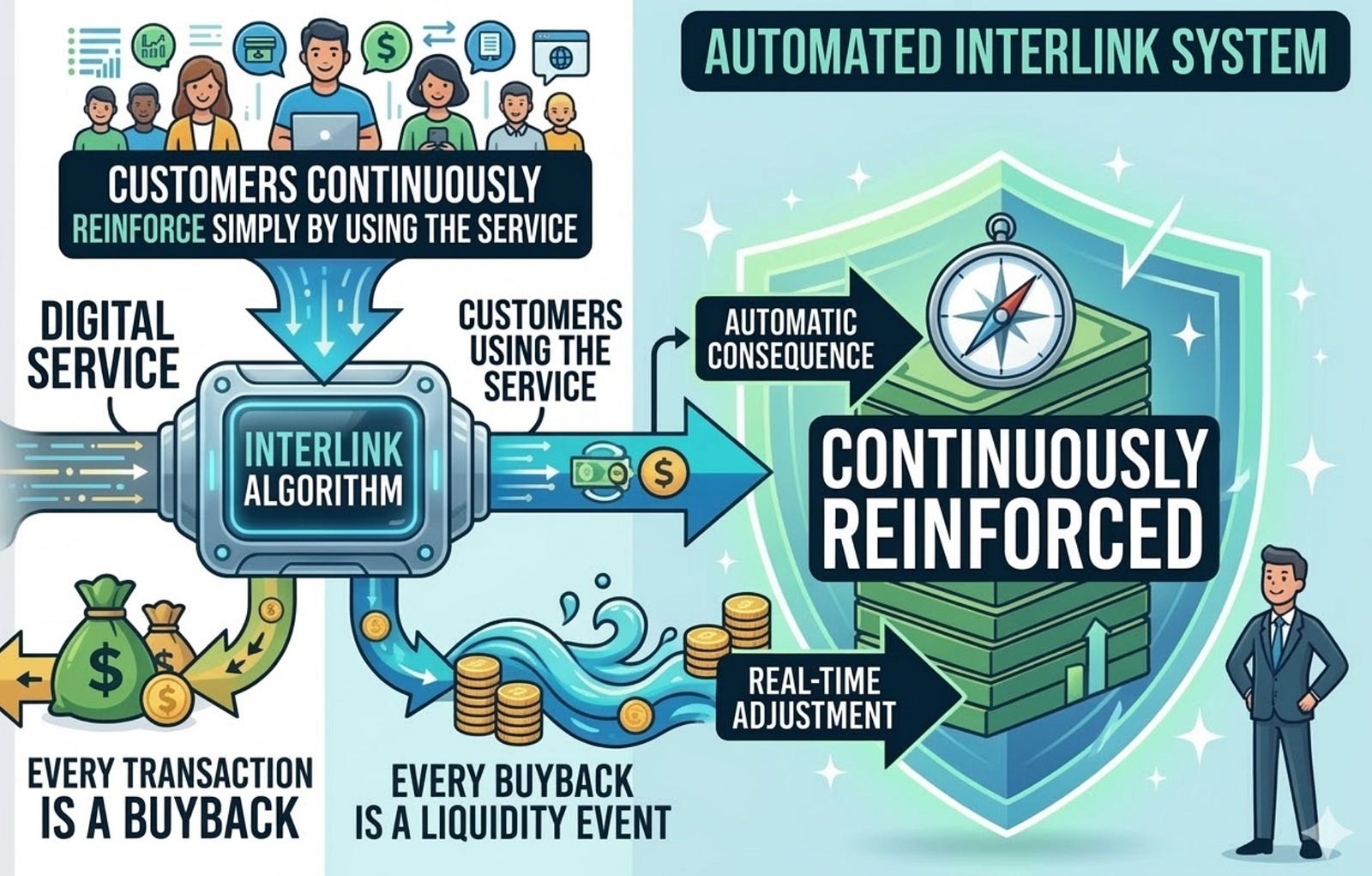
Every transaction is a buyback, and every buyback is a liquidity event.
The capital structure of a business is no longer something management periodically tends to; it is something customers continuously reinforce simply by using the service.
♾️ When Liquidity Becomes Endogenous
This shift carries a consequence that extends beyond market mechanics.
In traditional markets, liquidity is exogenous — it must be attracted and incentivized from the outside. The market is only as stable as the external capital willing to support it.
When sentiment shifts, liquidity withdraws, and the infrastructure collapses.
In the InterLink model, liquidity is endogenous. It does not originate from investor sentiment; it originates from commerce.
As long as the business transacts, the liquidity layer deepens.
Price discovery, in such a system, is no longer a negotiation between speculators about an uncertain future. It becomes a continuous measurement of a present reality.
💡 Done.T Insight
The stability of the market is no longer a function of how many speculators show up, but how many customers choose to buy a product.
🏦 The Settlement Layer Beneath Everything
There is a second structural effect that operates at the network level.
Because every tokenized business is paired with ITL, the transaction flows that strengthen individual pools also accumulate within the ITL settlement layer.
As the ecosystem scales — more merchants, more transactions, more pools — ITL does not simply participate in these events; it absorbs the aggregate of all of them.
What begins as a payment currency gradually becomes closer to a reserve asset — not by declaration, but by the mathematical accumulation of productive activity.
The individual business token reflects a single merchant’s performance; ITL reflects the pulse of the entire economy built on top of it.
🏁 The Paradigm Being Left Behind
Modern financial infrastructure was designed around a fundamental constraint:
the people who create economic value and the people who provide market liquidity are not the same, and their activities cannot be synchronized.
InterLink proposes that this constraint is no longer binding.
When settlement, liquidity, and payments run on the same protocol, the coordination problem dissolves. Commerce does not need to route through intermediaries to reach the capital layer.
The transaction is the capital event.
Liquidity, in this model, is not something markets must persuade external capital to provide.It is an architectural outcome — the inevitable byproduct of economic activity flowing through a system designed to capture it.
This is not a refinement of existing financial infrastructure. It is a different premise about what infrastructure is for.
Not a refinement.
A redefinition of financial infrastructure.
If you’d like to support my research, you may use my Interlink invitation code below. It also unlocks an instant mining boost ✚︎ Welcome Bonus for new users.
InterLink Referral Code: 905079415
Wallet Invitation Code : HSVZZPEJ (75% Commission Rebate)
❓ New to InterLink?
For a 🔗step-by-step guide, start with the pinned post at the top of my blog — Done.T Insight✨.
You don’t need capital. You just need five minutes.
📚 Done.T’s Related Insights
Zero-Capital Tokenization: How InterLink Creates Value Without Investment

Tokenization is one of those words that sounds important but rarely gets explained.
Bitcoin Revelation After Consensus: The Frozen Ledger Beneath the Agent Economy

Machines defined the boundary.
🔎 Search “Done.T Insight” on Google for real data & analysis.
Disclosure: This post contains referral links and reflects my personal research and experience. It is provided for informational purposes only and does not constitute financial advice.