

For most people, global reserve currencies feel permanent. The British pound once ruled global trade; today, the U.S. dollar dominates international finance.
This apparent permanence creates a dangerous illusion — that monetary power is stable, predictable, and self-sustaining.
History tells a very different story. Reserve currencies are not eternal. They rise, peak, and eventually give way — not because of ideology or political declarations, but because the underlying structure of power shifts.
Money Is Not Neutral — It Is a Structural Outcome
Money is often described simply as a medium of exchange. In reality, it is far more revealing:
a structural outcome that reflects where production is concentrated, where logistics are controlled, and where economic value is truly created.

A dominant currency does not emerge from policy ambition alone. It mirrors the gravitational center of the global economy — the place where people gather, production scales, and power consolidates.
This recurring pattern leads to a critical insight that history has never violated:
The currency of the place where people, power, and production concentrate is the one that gains monetary dominance.
Reserve currencies are not chosen. They emerge, and they persist only as long as the structure beneath them remains intact.
Three Industrial Eras — One Structural Rule
The First Industrial Era.
In the late 18th and early 19th centuries, the Industrial Revolution began in Britain. Steam engines, textile manufacturing, steel production, and unmatched maritime logistics transformed the country into the world’s primary production hub. British goods flowed across continents, and global trade routes gravitated toward British ports.
As production and logistics converged, London naturally evolved into the center of international finance. International trade increasingly settled in pounds, and with the formalization of the gold standard in 1821, the pound sterling crystallized as the world’s reference currency.
The country that produced the world’s goods inevitably produced the world’s money.
The Second Industrial Era.
By the late 19th century, the center of global production began to shift. The United States spearheaded the Second Industrial Revolution through electrification, steel and oil conglomerates, and a continent-wide railroad network. American industrial output soon surpassed Britain’s — but the decisive transmission came through conflict.
World War I and World War II devastated Europe’s infrastructure, while the United States emerged as both the world’s largest producer and its largest creditor. At that point, the dollar’s ascent was no longer a strategic choice. When production and finance converged within a single system, monetary dominance followed automatically.
The dollar did not replace the pound by design — it shadowed the shift in real economic power.
The Third Industrial Era.
From the 1970s onward, a new industrial phase unfolded. Computers, semiconductors, and the internet reshaped the global economy. At a glance, the world seemed multipolar: the U.S. led software, Japan dominated electronics, Germany excelled in precision manufacturing.
Yet monetary power did not fragment. It intensified. The end of the gold standard in 1971, the dollar’s central role in global energy markets, and the explosive growth of dollar-denominated financial markets reinforced a single conclusion: technology decentralized, but monetary gravity tightened around the dollar.
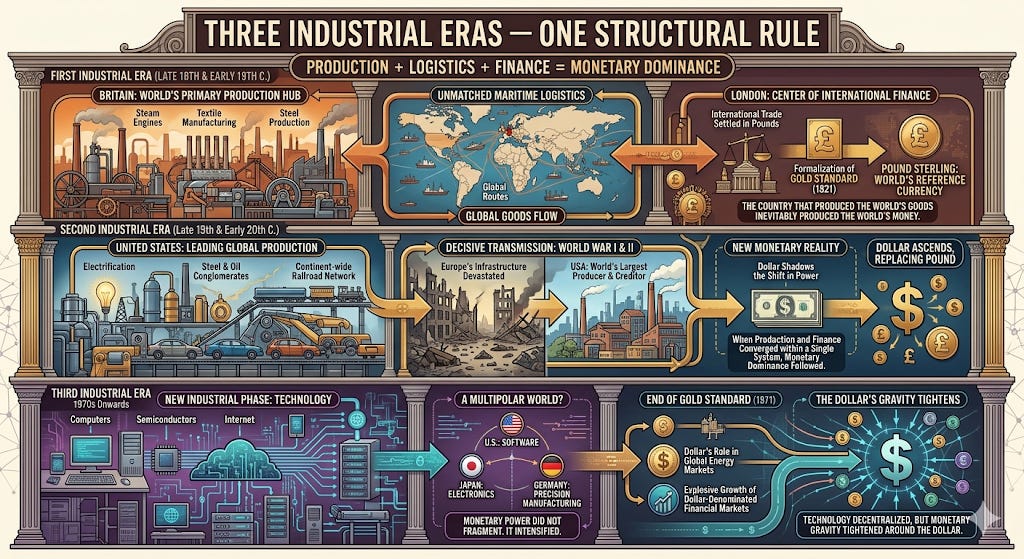
Across three industrial eras, the same rule held without exception.
Money never moved first. Reserve currencies are never the cause — they are always the result.
Money does not lead history.
It records it.
The Fourth Industrial Revolution — A Shift in Architecture
The Fourth Industrial Revolution did not begin with recent AI headlines. It began in the mid-2000s, when smartphones moved human activity — communication, labor, and coordination — onto always-connected platforms. For the first time, human time and attention became programmable inputs.
Value creation migrated from physical locations into software-mediated systems.
This was not merely technological progress. It marked the emergence of an entirely new production architecture.
A small group of global platforms— Google, NVIDIA among them —now exhibits characteristics once reserved for nation-states: user bases numbering in the billions, market capitalizations exceeding the GDP of developed nations, and integrated control over data, distribution, and monetization.
These entities no longer merely operate across borders. They function above them.
In the past, even the largest corporations operated within national frameworks. Today’s dominant platforms increasingly provide their own payment rails, identity layers, rules of participation, and closed economic ecosystems.
Corporations are no longer market participants — they are becoming market environments.
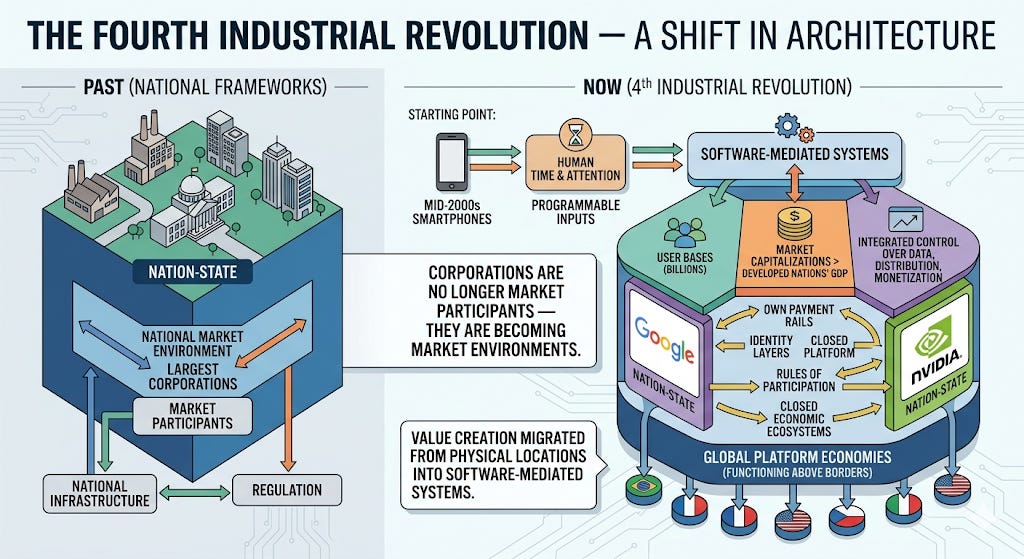
The structure has already shifted.
What follows the structure has not yet caught up.
Policy as Signal — The Recognition of a New Reality
Structural shifts are rarely acknowledged immediately. But when national policy begins to adjust, it signals a quiet recognition of a new gravitational center.
Two recent developments in the United States are particularly revealing. By defining stablecoins as regulated payment infrastructure, the GENIUS Act does not suppress digital settlement — it absorbs it. This represents an implicit admission that maintaining monetary relevance now requires a presence within digital layers.
Similarly, by elevating AI-driven production and coordination to a national priority, the Genesis Mission attempts to anchor the standards of digital organization before alternative centers emerge.
When the state that designed the dollar system moves to integrate digital payments and AI-driven production into its legal framework, it is not leading. It is responding.
Policy never leads.
It confirms.
The Structural Mismatch That Cannot Be Papered Over

Artificial General Intelligence accelerates this trajectory — but it does not create it. Even before full AGI arrives, economic systems are already being redesigned around non-human coordination: automated, algorithmic, executed at machine speed.
AGI systems operate continuously, transact programmatically, and coordinate value without nationality or physical residency.
This creates a structural mismatch that existing monetary systems cannot resolve by updating their interfaces or digitizing their rails.
The mismatch is not technical. It is architectural.
National currencies assume borders, human intermediaries, and legacy institutions. Digital production systems assume continuous, global, and algorithmic coordination.
These two sets of assumptions are not in tension — they are incompatible.
When production is no longer human-bound, money must operate at the same technical layer as the systems that produce value.
The question is not which currency adapts fastest. Money will not adapt to this system. A new system will define money. And in that system, currency will not lead. Qualification will.
Access will not be given.
It will be qualified.
In Part 2, we examine what that system must look like — and why the answer is not a currency at all, but a protocol.
🔗 [The Shift of Monetary Power— Part 2]
If you’d like to support my research, you may use my Interlink invitation code below. It also unlocks an instant mining boost ✚︎ Welcome Bonus for new users.
InterLink Referral Code: 905079415
Wallet Invitation Code : HSVZZPEJ (75% Commission Rebate)
❓ New to InterLink?
For a 🔗step-by-step guide, start with the pinned post at the top of my blog — Done.T Insight✨.
You don’t need capital. You just need five minutes.
📚 Done.T’s Related Insights
Why Proof of Personhood Makes You a Validator — No Hardware Required

For more than a decade, participating in blockchain validation meant clearing one of two very high bars.
Why Crypto's Definition of Alpha Is Quietly Changing

There is a rule that has governed crypto markets for the better part of a decade.
🔎 Search “Done.T Insight” on Google for real data & analysis.
Disclosure: This post contains referral links and reflects my personal research and experience. It is provided for informational purposes only and does not constitute financial advice.