

When InterLink launched, the headline feature was face verification. A real human, not a bot. That was the promise.
One year later, KYC is on the table.
And the first reaction from a lot of people was predictable. Why now? Why more? Isn’t face verification enough?
Wrong question.
They’re Not the Same Thing
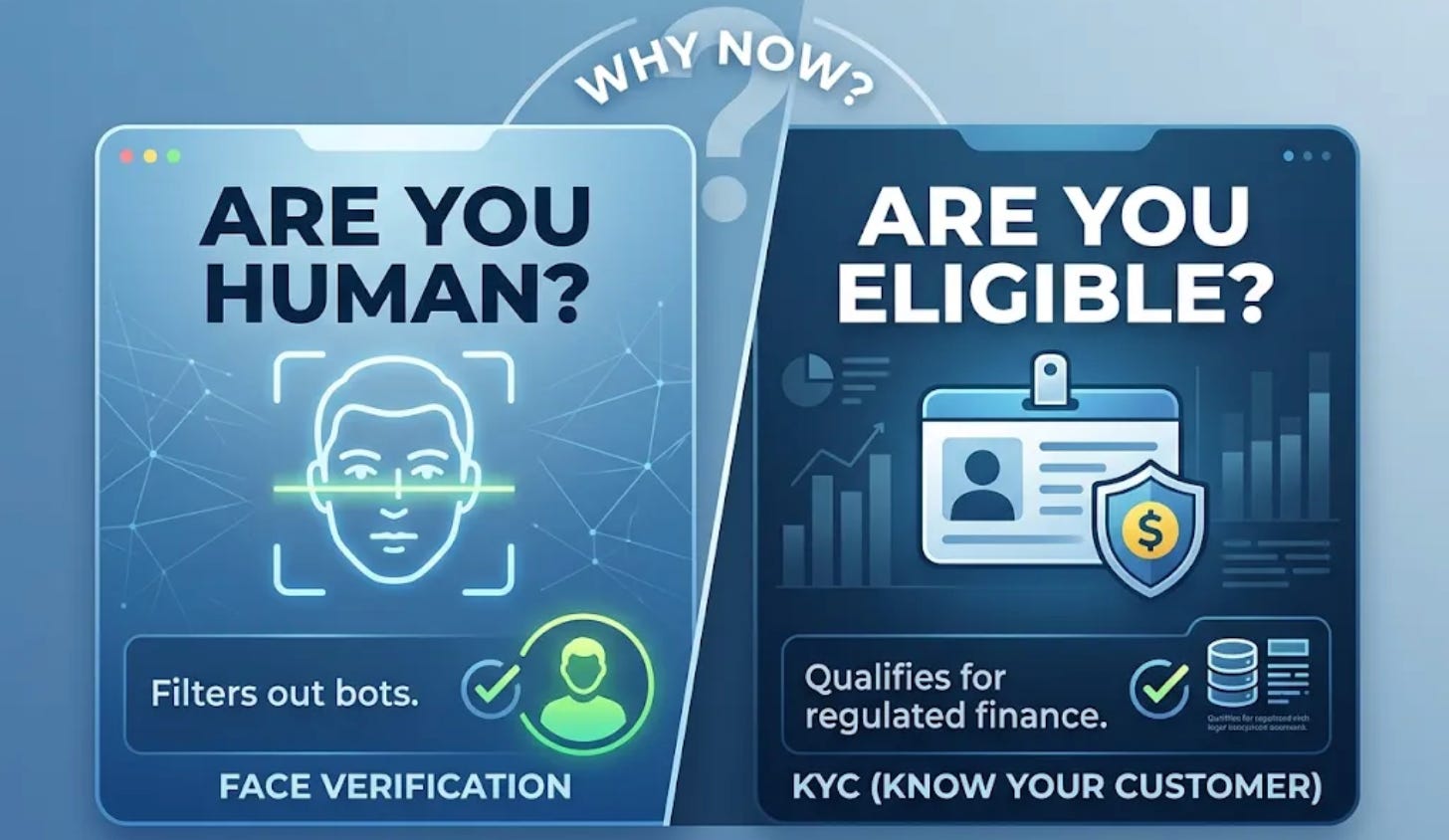
Face verification answers one question: are you human?
KYC answers a different one entirely: are you eligible?
One filters out bots. The other qualifies people for participation in a regulated financial system. These are not the same game. Confusing them is why the “why now” question misses the point completely.
InterLink didn’t add KYC because face verification failed. It added KYC because the destination changed — or more precisely, because the destination became visible.
February 24. The Declaration.
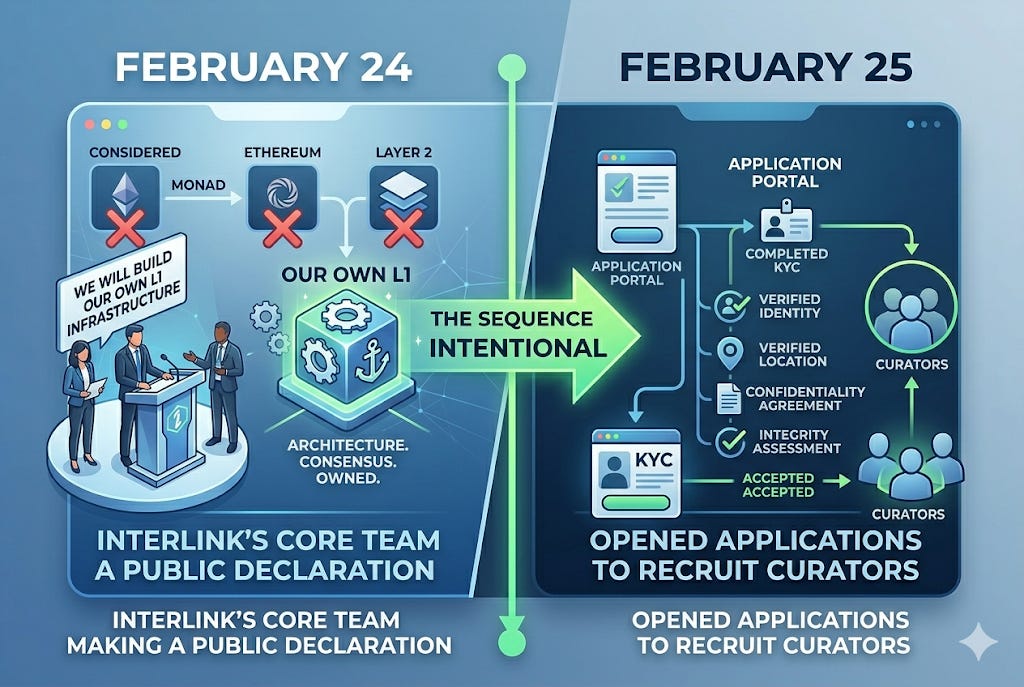
On February 24, InterLink’s core team made something public that most people scrolled past.
They had considered building on Ethereum mainnet. They had looked at high-performance chains like Monad. They had explored launching a Layer 2.
They chose none of it.
Instead, they decided to build their own blockchain infrastructure from the ground up. Architecture. TPS optimization. Consensus design. Validator economics. All of it, owned.
The reasoning was blunt: if you build on someone else’s foundation, you don’t control what happens to it. One Ethereum upgrade can make 90% of dependent ecosystems technically irrelevant overnight. InterLink had watched that happen to others. They weren’t going to rent.
They were going to build.
February 25. The Next Day.
Here’s where it gets interesting.
The day after the Layer 1 declaration — not a week later, not a month later, the next day — InterLink opened applications to recruit Curators. The individuals who would directly verify users. The requirements came from the InterLink Foundation itself: completed KYC, verified identity and location, strict confidentiality, demonstrated integrity in decision-making.
One day.
L1 declaration on the 24th.
KYC infrastructure moving on the 25th.
That’s not a coincidence. That’s a sequence. And sequences have intent.
Why Build From Scratch? The Threat Is Already Here.
To understand why InterLink needed to own its foundation, you have to look at what’s coming — and what’s already arrived.
In February, InterLink announced the formation of a dedicated quantum-resistant research team. Not a roadmap item. Not a future consideration. A team, already being assembled, while the private mainnet was still being built.
By April, the external signals had caught up. Google had already warned that current cryptographic standards may not hold before 2029, and that projects need to begin implementing quantum-resistant solutions now. InterLink had started months earlier.
Then came Anthropic’s Mythos. A model so capable at identifying software vulnerabilities that Anthropic restricted its release entirely — not because it didn’t work, but because it worked too well.
In recent weeks alone, Mythos identified a 27-year-old bug in OpenBSD and a 16-year vulnerability in widely used video software that 5 million automated test runs had missed. Anthropic’s own words: AI models have reached a level where they surpass most experts at finding and exploiting vulnerabilities. General release was not an option.
Quantum computing is the threat on the horizon. AI-powered exploitation is the threat right now.
A network built on borrowed infrastructure cannot respond to either. You cannot retrofit quantum resistance into someone else’s consensus layer. You cannot redesign validator economics you don’t own.
This is why InterLink builds its own foundation. Not ambition. Necessity.
So What Is KYC, Really?
With that context, the V5.0 Curator System looks completely different.
KYC in InterLink is not an identity checkpoint. It is a qualification layer. The Curator System was described as the core feature of V5.0 — designed to protect real users, eliminate bot activity, and serve as the gateway to verified asset ownership.
But the deeper signal is in the compliance framework attached to it. The verification process is built to meet three specific standards: AMLO, the Anti-Money Laundering and Counter-Terrorist Financing Ordinance of Hong Kong. The SFC VASP License from the Securities and Futures Commission. And FATF Recommendation 15, the Travel Rule.
These are not security features. These are the entry requirements for regulated financial infrastructure — payments, real-world assets, institutional participation.
Face verification proved you were human.
KYC proves you are eligible.
And eligibility is what the destination requires.
The Point
InterLink didn’t add KYC because something went wrong.
The Layer 1 declaration on February 24 was not a technical announcement. It was a destination announcement. And the moment the destination was declared, everything that destination requires had to follow.
KYC followed the next day. Not eventually. The next day.
That timing is the answer to every question about why now, why more, why this.
Face verification was the beginning. KYC is the destination made visible. And InterLink knew exactly where it was going before most people even understood what they had built.
The question was never what they added.
It was always why — and when they decided.
If you’d like to support my research, you may use my Interlink invitation code below. It also unlocks an instant mining boost ✚︎ Welcome Bonus for new users.
InterLink Referral Code: 905079415
Wallet Invitation Code : HSVZZPEJ (75% Commission Rebate)
❓ New to InterLink?
For a 🔗step-by-step guide, start with the pinned post at the top of my blog — Done.T Insight✨.
You don’t need capital. You just need five minutes.
📚 Done.T’s Related Insights
The Compliance Code Hidden Inside InterLink's Verification System

InterLink calls it verification. The regulatory references inside it suggest something else entirely.
Layer 1 Is Not a Tech Choice. It's a Trust Choice.

Blockchain has always been a story about trust. The question has never been whether a network can process transactions — the question is what the network ultimately trusts, and why.
🔎 Search “Done.T Insight” on Google for real data & analysis.
Disclosure: This post contains referral links and reflects my personal research and experience. It is provided for informational purposes only and does not constitute financial advice.