

Most protocol upgrades follow a familiar pattern. New features ship, users adapt, the network expands. The infrastructure moves first, and participation follows.
InterLink V5.0 inverts that sequence entirely.
Version 5.0 does not simply add features to an existing system. It establishes a condition — a specific state that must be achieved before the next phase of the network can exist.
The Curator System, the KYC pipeline, the Visa Card integration, the Verified ITLG conversion pathway: these are not independent upgrades. They are components of a single architectural decision about what has to happen before InterLink’s L1 chain goes live.
That decision is not technical. It is structural. And it changes what V5.0 actually is.
What V5.0 Actually Changed
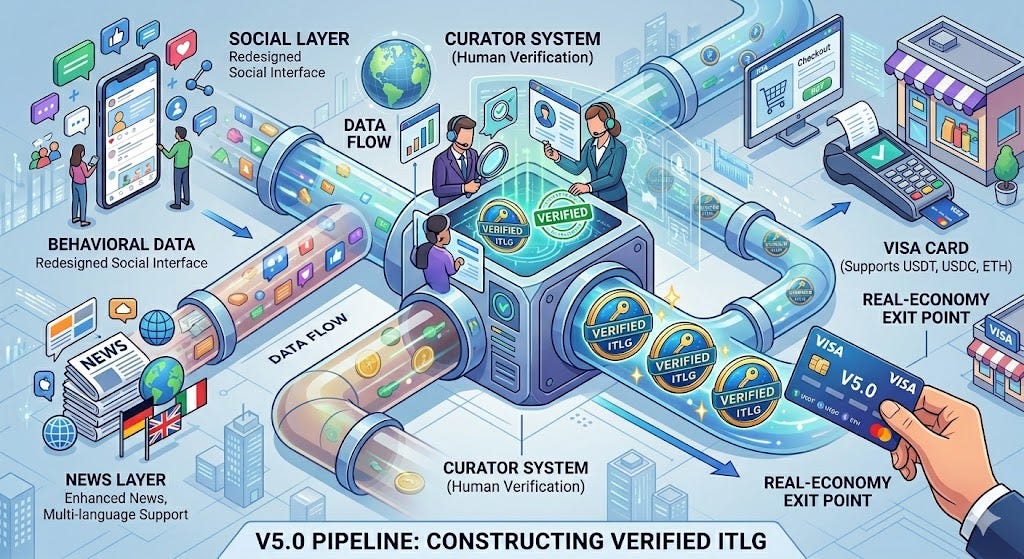
On the surface, V5.0 delivers a redesigned social interface, enhanced news features with multi-language support, a Curator System for human verification, and a Visa Card that supports USDT, USDC, and Ethereum for daily payments.
Read individually, these look like feature additions. Read together, they reveal a different logic.
The social layer generates behavioral data.
The news layer increases engagement consistency.
The Curator System converts behavioral data into verified identity.
The Visa Card gives verified identity a real-economy exit point.
Each component feeds the next.
V5.0 is not a feature release — it is the construction of a pipeline, and Verified ITLG is what moves through it.
Why Verified ITLG Is the Center of Gravity
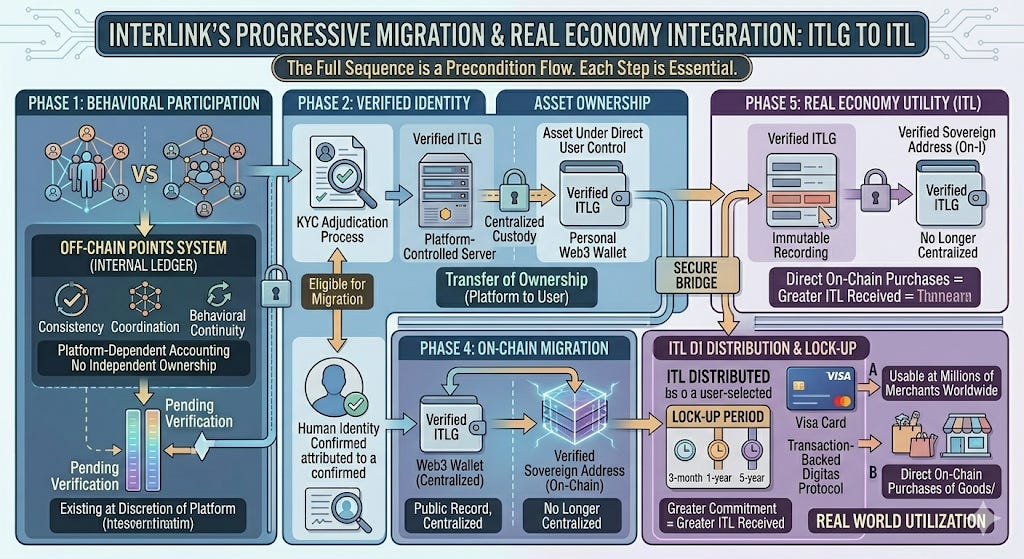
ITLG began as an off-chain point system — a participation record internal to InterLink’s ecosystem.
Verified ITLG is something categorically different. It is ITLG that has passed through the KYC adjudication process, attributed to a confirmed human identity, and made eligible for on-chain migration.
That distinction matters more than it appears. Off-chain points are a platform’s internal accounting. They exist at the discretion of the platform and carry no independent ownership claim.
Verified ITLG, once migrated to a personal Web3 wallet, becomes an asset under direct user control — immutably recorded, publicly verifiable, and no longer dependent on centralized custody.
The migration is not a reward distribution. It is a transfer of ownership from the platform’s ledger to the user’s sovereign address.
This is where most systems stop.
InterLink begins.
Verified ITLG on-chain can be distributed into ITL, with allocation proportional to the lock-up period the user selects. The longer the commitment, the greater the ITL received.
ITL then enters the real economy through the Visa Card integration, usable at millions of merchants worldwide, and through the Transaction-Backed Digital Assets Protocol, which enables direct on-chain purchases of goods and services.
The full sequence is: behavioral participation → verified identity → asset ownership → on-chain migration → real economy utility.
Every step is a precondition for the next. None can be skipped.
The Trigger: People First, Then the Chain
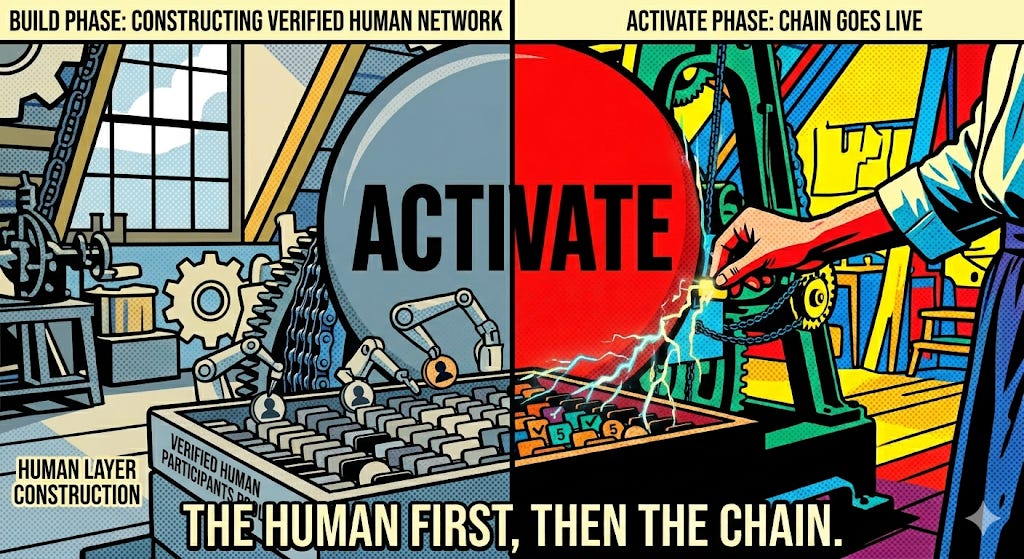
Here is where the architecture becomes genuinely unusual. When Verified ITLG begins migrating on-chain for eligible accounts, the InterLink L1 chain will officially go live.
The chain does not launch on a scheduled date. It does not activate when a technical threshold is met. It activates when a sufficient base of verified human participants exists to receive assets on it.
This is not a conventional blockchain launch sequence.
In standard protocol design, infrastructure precedes adoption — the chain launches, and users are invited to join.
InterLink has reversed the dependency. The human layer must be constructed first. Verification must be completed. Assets must be ready to migrate. Only then does the chain exist in any meaningful operational sense.
The implication is architectural. InterLink is not building a blockchain and then finding users for it. It is building a verified human network and then activating the blockchain as the infrastructure that serves it.
The L1 is not the foundation.
The verified user base is.
What Comes After the Trigger
Once the L1 goes live, the structure that follows is already defined.
External enterprises — traditional companies operating outside the crypto ecosystem — will be able to migrate to the L1 chain and issue their own crypto assets, supported by the InterLink Foundation.
This enterprise asset layer is designed to produce three things simultaneously:
an early economy driven by verified ITLG holders.
an environment where enterprises can anchor value against ITL at an early stage.
a long-term value foundation for ITL backed by real assets on the underlying chain.
The sequencing is deliberate.
Verified users arrive first, establishing the network’s economic base. Enterprises follow, anchoring institutional value against a user base that has already been legally adjudicated. ITL’s long-term value is then sustained not by speculation, but by the real asset activity accumulating on the chain beneath it.
This is the structure that V5.0 is building toward. Not a token launch. Not a feature upgrade.
A sequenced activation — where each layer depends on the one before it, and the entire architecture waits for one thing to move first.
The people.
Then the chain.
If you’d like to support my research, you may use my Interlink invitation code below. It also unlocks an instant mining boost ✚︎ Welcome Bonus for new users.
InterLink Referral Code: 905079415
Wallet Invitation Code : HSVZZPEJ (75% Commission Rebate)
❓ New to InterLink?
For a 🔗step-by-step guide, start with the pinned post at the top of my blog — Done.T Insight✨.
You don’t need capital. You just need five minutes.
📚 Done.T’s Related Insights
Recovery Comes First — Why Structural Reorganization Precedes Liquidity Competition

Something significant always happens before a major liquidity event. Systems reorganize quietly, through structural shifts rather than spectacle.
Zero-Capital Tokenization: How InterLink Creates Value Without Investment

Tokenization is one of those words that sounds important but rarely gets explained.
🔎 Search “Done.T Insight” on Google for real data & analysis.
Disclosure: This post contains referral links and reflects my personal research and experience. It is provided for informational purposes only and does not constitute financial advice.