

Most crypto networks ask one question at the door: are you here?
Presence is enough. Show up, connect a wallet, claim a reward. The logic is permissionless by design — inclusion is the default, exclusion is the exception.
InterLink V5.0 asks a different question entirely: do you qualify?
The distinction sounds subtle. It isn’t.
Three Layers, One Verdict
The verification process InterLink has published is not an onboarding flow. It is a three-layer adjudication system — and the sequence is not arbitrary.
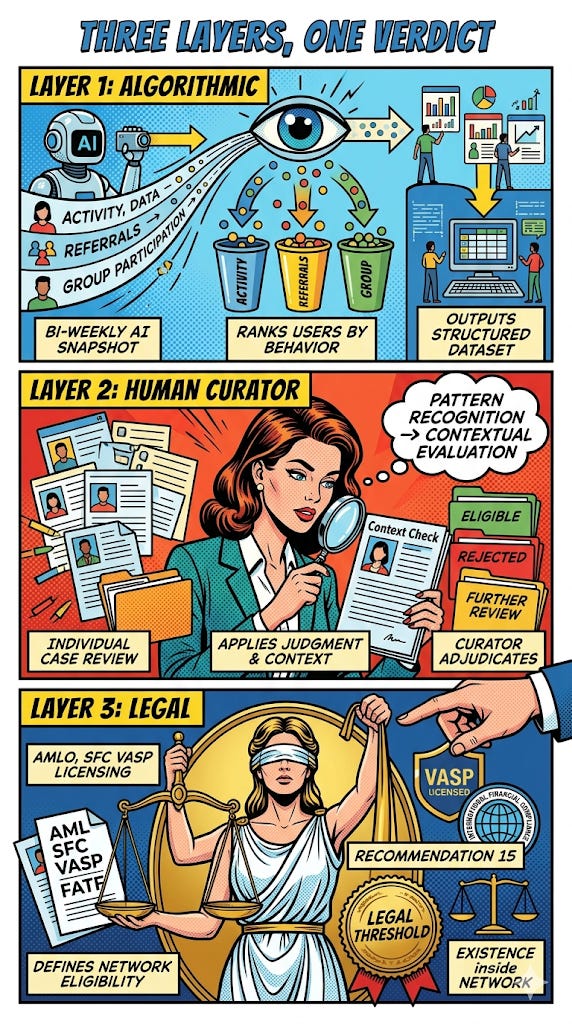
The first layer is algorithmic. Every two weeks, an AI snapshot ranks users by behavioral metrics: activity consistency, referrals, group participation. This layer does not make decisions. It produces a ranked dataset — a structured input for what comes next.
The second layer is human. Curators process each case individually, applying judgment to what the algorithm has surfaced. This is where pattern recognition gives way to contextual evaluation. The AI identifies; the Curator adjudicates.
The third layer is legal. Underlying both is a compliance framework that most crypto projects never approach: AMLO, SFC VASP licensing, and FATF Recommendation 15. This layer does not evaluate behavior. It defines the legal threshold a participant must clear to exist inside the network at all.
Three Layers, One Verdict
The verification process InterLink has published is not an onboarding flow. It is a three-layer adjudication system — and the sequence is not arbitrary.
The first layer is algorithmic. Every two weeks, an AI snapshot ranks users by behavioral metrics: activity consistency, referrals, group participation. This layer does not make decisions. It produces a ranked dataset — a structured input for what comes next.
The second layer is human. Curators process each case individually, applying judgment to what the algorithm has surfaced. This is where pattern recognition gives way to contextual evaluation. The AI identifies; the Curator adjudicates.
The third layer is legal. Underlying both is a compliance framework that most crypto projects never approach: AMLO, SFC VASP licensing, and FATF Recommendation 15. This layer does not evaluate behavior. It defines the legal threshold a participant must clear to exist inside the network at all.
Each layer is the precondition for the next.
Without ranked behavioral data, Curator judgment has no structured basis. Without Curator adjudication, legal compliance cannot be attributed to a specific, verified individual.
The three layers are not parallel processes.
They are a sequential credentialing pipeline.
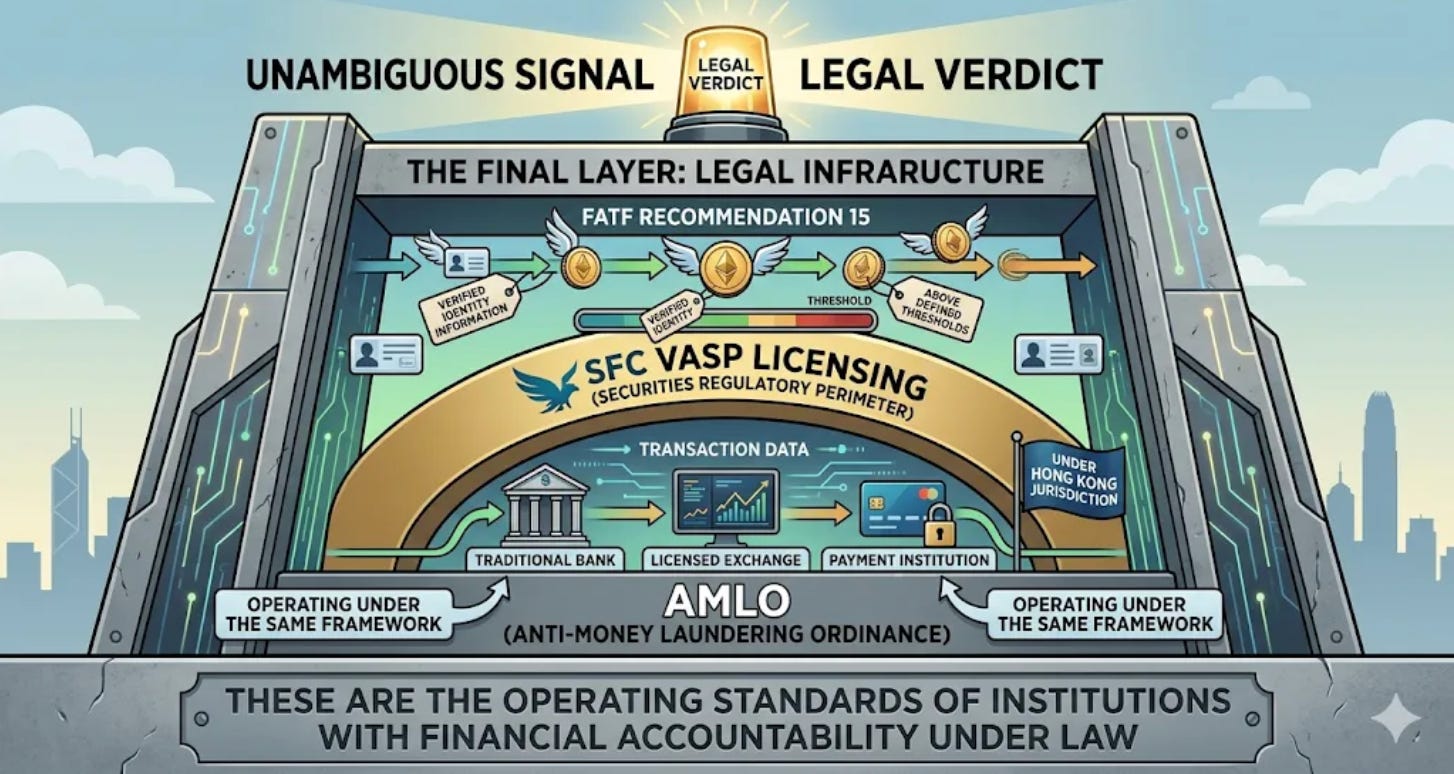
That last layer is where the signal becomes unambiguous. AMLO is not a crypto-native concept. It is the legal infrastructure of a regulated financial system — the same framework that governs banks, licensed exchanges, and payment institutions operating under Hong Kong jurisdiction.
SFC VASP licensing places a project inside a securities regulatory perimeter. FATF Recommendation 15 mandates that financial institutions transmit verified identity information alongside transactions above defined thresholds.
These are not aspirational compliance gestures. They are the operating standards of institutions that hold financial accountability under law.
When InterLink states that every verified user must meet these standards, the mistake is to read this as distribution. It isn’t. It is enrollment — into a regulated financial network with legal counterparty definitions.
What Users Are Actually Optimizing For
This reframes user behavior at a structural level. In a conventional token system, users optimize for accumulation — more tokens, earlier, at lower cost. The queue changes that calculus entirely.
Users inside InterLink’s system are no longer optimizing for accumulation. They are optimizing for eligibility. Behavioral metrics, referral activity, consistency signals — these are not paths to a larger reward. They are criteria in an adjudication process.
The user who understands this begins building a compliance profile. The user who doesn’t — who continues approaching the system with accumulation logic, treating metrics as levers for extracting more tokens rather than signals of genuine participation — is not simply disadvantaged.
They are structurally misaligned with what the system is selecting for.
In a ranked adjudication process, misalignment is not penalized gradually. It compounds. Every cycle, the gap between those optimizing for eligibility and those optimizing for extraction widens.
That shift in user orientation is not incidental to the system. It is what the system is designed to produce.
A Narrower Door
Passing the queue is not about earning tokens early. It is about becoming a recognized counterparty — an entity whose identity, behavioral history, and transaction capacity have been adjudicated against institutional standards.
The ITL token a verified user receives is not a reward for participation. It is the instrument issued to a cleared network participant.
A token reward system produces holders. A regulated onboarding process produces accountable participants.
One of those foundations can support enterprise asset issuance and Visa-integrated payment infrastructure. The other cannot.
InterLink is not building a longer queue. It is building a narrower door — deliberately, and with legal architecture behind it.
It is not a limitation of the system.
It is the constraint that defines it.
If you’d like to support my research, you may use my Interlink invitation code below. It also unlocks an instant mining boost ✚︎ Welcome Bonus for new users.
InterLink Referral Code: 905079415
Wallet Invitation Code : HSVZZPEJ (75% Commission Rebate)
❓ New to InterLink?
For a 🔗step-by-step guide, start with the pinned post at the top of my blog — Done.T Insight✨.
You don’t need capital. You just need five minutes.
📚 Done.T’s Related Insights
Zero-Capital Tokenization: How InterLink Creates Value Without Investment

Tokenization is one of those words that sounds important but rarely gets explained.
People First, Then the Chain: InterLink V5.0 and the Logic of the Trigger

Most protocol upgrades follow a familiar pattern. New features ship, users adapt, the network expands. The infrastructure moves first, and participation follows.
🔎 Search “Done.T Insight” on Google for real data & analysis.
Disclosure: This post contains referral links and reflects my personal research and experience. It is provided for informational purposes only and does not constitute financial advice.