

Eleven days. Three events. One question worth asking.
Was this a calendar coincidence — or a deliberate sequence designed to be read in order?
Most ecosystems announce partnerships before they have infrastructure to support them. Most chains publish benchmarks before anyone is actually using them.
InterLink did something different in April 2026. It built the case in reverse — users first, proof second, rails third.
That order is not incidental. It is the argument.
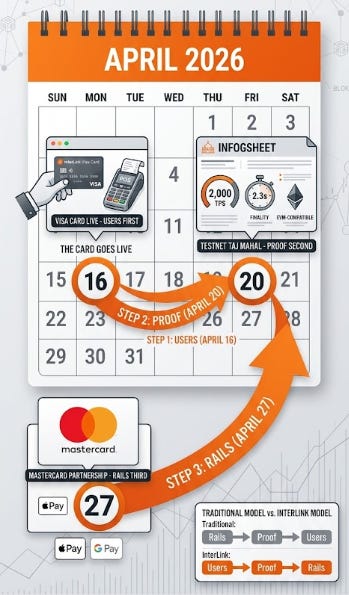
April 16: The Card Goes Live
On April 16, InterLink Visa Card officially launched. Not a preview. Not a waitlist. A live product, operating across real merchant networks.
This matters less as a milestone and more as a precondition.
A payment-grade chain cannot be claimed in theory. It has to be demonstrated under load, by real users, in real commerce environments. The Visa Card created that condition before any benchmark was published.
Usage preceded proof. That order is deliberate.
April 20: The Chain Earns Its Credentials
Four days later, InterLink Testnet Taj Mahal went live — and the numbers it produced were not presented as aspirational targets. They were earned results.
2,000 TPS. Sub-2.3 second finality. Deterministic. EVM-compatible. Average fee from $0.0002 in ITL. Each figure maps directly to what payment infrastructure actually requires.
Not what blockchain enthusiasts reward — what merchants, settlement systems, and compliance frameworks demand before they will touch a chain.
The critical distinction is finality.
Solana achieves roughly 0.15 seconds of block time — but finality is probabilistic, and the network carries a documented history of reorgs and outages. Ethereum reaches economic finality in approximately 12.8 minutes. TRON settles in roughly 57 seconds.
InterLink’s deterministic finality under 2.3 seconds means something precise: once a transaction is committed, it cannot be reversed.
No reorg window. No probabilistic waiting period. The settlement is final in the same operational sense that a wire transfer is final.
That is not a performance metric. That is a qualification.
When a merchant accepts payment, they are not asking how fast the block was produced. They are asking whether the settlement can be recalled.
Deterministic finality answers that question with a hard no — and that answer is what separates a chain built for payments from one that merely processes transactions quickly.
The Taj Mahal benchmark was not InterLink telling the market it was ready. It was InterLink showing the market what ready actually looks like.
April 27: The Rails Confirm the Chain
Seven days after the testnet launch, InterLink announced a partnership with Mastercard.
The InterLink Mastercard will support Apple Pay, Google Pay, and POS payment methods, accepted across platforms including Amazon, Uber, PayPal, Shopee, TikTok, and YouTube. Transaction limits reach $50,000 USD.
This is not a crypto card in the conventional sense.
Conventional crypto cards convert tokens to fiat at the point of sale and operate within the tolerances of probabilistic settlement. Mastercard’s network operates differently — it demands interoperability with global compliance infrastructure, predictable settlement timing, and transaction finality that institutional counterparties can rely on.
The Mastercard partnership does not confirm InterLink’s ambition. It signals alignment with the specific technical conditions the testnet had just demonstrated.
Whether that alignment holds under sustained real-world volume remains the test that only mainnet can answer.
But the sequence is notable: the credential arrived before the partnership, not after.
Deterministic finality is not a feature a chain adds for Mastercard. It is a baseline the infrastructure requires.
A chain that cannot guarantee irreversible settlement cannot be trusted at the payment layer of global commerce.
InterLink’s Taj Mahal benchmark arrived seven days before this announcement. Not as coincidence. As credential.

What the Sequence Proves
Read the three events in isolation and each looks significant on its own terms. Read them in sequence and something else becomes visible.
April 16 established that real users were already operating in real payment environments. April 20 demonstrated that the chain beneath those users met the technical standards payment infrastructure requires. April 27 signaled that a global financial network was prepared to integrate on the basis of that demonstration.
Users before proof. Proof before partnership.
That order is not how most blockchain projects operate. Most announce the partnership, then build the product, then discover the infrastructure wasn’t ready.
InterLink ran the sequence forward — and through Phase 1, the sequence held.
A payment-grade chain is not defined by throughput alone. It is defined by the combination of deterministic settlement, real-world adoption, and institutional integration.
Each condition is necessary. None is sufficient alone.
In eleven days, InterLink assembled all three. That is what the calendar is actually showing.
If you’d like to support my research, you may use my Interlink invitation code below. It also unlocks an instant mining boost ✚︎ Welcome Bonus for new users.
InterLink Referral Code: 905079415
Wallet Invitation Code : HSVZZPEJ (75% Commission Rebate)
❓ New to InterLink?
For a 🔗step-by-step guide, start with the pinned post at the top of my blog — Done.T Insight✨.
You don’t need capital. You just need five minutes.
📚 Done.T’s Related Insights
From ATV to Collateral: Could ITL Back a Real USDT Lending Product?

The question itself is worth asking.

🔎 Search “Done.T Insight” on Google for real data & analysis.
Disclosure: This post contains referral links and reflects my personal research and experience. It is provided for informational purposes only and does not constitute financial advice.