

InterLink calls it verification. The regulatory references inside it suggest something else entirely.
Three standards are embedded in the process: AMLO, the SFC VASP License, and FATF Recommendation 15. These are not decorative. They are directional.
Each one belongs to a specific legal architecture — and that architecture has a specific address.
Hong Kong.
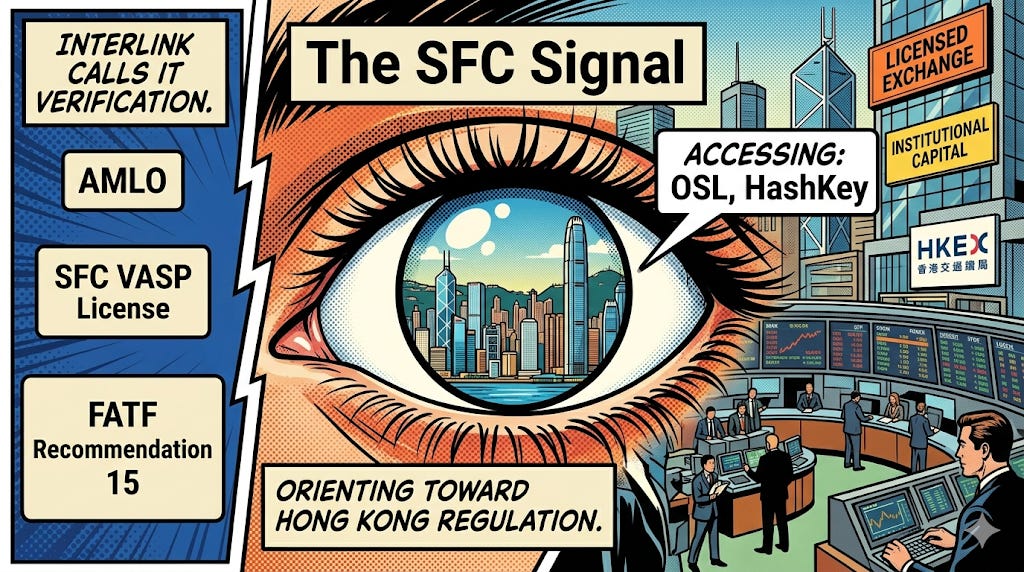
The SFC Signal
The Securities and Futures Commission is not a universal body. It governs virtual asset service providers operating within Hong Kong’s jurisdiction.
When a blockchain project embeds SFC VASP alignment into its user verification layer, it is not following general best practices. It is orienting itself toward a specific regulatory environment — and the exchanges that operate inside it.
OSL. HashKey.
The licensed trading venues that institutional capital in Asia actually uses.
These platforms do not list freely. They are gated, regulated, and selective.
To reach them, the asset — and the ecosystem behind it — must meet the standards from the ground up. InterLink is building those standards into the ground floor.
For a regulated desk evaluating this asset, that matters immediately. It reduces onboarding friction. It pre-clears a layer of counterparty risk that would otherwise require separate due diligence.
The compliance work that most projects defer, InterLink has front-loaded into its user base.
What FATF Recommendation 15 Actually Means Here
FATF R15 — the Travel Rule — requires that virtual asset transactions above a threshold carry sender and receiver identification data.
Most retail-focused projects avoid it entirely. It adds friction. It adds cost. It slows the onboarding experience that drives token distribution numbers.
InterLink is requiring it of its users.
A network where every verified participant already meets Travel Rule standards is a network that institutional liquidity providers can enter without triggering their own compliance problems.
The friction is absorbed by the infrastructure — front-loaded, not deferred — so that when capital flows in, the path is already clear.
This is not how a project designs itself for a retail token event. This is how a project designs itself for institutional integration.
The Asian Market Sequence
Hong Kong is not the destination.
It is the credential.
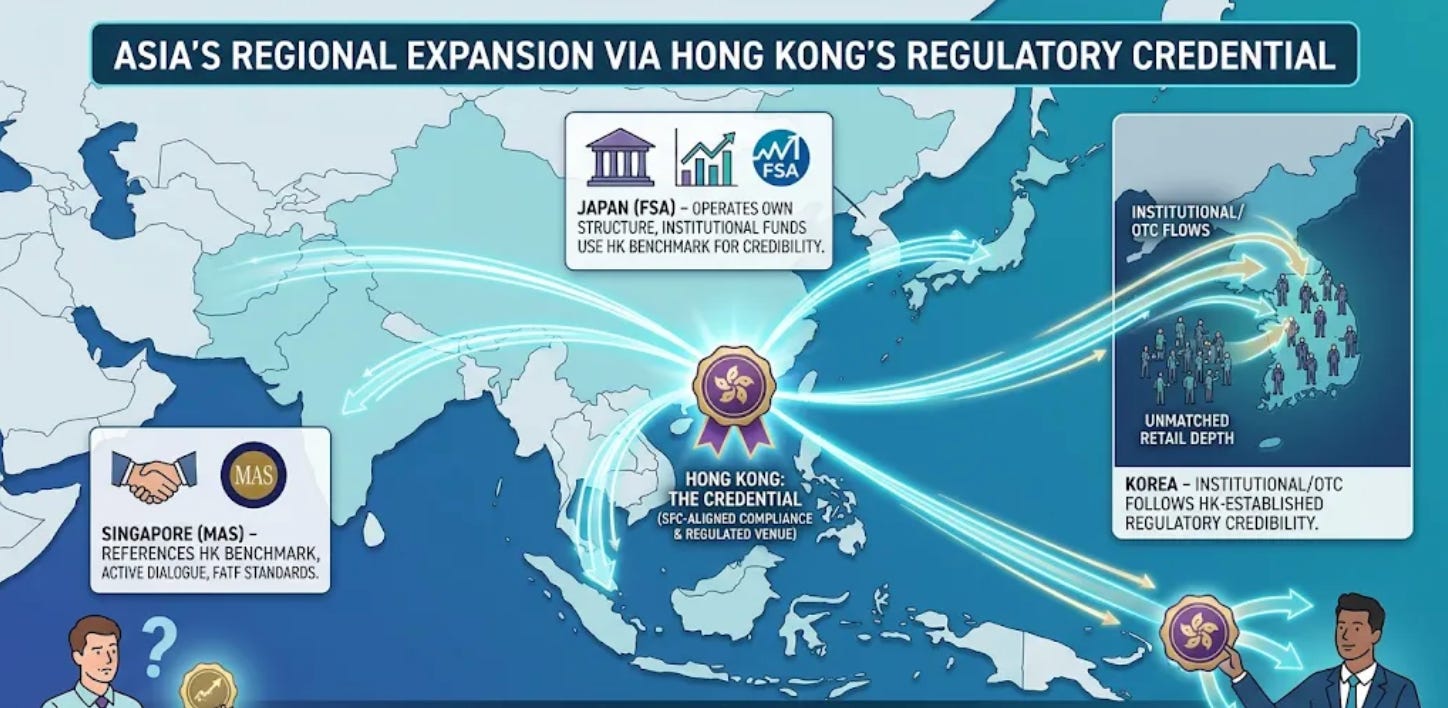
Once an asset carries SFC-aligned compliance and establishes presence on a regulated Hong Kong venue, the regional expansion logic follows the capital flows.
Singapore’s MAS references FATF standards and maintains active dialogue with the SFC framework. Japan’s FSA operates its own structure, but institutional funds across Asia use Hong Kong as the regional benchmark for what is considered credible.
Korea is a different case.
Its retail depth is unmatched in Asia. But institutional and OTC flows in Korea increasingly follow assets that have established regulatory credibility elsewhere first. An asset arriving from Hong Kong’s regulated tier enters a different conversation than one arriving from an unregulated launch.
The sequence is not arbitrary. Hong Kong first means subsequent markets receive an asset that already carries a compliance narrative. That changes the question from “is this legitimate?” to “how do we access this?”
Listing for Legitimacy vs Listing for Liquidity
Most crypto projects list for liquidity. The goal is volume — fast, visible, loud. Binance, OKX, Bybit. High traffic, high exposure, high volatility. The listing is the event.
A different category of project lists for legitimacy. The goal is positioning — access to capital channels that require compliance as a precondition. This path is slower. It is also structurally harder to replicate.
The difference is not just timing. It is what the listing means to the capital that follows it. Retail volume can be generated by a marketing cycle. Institutional allocation requires a compliance record.
One fades. The other compounds.
InterLink’s verification structure suggests it is building for the second path.
Liquidity can be manufactured.
Legitimacy cannot.
What to Watch
A compliance framework inside a KYC queue is not the same as a VASP license issued. Named exchange partnerships have not been publicly confirmed.
The distance between structural alignment and structural achievement is real.
What the verification system reveals is design and intent. The regulatory references are too specific to be accidental — AMLO is Hong Kong law, SFC VASP is a Hong Kong license, FATF R15 is the standard Hong Kong’s regulated venues require. But design is not execution.
The confirmation will come from elsewhere: SFC licensing documentation, named partnerships within Hong Kong’s regulated exchange tier, OTC or institutional liquidity channel disclosures, compliance infrastructure that extends beyond user-level KYC into the protocol layer itself.
If those appear, the structure visible in the verification system becomes a roadmap that was legible before the market understood it.
If they don’t, this remains architecture without an address.
The Verdict
The system is pointing somewhere.
It hasn’t arrived.
InterLink’s verification system is not an onboarding queue. It is a compliance posture — one oriented toward a specific regulatory jurisdiction, a specific class of exchange, and a specific category of capital.
Whether that posture becomes infrastructure depends entirely on execution that has not yet been confirmed.
The structure is visible. The direction is readable. The licensing is not yet in hand.
Until it is, this is design. Not infrastructure.
The difference is everything.
Source:


If you’d like to support my research, you may use my Interlink invitation code below. It also unlocks an instant mining boost ✚︎ Welcome Bonus for new users.
InterLink Referral Code: 905079415
Wallet Invitation Code : HSVZZPEJ (75% Commission Rebate)
❓ New to InterLink?
For a 🔗step-by-step guide, start with the pinned post at the top of my blog — Done.T Insight✨.
You don’t need capital. You just need five minutes.
📚 Done.T’s Related Insights
Qualification, Not Participation: What InterLink's Verification Process Actually Builds

Most crypto networks ask one question at the door: are you here?
Why You Don't Need to Be a Crypto Expert to Participate in Tokenization

We are moving toward a world where real economic activity runs on blockchain infrastructure.
🔎 Search “Done.T Insight” on Google for real data & analysis.
Disclosure: This post contains referral links and reflects my personal research and experience. It is provided for informational purposes only and does not constitute financial advice.