
Wall Street Is Watching the RWA Market. InterLink Is Building It.
The $2 trillion race has a missing layer. InterLink is trying to be it.

BlackRock sees it. McKinsey quantified it. Fidelity, Franklin Templeton, and a growing roster of institutional giants have all positioned Real World Asset tokenization as the defining investment frontier of this decade.
The numbers are not modest — McKinsey projects the RWA tokenization market could reach $2 trillion by 2030.
And yet, for all the institutional attention, something is conspicuously missing from the conversation.
No one is talking about the restaurant on the corner. The family-run clinic. The logistics company with thirty employees and fifteen years of operating history. The businesses that make up 99% of the global economy — and have zero access to the capital markets that institutions are now rushing to tokenize.
This is not an oversight.
It is a structural blind spot.
Institutions are looking at RWA as an asset class to capture. What they are not building is the infrastructure that allows real economic activity — the kind happening in small businesses every day — to become tokenizable in the first place.
That distinction matters more than it appears.
From Airdrop to Architecture
InterLink did not begin with a $2 trillion vision statement. It began with free token distributions — the most accessible entry point in Web3. Skeptics saw a familiar pattern. Another community-building exercise dressed in blockchain language.
But something shifted quietly.
The language coming out of InterLink has changed. Transaction-Backed Digital Asset Protocol. Public SDKs. The ITLX Business Token Exchange. These are not community project terms. This is infrastructure company language — the kind used by teams that are not trying to attract users, but trying to build rails that others run on.
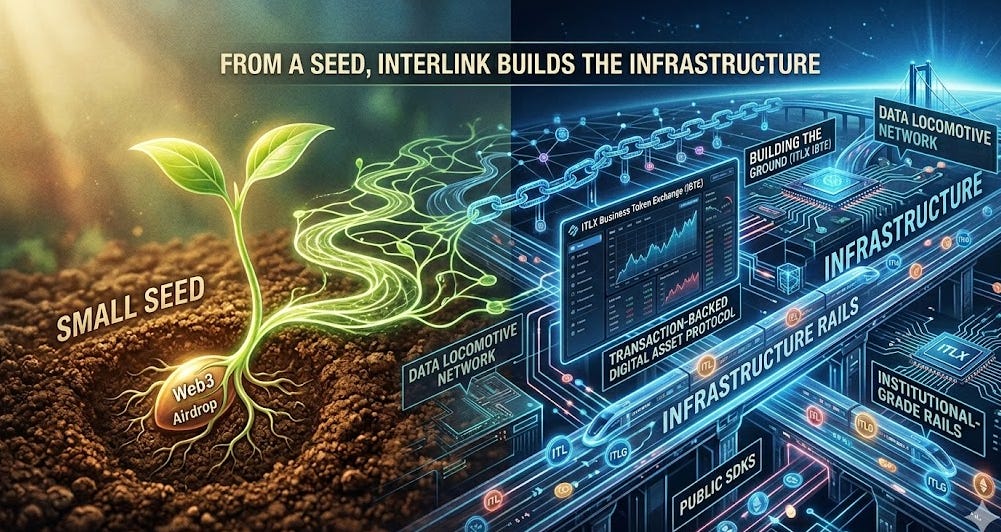
The trajectory reads differently when you stop looking at where InterLink started and start looking at what it is becoming.
The Problem No One Is Solving
Here is what the institutional RWA narrative gets right: tokenization removes friction. It enables fractional ownership, 24/7 tradability, and near-instant settlement.
These are genuine structural improvements over legacy financial infrastructure.
Here is what it gets wrong by omission: tokenization of what, exactly?
BlackRock’s tokenized fund holds US Treasury bills. The institutional conversation is almost entirely about tokenizing assets that already exist within the formal financial system — bonds, real estate funds, commodities. What remains untouched is the vast layer of economic value that never made it into that system at all.
A traditional IPO costs millions of dollars, takes years, and requires regulatory infrastructure that most small businesses cannot access. The result is not a flaw — it is a design.
Capital markets were built for capital. SMEs were not the intended users.
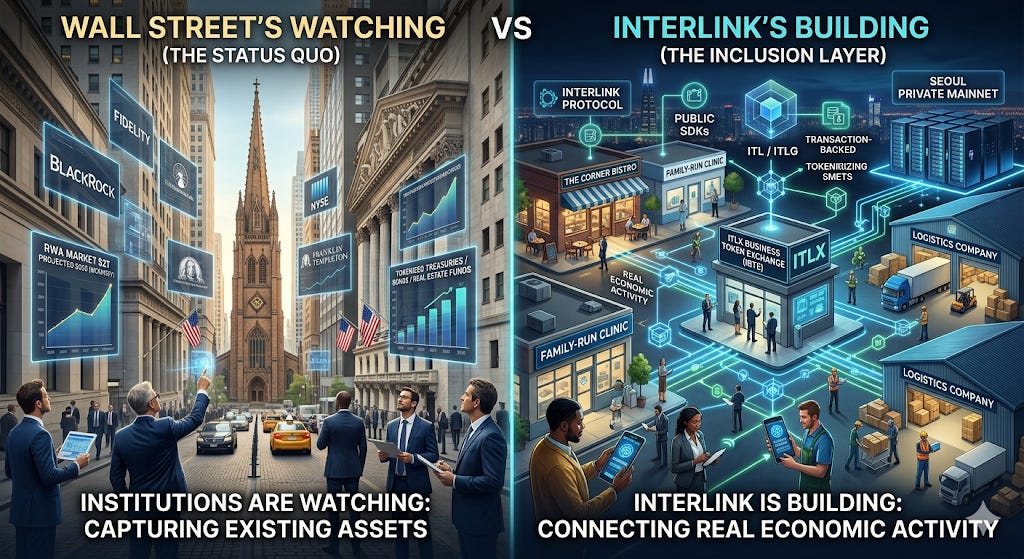
InterLink’s premise is that this design is outdated. Not wrong for its time — outdated for this one.
Watching vs. Building
BlackRock is positioning to capture value from a tokenized future. InterLink is trying to construct the conditions under which that future becomes real for businesses that currently have no path to it.
These are not the same activity.
One requires identifying which existing assets are best suited for tokenization and structuring products around them. The other requires building the protocol layer that allows a business — any business, not just one that can afford Goldman Sachs — to create a digital asset backed by its own economic activity.
The Seoul Private Mainnet is not a marketing milestone. It is the moment when that protocol layer stops being a whitepaper and starts being infrastructure that can be tested against real conditions.
The long-term frame is thousands of SMEs listed on the ITLX Business Token Exchange (IBTE) — a dedicated marketplace for business-backed digital assets, powered by InterLink’s native assets ITL and ITLG.
But the near-term signal is simpler: InterLink is building something that the institutions watching this market are not building. They are waiting for the infrastructure to exist.
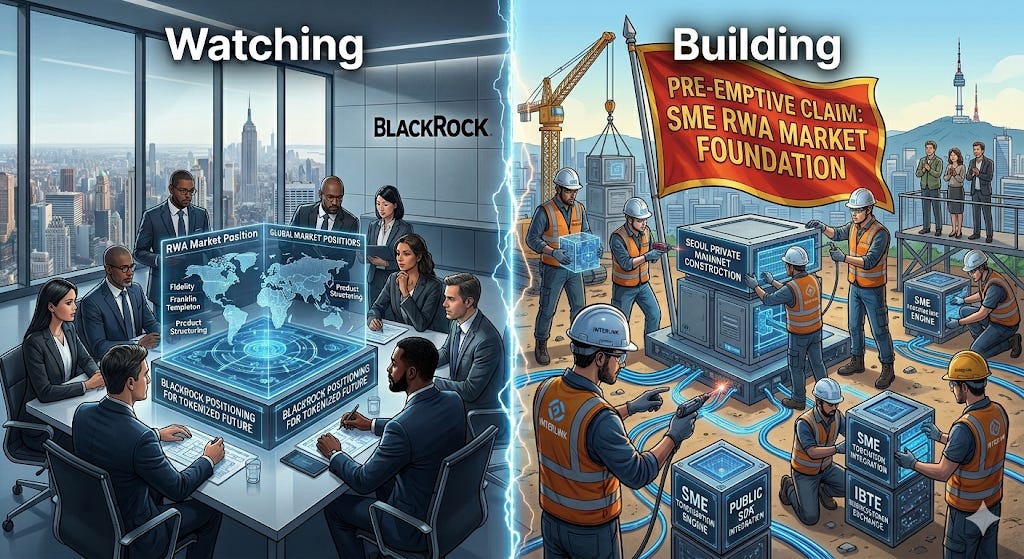
InterLink is positioning itself as the infrastructure.
The Gap Is the Opportunity
Institutional interest in RWA validates the direction. It does not fill the space.
Between BlackRock’s tokenized treasury products and the corner business that will never see a term sheet, there is an enormous execution gap.
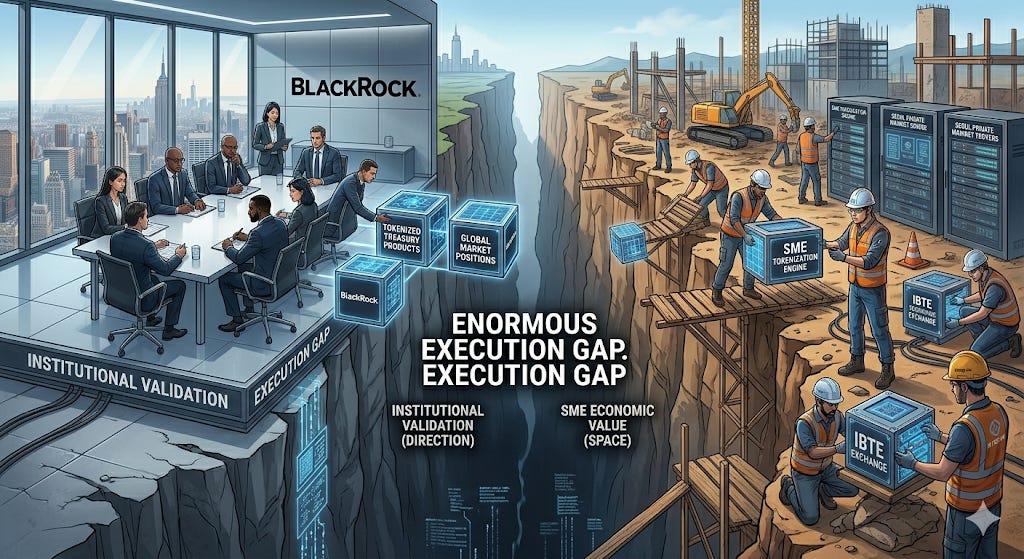
The technology to bridge it is emerging. The regulatory clarity — while incomplete — is improving. The demand from SMEs for alternative capital access is not a future hypothesis; it has been a persistent reality for decades.
What has been missing is a credible attempt to build the connective layer.
InterLink started with airdrops. It is now describing transaction-backed digital assets, public SDKs, and a dedicated business token exchange. That is not a pivot. That is a project revealing what it was always trying to become.
The institutions are watching the RWA market.
InterLink is trying to build the ground it stands on.
If you’d like to support my research, you may use my Interlink invitation code below. It also unlocks an instant mining boost ✚︎ Welcome Bonus for new users.
InterLink Referral Code: 905079415
Wallet Invitation Code : HSVZZPEJ (75% Commission Rebate)
❓ How to Join InterLink
The InterLink Sign-up Guide: Secure Your Digital Assets in 5 Minutes

The world moves in complex ways, but growing your assets doesn’t have to.
You don’t need capital. You just need five minutes.
📚 Done.T’s Related Insights
Why You Don't Need to Be a Crypto Expert to Participate in Tokenization

We are moving toward a world where real economic activity runs on blockchain infrastructure.
Before Mainnet, InterLink Needed a Place to Spend ITL. Now It Has One.

When the InterLink Foundation announced LinkersMap as the first dApp incubated and invested in within the InterLink ecosystem, the headline read like a product launch.
🔎 Search “Done.T Insight” on Google for real data & analysis.
Disclosure: This post contains referral links and reflects my personal research and experience. It is provided for informational purposes only and does not constitute financial advice.