

The Source of Asymmetric Wealth
The largest fortunes in modern technology share a pattern that is easy to miss in real time, but obvious in retrospect.
They rarely come from applications.
They come from the ground beneath applications.
Bitcoin didn’t generate wealth through wallets or exchanges. It generated wealth by becoming the foundational layer of trustless settlement — the Proof-of-Work infrastructure that everything else was eventually built on top of.
Ethereum didn’t win because of any single dApp. It won because it became the programmable substrate for an entire financial ecosystem. Nvidia didn’t simply make graphics cards. It quietly became the irreplaceable compute layer for the AI era before most people understood what that meant.
Applications change. Infrastructure compounds.
This is why early infrastructure positions tend to produce disproportionate returns. Once a layer becomes embedded in how systems operate, the cost of replacing it — technically, economically, socially — becomes prohibitive.
The window to challenge it closes. And the value of holding that position grows with every new participant who builds on top of it.
This is the lens through which Bitcoin Revelation deserves to be examined. Not as a speculative asset, but as a potential infrastructure layer. The question is whether that potential is real — or whether it only appears that way from a distance.

The Three Conditions That Actually Matter
History offers a useful filter. True infrastructure platforms don’t just grow. They satisfy three structural conditions that separate them from everything that merely looks like infrastructure during its early stages.
Network effects must become self-reinforcing. Infrastructure becomes powerful not when it is useful, but when every new participant makes it more useful for everyone else.
Bitcoin miners don’t just secure their own investment — they secure the entire network, which attracts more miners, which makes the network harder to attack, which attracts more capital. This compounding dynamic is what separates infrastructure from technology. Without it, a protocol remains sophisticated but fragile.
The position must become effectively irreplaceable. TCP/IP didn’t win because it was the best possible internet protocol. It won because enough systems were built on top of it that replacing it became structurally impractical.
Visa didn’t maintain dominance purely through innovation. It maintained dominance because the cost of rebuilding its network from scratch was simply too high. Ethereum faces constant competition, yet its developer ecosystem and smart contract standards have created switching costs that most challengers underestimate. Real infrastructure doesn’t just solve problems. It becomes the default assumption inside which problems are solved.
Capital must have a persistent reason to concentrate. Bitcoin attracted capital because it offered trustless settlement in a world that had no prior solution. Ethereum attracted capital because it made financial logic programmable at scale. Nvidia attracted capital because the demand for AI training compute appeared essentially bottomless. In each case, capital followed a structural economic problem — not a narrative. Without that underlying demand, even technically impressive protocols remain perpetually at the speculation stage.
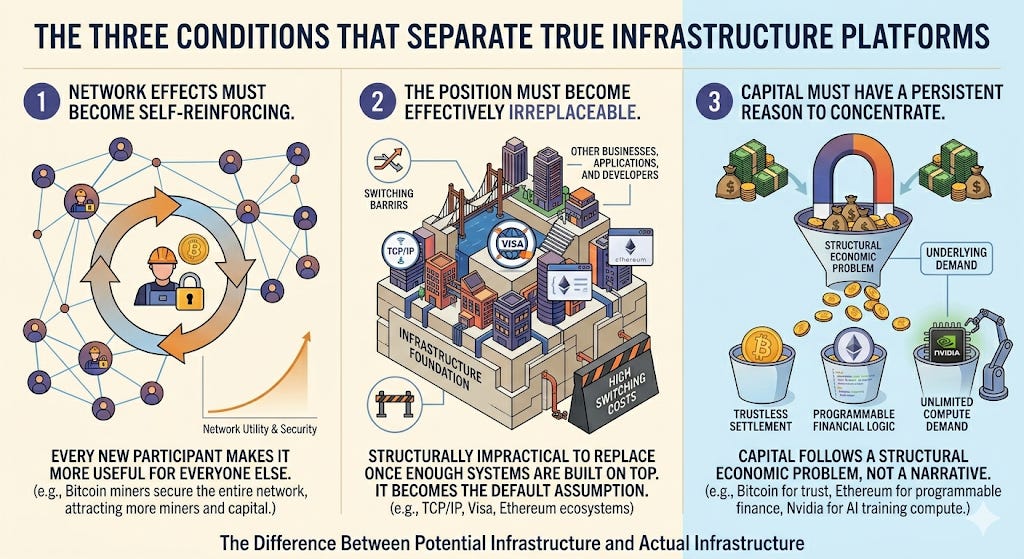
These three conditions are the difference between potential infrastructure and actual infrastructure. The gap between them is where most projects quietly disappear.
Where Revelation Currently Stands
Honestly stated: Revelation is in a hypothesis stage.
Its narrative is genuinely compelling. An experimental Proof-of-Work model. Machine participation as a first-class concept. A strong conceptual story about what comes after human-centric blockchain design. These are not trivial ideas, and the people who find them compelling are not wrong to do so.
But narrative is not infrastructure.
Narrative is the beginning of a case, not the conclusion.
The relevant question isn’t whether Revelation’s story sounds like infrastructure. It’s whether the conditions described above are being built, systematically, in a way that would eventually make the answer to “do other systems require this?” something other than no.
Right now, that answer is no.
What follows is an attempt to map what would have to change for that to become yes.
🔜 In Part 2, we map the possible tech tree that Revelation would need to follow if it were ever to evolve from an experiment into real infrastructure.
Source code referenced in this analysis:
🔗 Github repository
If you’d like to support my research, you may use my Interlink invitation code below. It also unlocks an instant mining boost ✚︎ Welcome Bonus for new users.
InterLink Referral Code: 905079415
Wallet Invitation Code : HSVZZPEJ (75% Commission Rebate)
❓ New to InterLink?
For a 🔗step-by-step guide, start with the pinned post at the top of my blog — Done.T Insight✨.
You don’t need capital. You just need five minutes.
📚 Done.T’s Related Insights
Why You Don't Need to Be a Crypto Expert to Participate in Tokenization

We are moving toward a world where real economic activity runs on blockchain infrastructure.
InterLink Macro What-If: From Crypto Experiment to Financial Infrastructure

In the volatile landscape of digital assets, a fundamental law persists: Price follows hype, but Capital follows structure.
🔎 Search “Done.T Insight” on Google for real data & analysis.
Disclosure: This post contains referral links and reflects my personal research and experience. It is provided for informational purposes only and does not constitute financial advice.