

There is a category difference between a protocol that adds features and a protocol that begins operating. Feature releases expand what a system can do. Operational releases change what the system is.
Version 5.1 is the second kind.
The announcements are straightforward on the surface — a Private Mainnet launch, vITLG migration, 2FA security, staking mechanics, wallet redesign, KYC optimization.
Read as a feature list, it looks like a routine upgrade cycle. Read as a sequence, it tells a different story.
Every item on that list is a precondition for the one that follows. V5.1 is not expanding the system. It is activating it.

The Chain Exists Now
The Private Mainnet launch is the structural event that makes everything else in V5.1 coherent.
Until a chain exists, migration is a concept. Staking is a promise. The Visa Card is an interface without a settlement layer beneath it. The Private Mainnet is not a milestone on a roadmap —
it is the physical substrate that turns every downstream component from planned to possible.
What matters here is the sequencing logic InterLink has maintained from the beginning. The chain did not launch first and wait for users. Users were verified first, assets were credentialed, and the chain activates as the infrastructure that serves a participant base that already exists.
The Private Mainnet going live is not InterLink announcing that it has built something. It is InterLink confirming that the conditions required to build it have been met.
That is a different kind of launch. Most chains open to anyone and hope adoption follows. This one opens to a verified population that was assembled before the chain existed.
Why 2FA Appears at This Exact Moment
Two-factor authentication is easy to read as a security feature. It is not. It is a declaration about what kind of asset is now moving through the system.
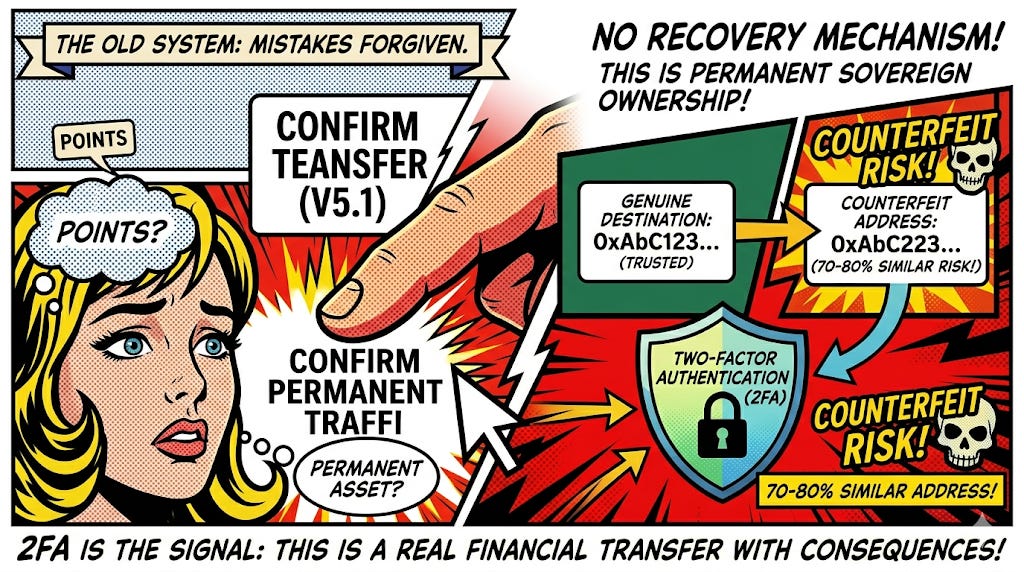
The migration of Verified ITLG onto the InterLink chain is irreversible. There is no recovery mechanism. There is no reversal. If a fraudulent wallet address replaces the designated destination — and these counterfeit addresses can appear 70 to 80 percent similar to the original — the transferred tokens are permanently gone.
This is the risk profile of a real financial transfer, not a points system adjustment.
2FA does not appear in V5.1 because the system became more sophisticated. It appears because the moment of transfer is now the moment of permanent, sovereign asset ownership.
Every migration request requires a second authentication layer that only the legitimate account holder can clear. Even partial unauthorized access cannot execute the transfer without passing that layer.
This is the point where most users realize: this is no longer a system that can forgive mistakes.
The security architecture is calibrated to the irreversibility of what it protects. That calibration is the signal.
When a system introduces this level of transfer security, it is acknowledging that the assets crossing that threshold carry consequences that cannot be undone.
What 2FA Is Actually Protecting
The question worth asking is not how 2FA works. It is what, specifically, it is protecting.
The InterLink Visa Card answers that question directly. Once Verified ITLG migrates on-chain and converts into ITL, that ITL is spendable at more than 50 million Visa and Mastercard merchants across 170 countries. It integrates with Apple Pay and Google Pay. It functions as a daily payment instrument across any platform that accepts Visa.
This is the asset that 2FA is guarding at the migration threshold.
The protection is not over a speculative token balance sitting in a portfolio. It is over the purchasing capacity of a verified participant in a global payment network.
The distinction is not minor.
A token that trades on an exchange and a token that pays for goods at a merchant counter are not the same instrument — not in terms of utility, not in terms of consequence, and not in terms of what it means to lose access to one.
InterLink introduced 2FA at the exact moment vITLG becomes that second kind of instrument. The timing is not coincidental. It is structurally precise.
What V5.1 Is Actually Saying
Taken together, the Private Mainnet, the migration security layer, and the Visa Card integration are not three separate announcements. They are three components of a single architectural statement.
The chain is live. Assets are moving. They cannot be retrieved if lost. And their destination is the real economy.
V5.1 is not preparing InterLink for something that comes later. It is the transition from a system that was being built into a system that is operating.
The features are not additions. They are the indicators that the weight of this network has changed — and that the infrastructure around asset ownership has been calibrated to match it.
The stakes are different now.
V5.1 is how InterLink is saying so.
source:

If you’d like to support my research, you may use my Interlink invitation code below. It also unlocks an instant mining boost ✚︎ Welcome Bonus for new users.
InterLink Referral Code: 905079415
Wallet Invitation Code : HSVZZPEJ (75% Commission Rebate)
❓ New to InterLink?
For a 🔗step-by-step guide, start with the pinned post at the top of my blog — Done.T Insight✨.
You don’t need capital. You just need five minutes.
📚 Done.T’s Related Insights
Zero-Capital Tokenization: How InterLink Creates Value Without Investment

Tokenization is one of those words that sounds important but rarely gets explained.
Why You Don't Need to Be a Crypto Expert to Participate in Tokenization

We are moving toward a world where real economic activity runs on blockchain infrastructure.
🔎 Search “Done.T Insight” on Google for real data & analysis.
Disclosure: This post contains referral links and reflects my personal research and experience. It is provided for informational purposes only and does not constitute financial advice.