

Most crypto investors have already made a choice they don’t fully recognize as a choice.
They stake, or they hold. Sometimes both. The logic feels different — one generates yield, the other waits for appreciation — but the underlying assumption is identical: income is a function of time.
You commit capital, endure the wait, and hope the market eventually delivers a verdict on your patience.
For most of crypto’s history, this was the only rational framework available. In an era dominated by speculative hype and “Ponzi-nomics,” simply being “in the game” was enough.
But infrastructure changes, and so does the market’s appetite for substance.
When the game shifts from pure speculation to structural value, it doesn’t announce itself with a trumpet; it simply becomes available to those paying attention.
⏳ Two Models, One Passive Assumption
Staking is elegant in its simplicity.
Lock tokens, earn emissions, and compound. The yield feels active because it accumulates visibly in your dashboard, but the mechanism remains fundamentally passive.
You are not making decisions about capital; you are making a decision about time — specifically, how much of it you are willing to surrender in exchange for a protocol’s programmed inflation.
Holding operates on a different timeline but shares the same logic: a bet on external demand.
You own the asset and wait for the global market to agree with your valuation. Conviction is the primary input; price appreciation is the desired output. The investor’s role is essentially to stay put and endure the volatility.
Neither model is “wrong.” Both have produced real wealth.
However, they are variants of the same posture: passive exposure to time. The question worth asking now is whether there is a third structure — one where the investor’s role is not to wait, but to allocate.

⚙️ What “Allocation” Actually Requires
In the traditional financial world, “Allocation” is the hallmark of sophisticated capital.
In crypto, however, it’s often used loosely to mean mere diversification. True capital allocation requires a system where deployed capital connects directly to actual economic activity, generating structural demand rather than speculative pressure.
Most crypto assets derive value from a fragile source: the expectation that someone else will pay more later.
While transaction volume exists, it rarely feeds into asset demand through a hard-coded mechanism. The connection is loose, narrative-driven, and sentiment-dependent.
To move beyond this, we need a closed circuit — an architecture where every real-world transaction acts as a heartbeat for the asset’s value.
This is the moment crypto stops rewarding patience and starts rewarding judgment.
🔄 The Architecture of a Closed Circuit
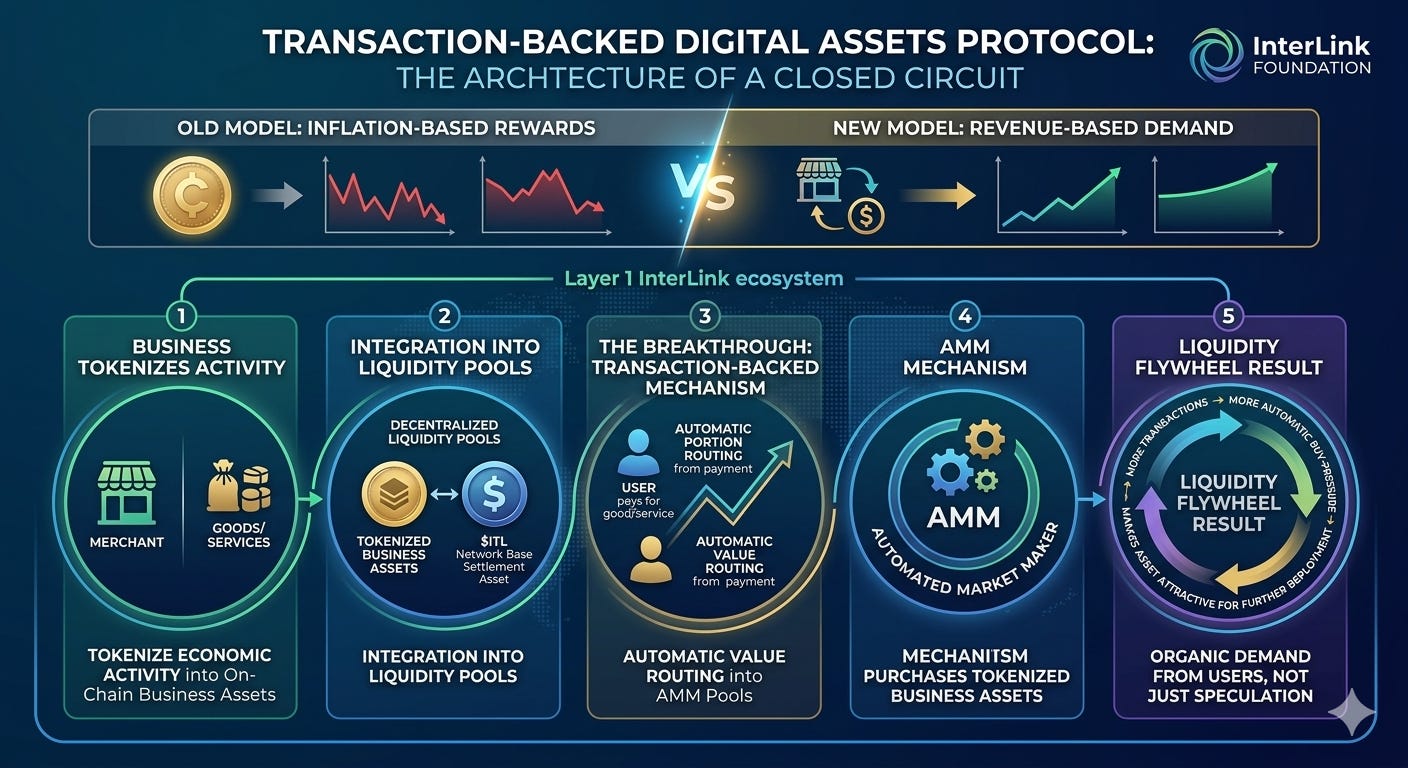
The InterLink Foundation’s Transaction-Backed Digital Assets Protocol is the answer to this challenge.
It represents a fundamental transition in how value is captured within a Layer 1 ecosystem, moving from “inflation-based rewards” to “revenue-based demand.”
In this model, businesses operating within the InterLink ecosystem tokenize their economic activity into on-chain digital assets.
For the business, this provides a transparent way to represent value and access liquidity. For the ecosystem, these assets are integrated into decentralized liquidity pools and paired with $ITL, the network’s base settlement asset.
The breakthrough is the “Transaction-Backed” mechanism.
When transactions occur — actual payments for goods or services — the protocol automatically routes a portion of that value into liquidity pools. This capital is then used to purchase the associated digital assets through Automated Market Maker (AMM) mechanisms.
This creates a liquidity flywheel: more transactions lead to more automatic buy-pressure, which deepens liquidity, making the asset more attractive for further business deployment.
This demand is organic, generated by users who are simply transacting, not just speculating.
⚖️ The Burden of Judgment
This shift introduces a new kind of risk — one that staking and holding never required.
When you stake, the protocol bears the analytical weight — you look at emission schedules and lock-up terms. When you hold, you wait for the global market to price in the truth.
But when you allocate capital into specific business assets on the InterLink chain, you must make active, qualitative judgments:
Which businesses will drive sustained, real-world transaction volume?
Which assets represent genuine economic throughput versus empty infrastructure?
How does a business’s growth cycle align with your entry point?
These questions reward analytical clarity.
In this model, better decisions compound, while poor allocation may not recover through the passage of time alone. It is a meritocratic shift in crypto-finance.
🧠 From “Early” to “Wise”
This shift is no longer a whitepaper promise.
With InterLink Version 5.0, $ITL becomes freely tradable on the OTC market, and external business assets begin deploying on the L1 — marking the transition from whitepaper to operational reality.
In the first wave of crypto, winners were those who arrived early. In the second, it was those who stayed long.
In this emerging phase, the winners will be those who allocate wisely.
They won’t just be holding tokens; they will be operating with a fundamentally different understanding of where value actually comes from.
The game has changed.
The architecture is ready.
The only question is whether your strategy is ready to match the new standard of allocation.
If you’d like to support my research, you may use my Interlink invitation code below. It also unlocks an instant mining boost ✚︎ Welcome Bonus for new users.
InterLink Referral Code: 905079415
Wallet Invitation Code : HSVZZPEJ (75% Commission Rebate)
❓ New to InterLink?
For a 🔗step-by-step guide, start with the pinned post at the top of my blog — Done.T Insight✨.
You don’t need capital. You just need five minutes.
📚 Done.T’s Related Insights
I Paid With Crypto. Here’s What Actually Happened Behind That Tap: On the InterLink Visa Card

Most people think paying with crypto means spending a token.
ITL - The Asset That Moves an Economy

🔙 Part 1 explained why ITL supply expands slowly — and why that constraint is structural rather than accidental.
🔎 Search “Done.T Insight” on Google for real data & analysis.
Disclosure: This post contains referral links and reflects my personal research and experience. It is provided for informational purposes only and does not constitute financial advice.