

Most discussions about blockchain start with technology.
But the networks that survive long enough eventually face a different question — governance.
🔍 The Question Behind the Technology
When people evaluate a blockchain project, the conversation almost always starts in the same place: consensus mechanisms, transaction speed, scalability.
These are legitimate questions. But they are also the easy ones.
Once a network grows beyond its early stage, a quieter and more consequential question begins to surface.
Not how fast the network moves, but who decides where it goes. Not the technical architecture, but the institutional one.
Blockchain ecosystems do not grow through code alone. Development requires funding. Research requires coordination. Partnerships require trust.
And wherever resources accumulate, decisions must be made about how they are deployed.
That decision-making structure — more than any consensus algorithm — shapes whether an ecosystem survives its own success.

⚖️ The Invisible Power Structure
In the early days of most projects, that structure is informal. Decisions flow from the founding team, from venture backers, from the largest token holders.
This concentration of power is not always malicious.
In the beginning, speed matters, and speed requires authority. But it creates a structural tension that compounds over time.
Blockchain was built on the premise of decentralization.
Yet in practice, the flow of capital often remains stubbornly centralized — flowing toward those who were already positioned at the start, rather than toward the initiatives that would actually strengthen the network.
This is where many technically impressive projects eventually lose their footing.
Not because the code failed, but because the governance did.
🏢 The Institutional Answer
Mature ecosystems recognized this problem early.
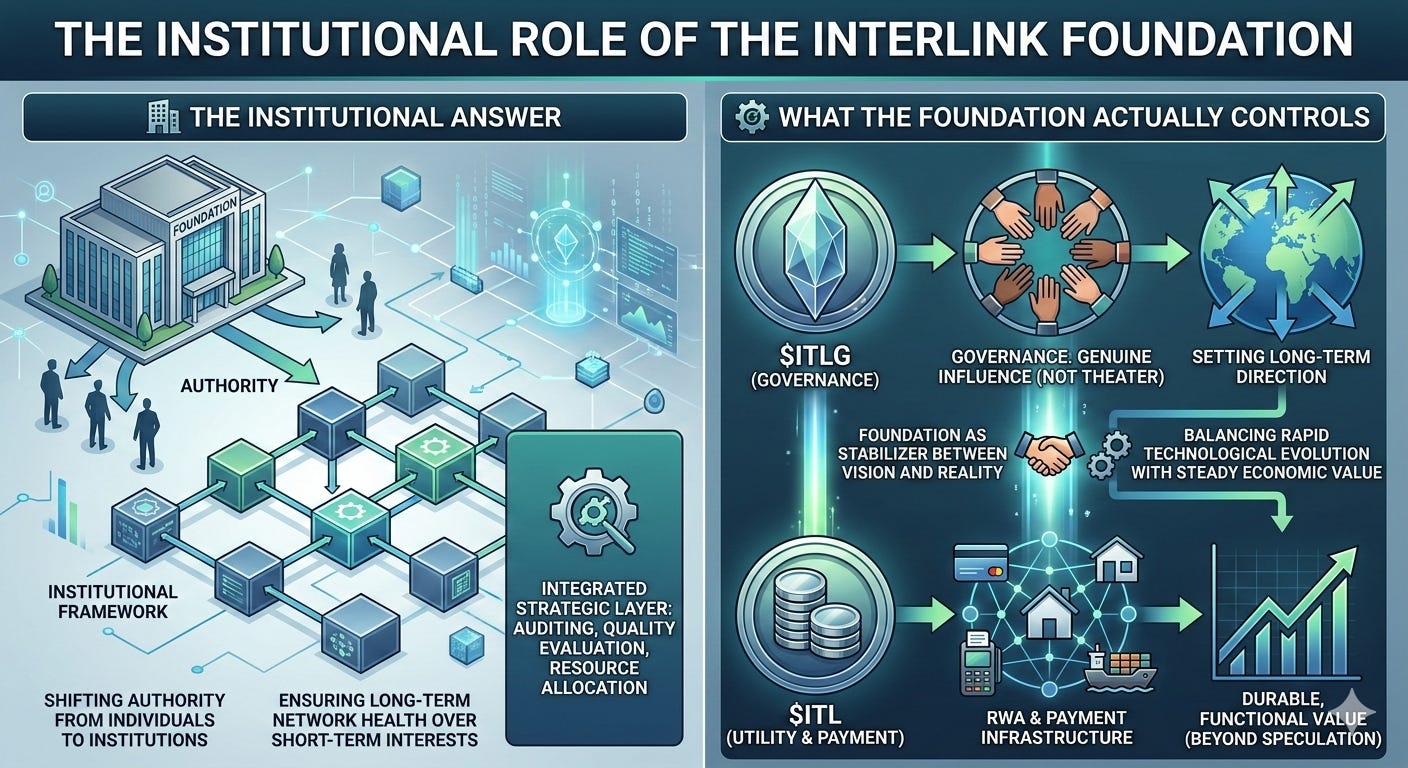
Ethereum, Solana, and Avalanche each built an answer into their architecture: an independent, non-profit foundation responsible for long-term stewardship of the ecosystem’s resources.
The logic is straightforward.
A foundation shifts authority from individuals to an institutional framework. It creates accountability structures that personal discretion cannot.
It ensures that treasury decisions serve the network’s long-term health rather than short-term interests — and crucially, it does so in a way that remains stable even as leadership changes over time.
What separates InterLink’s approach is that the Foundation is not positioned as a caretaker.
It operates as the strategic layer of the entire network — responsible for auditing, quality evaluation, and the allocation of every resource tied to the InterLink Token.
The governance question is not left to resolve itself. It is the Foundation’s primary mandate.
⚙️ What the Foundation Actually Controls
Two assets sit at the center of InterLink’s economy, and the Foundation’s relationship to each is distinct.
ITLG, the governance token, is where long-term direction is set. The Foundation manages its strategic utility — ensuring that holders exercise genuine influence over the ecosystem’s trajectory rather than symbolic participation.
Governance, in this model, is not theater.
ITL, the utility and payment token, is where real-world adoption lives. The Foundation’s focus here is on expanding RWA and payment infrastructure — building the use cases that give ITL durable, functional value beyond speculation.
A payment token without payment infrastructure is just another volatile asset. The Foundation’s role is to close that gap.
By holding responsibility for both, the Foundation acts as a stabilizer between long-term vision and operational reality. Technology can evolve rapidly. Economic value requires something steadier.
🗳️ The Governance Question That Remains
Every blockchain project eventually faces the same test: not whether the network can process transactions, but whether it can make decisions — consistently, transparently, and in service of the ecosystem rather than a narrow set of insiders.
Code can launch a network.
Governance determines whether it lasts.
The InterLink Foundation answers that question with structure: a professional institutional framework designed to ensure that capital flows toward initiatives that generate real value, and that the ecosystem it stewards becomes something more durable than a technology experiment.
Who decides where the money goes?
In InterLink, the answer is not a person. It is a structure.
If you’d like to support my research, you may use my Interlink invitation code below. It also unlocks an instant mining boost ✚︎ Welcome Bonus for new users.
InterLink Referral Code: 905079415
Wallet Invitation Code : HSVZZPEJ (75% Commission Rebate)
❓ New to InterLink?
For a 🔗step-by-step guide, start with the pinned post at the top of my blog — Done.T Insight✨.
You don’t need capital. You just need five minutes.
📚 Done.T’s Related Insights
Zero-Capital Tokenization: How InterLink Creates Value Without Investment

Tokenization is one of those words that sounds important but rarely gets explained.
When Machines Earn and Spend: The Settlement Layer Nobody Built

CES 2026 did not simply showcase better hardware. It exposed a structural debt we have been postponing.
🔎 Search “Done.T Insight” on Google for real data & analysis.
Disclosure: This post contains referral links and reflects my personal research and experience. It is provided for informational purposes only and does not constitute financial advice.