

Bitcoin Revelation began with a single question.
How far can consensus go — using only machines and physical cost?
But its implementation? Surprisingly conservative — almost radically so.
This project doesn’t invent a new consensus mechanism. It refactors Bitcoin’s Proof-of-Work structure down to its most minimal, most immutable form.
Bitcoin Revelation operates on these premises: no central operator, no trusted authority, no checkpoints, no governance keys, no external dependencies.
Each node independently verifies every block, every transaction, and the entire history — locally.
The network transmits. It does not arbitrate.
In Bitcoin Revelation, network state has zero authority over consensus.
Connectivity affects propagation speed, not validity.
Truth is decided by computation, not connection.

🔄 What Changed in v4 — And Why It Matters
The v4 upgrade looks simple. But this change locks down the foundation of consensus.
The core shift :
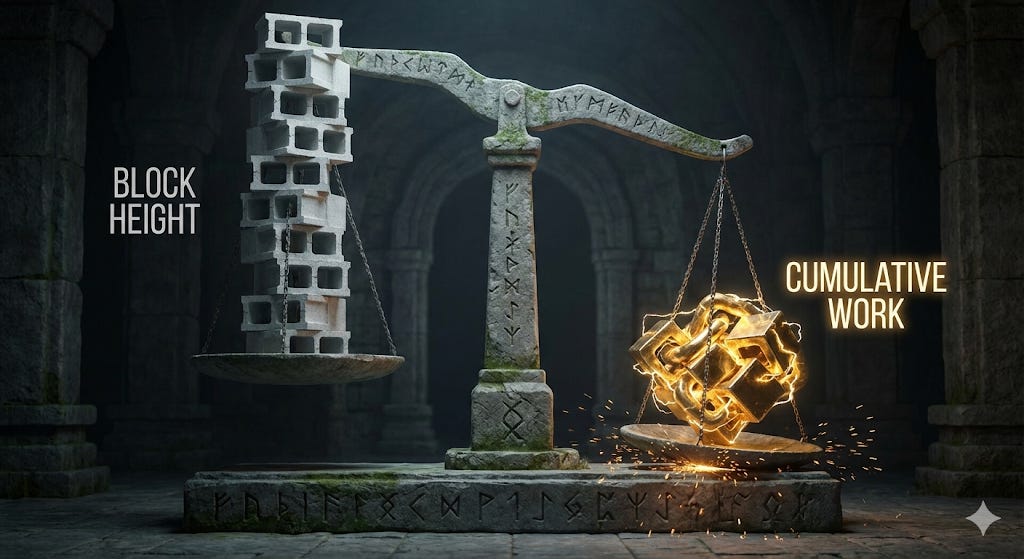
chain validity is no longer determined by block height, but by cumulative Proof-of-Work.
A longer chain doesn’t automatically win. A shorter chain with more accumulated work does.
Fork ambiguity is eliminated. The criterion is objective, computational, final.
Equally important is what v4 didn’t change ❌:
PoW hash function, difficulty adjustment, genesis block, block rewards, transaction rules. v4 doesn’t touch the economic model.
It answers one question: “Which chain is true?”
Consensus is no longer interpretation. It’s the measurable result of accumulated action.
🔒 FINAL / FROZEN — Why Stop Here?
After v4, Bitcoin Revelation’s consensus rules are declared FINAL / FROZEN.
This doesn’t mean development stops. It means: all future changes happen outside consensus, not within it.
The only way to modify consensus rules is through an explicit, version-gated hard fork. And at that moment, it’s no longer the same Revelation.
Most projects never declare this, because it means:
✔️ No patching consensus bugs
✔️ No discretionary rule changes
⭕ Changes require explicit hard forks
This project is no longer “a product that improves.”
It’s an experiment showing how minimal Bitcoin can be.
From this point forward, Bitcoin Revelation transitions from operational phase to consensus fixation phase.
💡 Done.T’s Note: Installation Impressions
“This is what running Bitcoin Core from the beginning must have felt like.”
Sync is fast. Logs are bare. UX is nonexistent.
This isn’t regression — it’s intentional reset. Bitcoin Revelation is an experiment in how minimal consensus can be.
⚖️ Human Nodes vs. Proof-of-Work — Are They Actually Opposing Forces?
“Doesn’t Bitcoin Revelation’s PoW contradict InterLink’s Human Nodes?”
Short answer:
No. The direction is the same. The roles are different.
InterLink gathers people (Identity).
Bitcoin Revelation protects the value those people create.
Proving you’re human (Human Node) is optimal for ecosystem expansion. Low barriers, rapid growth.
But there’s a limitation:
economic weight doesn’t emerge automatically.
Someone has to burn electricity, run equipment, pay physical costs — only then does the network shift from “free points system” to “ledger capable of holding assets.”
This is why v0.4.0 locked chain selection to Cumulative Proof-of-Work.
In a structure where tens of thousands of Human Nodes participate lightly via phones — the entire structure is secured by a small number of powerful PoW nodes.
Human Nodes expand participation.
PoW nodes make attack costs prohibitively unrealistic.
Participation is human.
Security is mechanical.
This isn’t conflict. It’s division of labor.
The equality InterLink speaks of isn’t “equality of reward” — it’s “equality of opportunity.”
Anyone can join as a Human Node. Everyone starts from the same line.
After that, those who invest more resources take on more responsibility and capture more reward.
If I had to describe this structure in one sentence:
You’re test-driving the armored vehicle guarding the central bank vault of a nation called InterLink.

🚩 What “Completion” Really Means
When we hear “completed,” we think:
Now it’s usable. Now it scales.
But completion in Bitcoin Revelation means something different.
This project’s completion is a declaration that “touching this further would break the meaning itself.”
Bitcoin Revelation deliberately closed off several things ❌:
No roadmap. No governance. No admin privileges.
Instead, it kept four things:
Consensus rules
Proof-of-Work
Time
Cumulative work
This is no longer a “system under development.” It’s a fixed reference point — like legal precedent.
Ironically, because it’s frozen, it can serve as the baseline for every other experiment.
InterLink’s Human Nodes, identity-based consensus, AI economies, governance experiments — all eventually face the same question:
“Does the layer we added still hold — even on top of fixed consensus?”
🌄 The Shared Boundary — Where Machines End, Humans Begin
“This far, machines can go.
Beyond this, humans must enter.”
Bitcoin Revelation and InterLink share precisely this boundary.
Bitcoin Revelation fixes the baseline of consensus — using only machines and physical cost — until it can be reduced no further.
It demands nothing beyond that. No humans, no identity, no governance.
InterLink begins exactly where that ends.
It proves humanity, accumulates trust, designs economy and participation on top of that foundation.
Bitcoin Revelation shows the end of consensus without humans.
InterLink is the architecture that places humans back on top.
These two don’t compete.
Their roles are different.

🏁 Conclusion
Because consensus achievable by machines alone is now fixed, architecture that reintroduces humans finally gains meaning.
Bitcoin Revelation pushed one question as far as it could go: How far can consensus hold — using only machines and physical cost?
At v4, that experiment stopped.
Not because it failed to advance. But because advancing further would break what it means.
What comes next is no longer a consensus problem.
InterLink begins exactly where Bitcoin Revelation ends. Proving humanity, accumulating trust, designing economies and participation — these only make sense on top of fixed consensus.
Without that floor, human layers collapse into governance theater. With that floor locked, they become architecture.
So these two systems don’t compete. They don’t overlap.
Bitcoin Revelation shows where machines end.
InterLink shows where humans must begin.
Role separation.
Sequential design.
🔗 [Continued in Part 2]
Source code referenced in this analysis:
🔗 Github repository
If you’d like to support my research, you may use my Interlink invitation code below. It also unlocks an instant mining boost ✚︎ Welcome Bonus for new users.
InterLink Referral Code: 905079415
Wallet Invitation Code : HSVZZPEJ (75% Commission Rebate)
❓ New to InterLink?
For a 🔗step-by-step guide, start with the pinned post at the top of my blog — Done.T Insight✨.
You don’t need capital. You just need five minutes.
📚 Done.T’s Related Insights
When the Chain Goes Live, the Stakes Change: What V5.1 Is Actually Saying

There is a category difference between a protocol that adds features and a protocol that begins operating. Feature releases expand what a system can do. Operational releases change what the system is.
From Assets to Revenue: The Next Phase of RWA

When most people hear “Real-World Assets,” they picture the same short list.
🔎 Search “Done.T Insight” on Google for real data & analysis.
Disclosure: This post contains referral links and reflects my personal research and experience. It is provided for informational purposes only and does not constitute financial advice.