

Money has always followed production.
But for the first time, production has moved into systems that money cannot understand.
In Part 1, we established a structural rule that history has never violated: money follows the concentration of people, power, and production.
The pound shadowed industrial Britain; the dollar emerged from American mass production; and today, as production migrates into algorithmic and platform-based environments, the question is no longer historical.
It is architectural.
🔗 [The Shift of Monetary Power— Part 1]
The Failure Mode of “Just Digital”
It is tempting to assume that existing digital assets will automatically fill the void left by nation-state currencies. Bitcoin and Ethereum are compelling stores and movers of value — but they remain structurally disconnected from real-time production.
They can record a transaction. They cannot measure the quality of participation that produced the value being transacted.
A monetary system built for the algorithmic era cannot merely denominate value — it must coordinate the production of value.
It must know not just that a transfer occurred, but who participated, how consistently, and whether that participation can be trusted across time.
Existing crypto-assets were not designed to answer these questions. That is not a failure of ambition — it is a design boundary.
Digital assets move value.
They do not qualify it.

Five Requirements for a Post-Industrial Monetary Layer
What would a monetary system need to look like if it were designed from scratch for a world of global platforms, AI agents, and algorithmic production? Five structural requirements emerge — not as aspirational features, but as minimum conditions for relevance.
Production-Coupled Issuance. In the platform era, the equivalent of gold is verified participation. Value must be linked to what nodes in the network actually do — not merely to what capital they hold.
Identity-Aware Design. As AI agents proliferate, distinguishing human participants from automated actors becomes foundational. This distinction must be achievable without centralizing personal data.
Native Digital Settlement. Programmable economic systems operate at machine speed, across multiple chains. A monetary protocol must match that speed as a core architectural property — not as an afterthought.
Adaptive Governance. National currencies are governed by political cycles. A viable monetary protocol derives its rules from network data and trust metrics — not from institutions whose decision-making horizons are measured in election cycles.
Transition Compatibility. No monetary system achieves relevance by confronting the existing order directly. A protocol designed for the algorithmic era must operate alongside existing financial rails — providing trust infrastructure that current systems can use, rather than demanding their replacement.
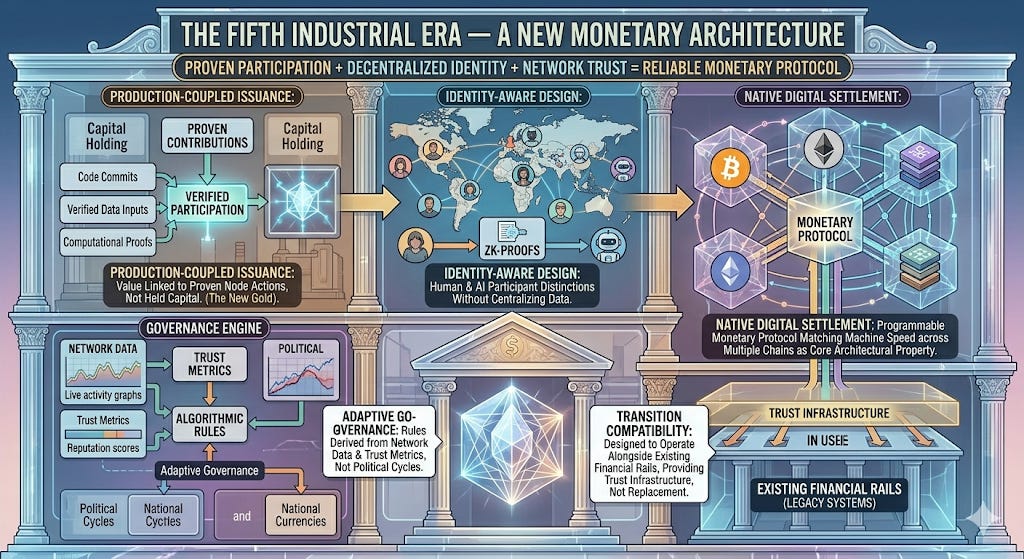
These five requirements define the gap between what exists and what the emerging production environment demands. No current system fully satisfies all of them.
That gap is where the next monetary layer will be built.
Without qualification, money becomes noise.
A Case Study in Structural Architecture: InterLink
Among the projects currently attempting to close this gap, InterLink represents one of the most structurally coherent approaches — worth examining not as a product to be promoted, but as an architecture to be analyzed.
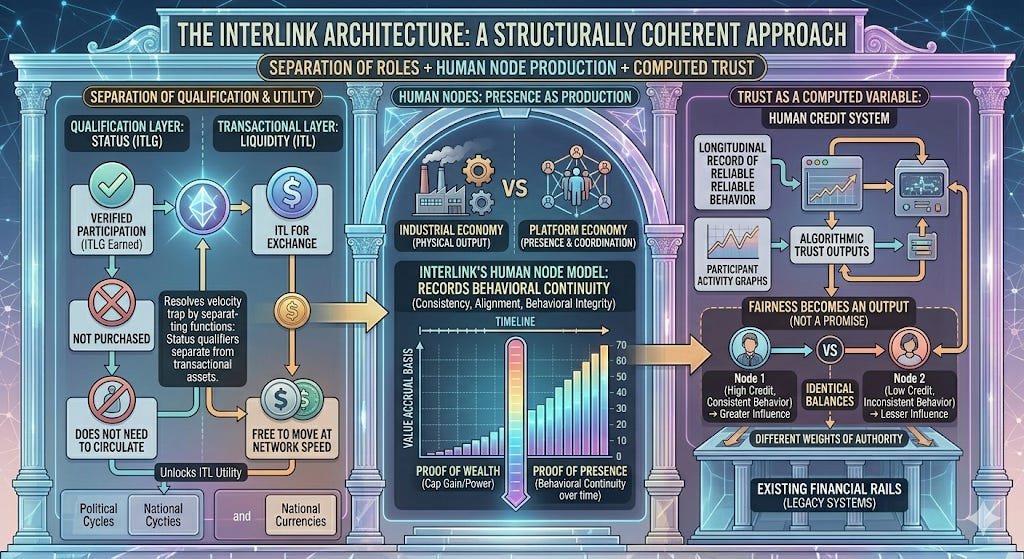
Separation of Qualification and Utility. Most monetary systems fail by forcing a single asset to store value and facilitate exchange simultaneously. The result is a velocity trap — holders resist spending, and the medium of exchange ceases to flow.
InterLink resolves this by separating ITLG from ITL. ITLG is not purchased; it is earned through verified participation — a qualification layer that does not need to circulate. ITL is the transactional layer, free to move at network speed. Status and liquidity serve different functions.
Human Nodes: Presence as Production. In the industrial economy, production was physical output.
In the platform economy, the relevant input is presence, availability, and consistent coordination.
InterLink’s Human Node model records behavioral continuity rather than hardware power or capital leverage — moving the basis of value accrual from proof of wealth to proof of presence.
Trust as a Computed Variable. The Human Credit System converts trust from a social construct into an algorithmic output. Two participants holding identical balances may carry very different weight within the network, determined by their longitudinal record of reliable behavior.
Fairness becomes an output — not a promise.
From Currency to Infrastructure
The history of monetary power is a history of structural inevitability.
Britain did not choose to become the center of global finance; production concentrated there, and money followed. America did not design dollar dominance; it emerged from the convergence of industrial output and geopolitical circumstance.
The same structural logic applies now.
The monetary systems that survive will be those capable of operating natively within the algorithmic environment — not as currencies that happen to be digital, but as protocols that coordinate the production of value at its source.
The decisive question is no longer what the money is called. It is what system grants the right to generate and settle it.
Money will not evolve into this system. This system will redefine money.
And in that system, currency is not the center.
Qualification is.
If you’d like to support my research, you may use my Interlink invitation code below. It also unlocks an instant mining boost ✚︎ Welcome Bonus for new users.
InterLink Referral Code: 905079415
Wallet Invitation Code : HSVZZPEJ (75% Commission Rebate)
❓ New to InterLink?
For a 🔗step-by-step guide, start with the pinned post at the top of my blog — Done.T Insight✨.
You don’t need capital. You just need five minutes.
📚 Done.T’s Related Insights

Why Proof of Personhood Makes You a Validator — No Hardware Required

For more than a decade, participating in blockchain validation meant clearing one of two very high bars.
🔎 Search “Done.T Insight” on Google for real data & analysis.
Disclosure: This post contains referral links and reflects my personal research and experience. It is provided for informational purposes only and does not constitute financial advice.