

For most of InterLink’s existence, the community has been reading about what is coming. Mainnet is coming. Validators are coming. Real-world payments are coming.
That framing shifted this week.
The announcements stopped describing a future state. They started describing an operational structure. A project that tells you what it will build is asking for trust. A project that shows you what it has built is offering evidence.
What emerged this week — across the DAO vote, the organizational disclosures, the liquidity market details, and the infrastructure specifications — was not a roadmap update.
It was a status report.
First, a Reminder: The Structure Behind the Strategy
InterLink operates through two distinct entities.
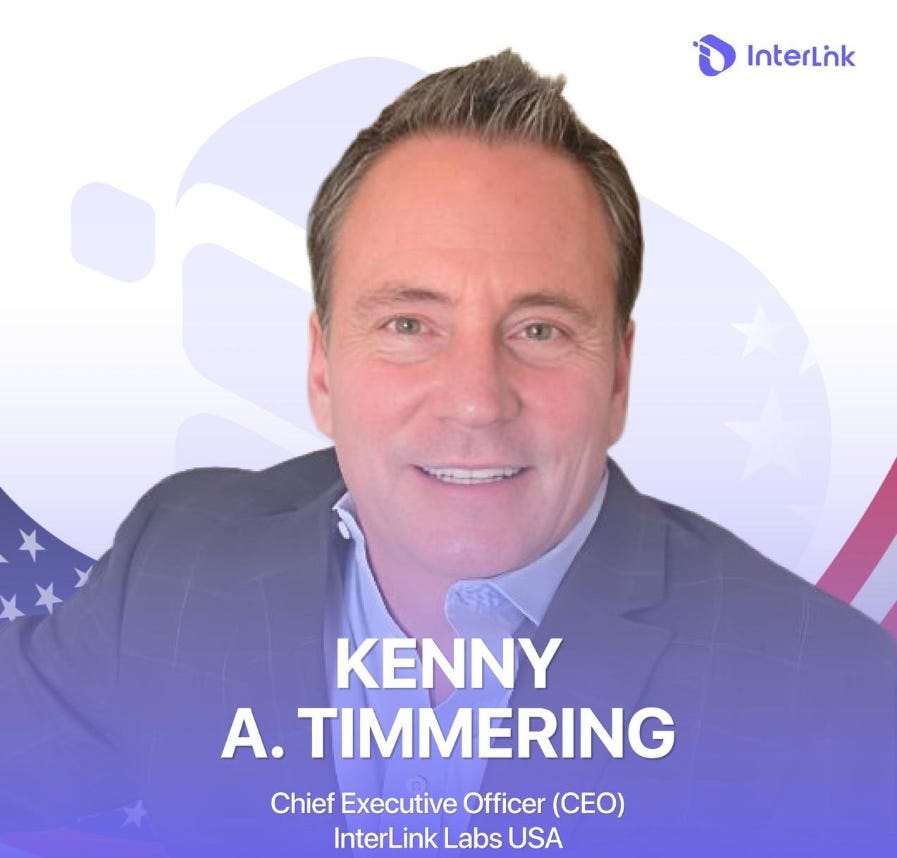
The InterLink Foundation, registered in Hong Kong, governs the protocol. InterLink Labs USA, led by CEO Kenny A. Timmering, executes the business. KV chairs the Foundation. Timmering runs the American operation.
This is the organizational architecture of a company that intends to operate in regulated financial environments across multiple jurisdictions.
A foundation governing a protocol and a legal entity executing commercial agreements is how serious financial infrastructure gets built.
That structure was already in place. This week’s announcements make more sense when read against it.
What the DAO Actually Decided
The DAO vote concluded with Option 2 — Balanced Growth selected. Most participants focused on the conversion numbers. The structural significance runs deeper.
Option 2 was not chosen because it maximizes individual returns. It was chosen because it creates the conditions under which the ecosystem can absorb genuine commercial demand without being destabilized by supply pressure.
Circulating supply will be close to zero outside of Human Nodes. The core team holds no mainnet tokens. No VC allocations.
💡One clarification worth stating directly:
Staking ITLG does not mean locking tokens away. The ITLG remains inside the owner’s wallet at all times. Staking grants additional rights and allocation benefits for ITL ownership.
The lock applies to the ITL received in return, released linearly as the network matures.
The DAO did not vote on a number.
It voted on the pace at which a new token economy earns the right to exist.
$3 Billion Per Day: The First Real Number for V
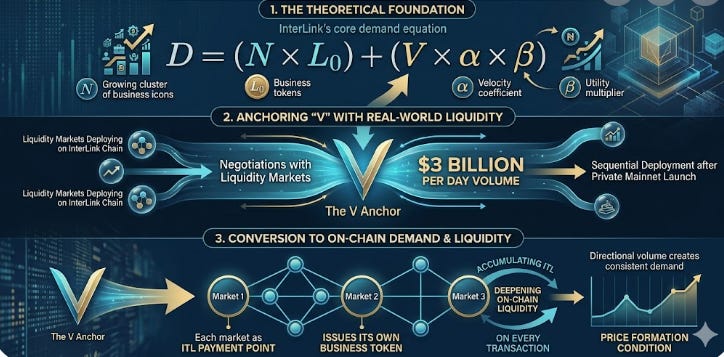
The demand equation InterLink’s whitepaper describes is D = (N × L₀) + (V × α × β).
N grows as businesses onboard. V grows as transactions scale. Until this week, V had no concrete anchor.
According to Vyx, a prominent influencer in the InterLink ecosystem, InterLink Labs USA CEO Kenny Timmering has been negotiating with liquidity markets reaching $3 billion per day in volume since late last year.
These markets are expected to begin deploying on InterLink Chain sequentially following the Private Mainnet launch.
Each market will operate as an ITL payment point and issue its own Business Token, accumulating ITL and deepening on-chain liquidity with every transaction.
Scale alone does not create price. Volume creates activity. Structure creates demand.
When transaction flow is paired with protocol-level liquidity mechanisms, volume is no longer neutral. It becomes directional. That is the condition under which demand turns into price.
If this materializes as described, V is no longer an abstraction.
It is $3 billion per day entering a chain where the core team holds no tokens, VCs have no allocation, and circulating supply is structurally constrained.
RWA Just Changed Definition
Real-world asset tokenization has been part of InterLink’s narrative from the beginning. That definition expanded this week.
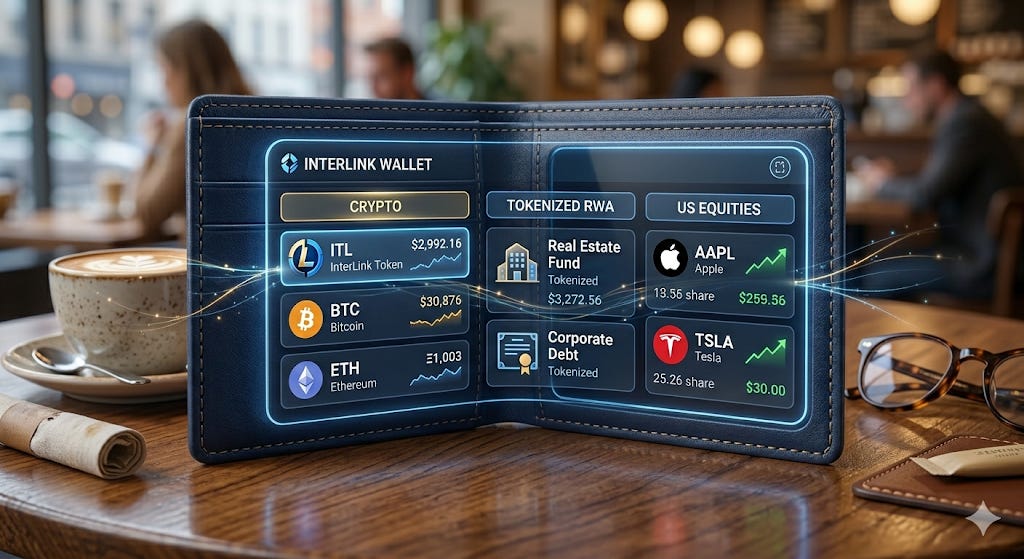
InterLink’s official communications now reference a wallet that supports both crypto and tokenized US equities.
Tokenizing US-listed equities requires navigating securities law, engaging with regulated custodians, and satisfying compliance requirements that most blockchain projects have avoided entirely.
The fact that this capability appears in official communications suggests the legal groundwork is substantially further along than the community has recognized.
A wallet where a user holds crypto, tokenized business assets, and US equities simultaneously is not a crypto wallet with extra features. It is a financial account.
The boundary between blockchain infrastructure and traditional capital markets is not approaching. It is dissolving.
The Compliance Layer That Makes Institutions Possible
Two infrastructure specifications confirmed this week address why regulated enterprises would actually use this.
Travel Rule compliance is built natively into the protocol — not added as an application layer, not optionally implemented, enforced on every transaction. For any institution operating under FATF guidelines, this is a prerequisite, not a preference.
Cross-border transfers that currently cost between $10 and $40 per transaction and take up to five business days are reduced by 60 to 80 percent in cost and settle in seconds. Transaction privacy ensures only the parties involved in a payment can see its details.
These are not features designed to attract retail users. They are specifications designed to satisfy institutional procurement requirements.
What This Week Actually Was
“From Free Mining App to One of the World’s Largest Payment and Real-World Asset Ecosystems. This Is the Goal.”
Read that not as aspiration. Read it as a structural description of what is already being assembled.
The DAO has set the tokenomic foundation. The organizational structure spans two jurisdictions. A US CEO is negotiating $3 billion in daily liquidity. A wallet supporting US equities is in development. Travel Rule compliance is protocol-native.
The free mining phase built something no amount of venture capital can manufacture: a verified, globally distributed network of real human participants.
InterLink is no longer asking whether the system can be built. It is testing whether it can hold.
If you’d like to support my research, you may use my Interlink invitation code below. It also unlocks an instant mining boost ✚︎ Welcome Bonus for new users.
InterLink Referral Code: 905079415
Wallet Invitation Code : HSVZZPEJ (75% Commission Rebate)
❓ How to Join InterLink
The InterLink Sign-up Guide: Secure Your Digital Assets in 5 Minutes

The world moves in complex ways, but growing your assets doesn’t have to.
You don’t need capital. You just need five minutes.
📚 Done.T’s Related Insights
Zero-Capital Tokenization: How InterLink Creates Value Without Investment

Tokenization is one of those words that sounds important but rarely gets explained.
What the DAO Vote Actually Decided: InterLink's Economic Foundation, Not Just a Staking Ratio

When InterLink’s DAO opened voting on the vITLG to ITL conversion ratio, the community’s attention went to the numbers. 160:1 or 1.125:1. Thirty-six months or sixty months. How much do I get, and how long do I wait.
🔎 Search “Done.T Insight” on Google for real data & analysis.
Disclosure: This post contains referral links and reflects my personal research and experience. It is provided for informational purposes only and does not constitute financial advice.