

Most update announcements get read as a checklist. New Curators. Snapshot live. Recovery upgraded. Note it, move on.
That reading misses what V5.0.3 is actually doing.
Taken individually, each update is a feature.
Taken together, they represent a single structural shift: InterLink is redesigning its participation mechanics to work with human behavior rather than against it.
And that shift has direct consequences for how your position inside the network is being evaluated right now.
The Curator Network Expands Its Judgment Layer
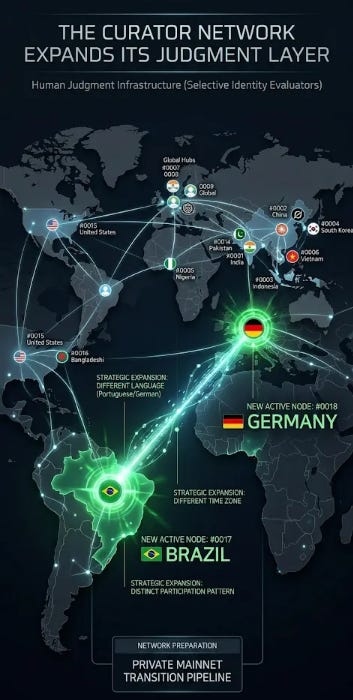
Brazilian Curator #0017 and German Curator #0018 are now active.
The Curator system was introduced as a selective human verification layer — not moderators, but identity evaluators whose role is to assess behavioral legitimacy at scale. Each Curator addition is not a staffing decision. It is a geographic extension of the network’s human judgment infrastructure.
Brazil and Germany are not arbitrary choices. They represent two strategically important and structurally distinct InterLink communities — different languages, different time zones, different participation patterns.
Expanding the Curator layer into both simultaneously signals that the verification pipeline is being prepared for the volume the Private Mainnet transition will demand.
The Snapshot Changes What “Progress” Means
Migration 1 introduced a mechanism that most participants have not fully priced in: the Snapshot.
When you complete Migration 1, the system records your stats at that exact moment — personal mining rate, group mining rate, burn cycles, referral count, HCS balance.
That snapshot becomes your baseline. Your vITLG ratio is calculated from your current balance in full, distributed across multiple migration phases.
Here is what matters most: every round after Migration 1 evaluates not your absolute numbers, but how much your stats have improved since the last snapshot. The stronger your improvement relative to your previous record, the higher your priority in the next migration phase.
This is a meaningful design change.
The system is no longer ranking participants by how much they have accumulated. It is ranking them by trajectory — by the rate and consistency of their improvement over time.
The implication is direct.
Completing Migration 1 is not the moment to slow down.
The participants who stay consistent, keep mining active, and keep growing after Migration 1 will move through future phases faster. Complacency after a milestone is the easiest way to fall behind the people who kept going.
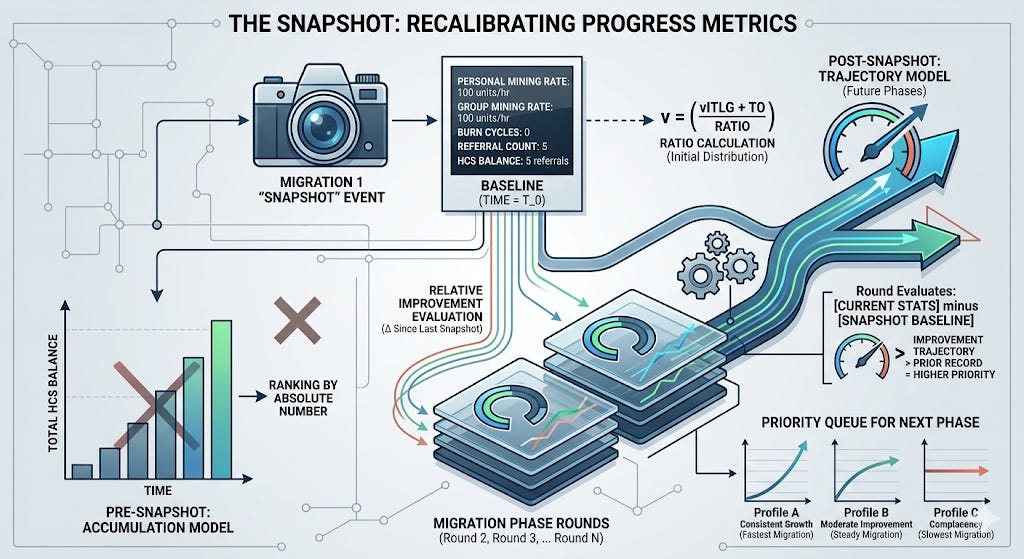
Your position is not fixed at Migration 1. It is being continuously re-evaluated against your own prior record.
Recovery Is No Longer a Punishment System
The Recovery Burning Mechanism has been upgraded in two ways that change its fundamental character.
Previously, recovery progress was built on daily streaks. Miss a day, and that progress reset. The system penalized the kind of irregular participation that characterizes real human life — travel, illness, work, anything that breaks a daily routine.
Under the upgraded system, progress now accumulates from the total number of mining sessions since you returned, not from consecutive daily streaks. You can miss a day without losing what you built. The only thing that resets your recovery is staying inactive long enough to trigger a new burn penalty.
The second change is equally significant: one recovery ticket now clears every burned record at the same tier in a single move.
No more clearing records one by one.
These two changes together do not simply make recovery easier. They change what the recovery system is for.
The old design filtered out people who failed to maintain perfect streaks. The new design filters out people who genuinely stop participating — while welcoming back everyone else.
A network scaling toward one billion users cannot be built on mechanics that penalize real human behavior.
Infrastructure at that scale has to accommodate the way people actually live. The upgraded Recovery system reflects that constraint being taken seriously.
Position Lock
V5.0.3 is not a quality-of-life update. It is a signal about how the network intends to evaluate its participants as it enters the most consequential transition in its history.
The Curator expansion scales human judgment before verification demand peaks. The Snapshot system shifts the evaluation metric from accumulation to improvement trajectory. The Recovery upgrade removes the penalty for being human while preserving the penalty for genuine disengagement.
Three updates. One direction.
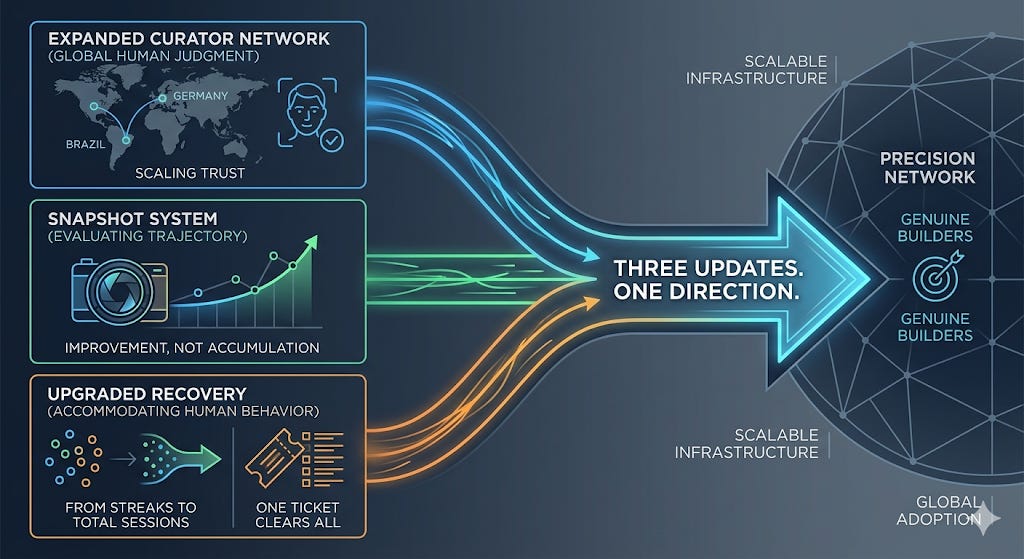
The system is not becoming more lenient. It is becoming more precise — better at distinguishing the participants who are genuinely building from the ones who have stopped.
Participation is no longer being recorded. It is being interpreted.
If you’d like to support my research, you may use my Interlink invitation code below. It also unlocks an instant mining boost ✚︎ Welcome Bonus for new users.
InterLink Referral Code: 905079415
Wallet Invitation Code : HSVZZPEJ (75% Commission Rebate)
❓ New to InterLink?
For a 🔗step-by-step guide, start with the pinned post at the top of my blog — Done.T Insight✨.
You don’t need capital. You just need five minutes.
📚 Done.T’s Related Insights

Why You Don't Need to Be a Crypto Expert to Participate in Tokenization

We are moving toward a world where real economic activity runs on blockchain infrastructure.
🔎 Search “Done.T Insight” on Google for real data & analysis.
Disclosure: This post contains referral links and reflects my personal research and experience. It is provided for informational purposes only and does not constitute financial advice.