

📈 User Growth Overview
As of May 31, 2026, InterLink reached a total of 8,603,877 InterLink IDs, up from 7,899,948 at the end of April.
This represents a net increase of 703,929 users, equivalent to approximately 8.9% month-over-month growth — the sixth consecutive month of sustained, structurally consistent expansion.
Verified InterLink IDs rose to 5,788,942, adding 475,706 verified users during the same period — also 8.9% month-over-month growth.
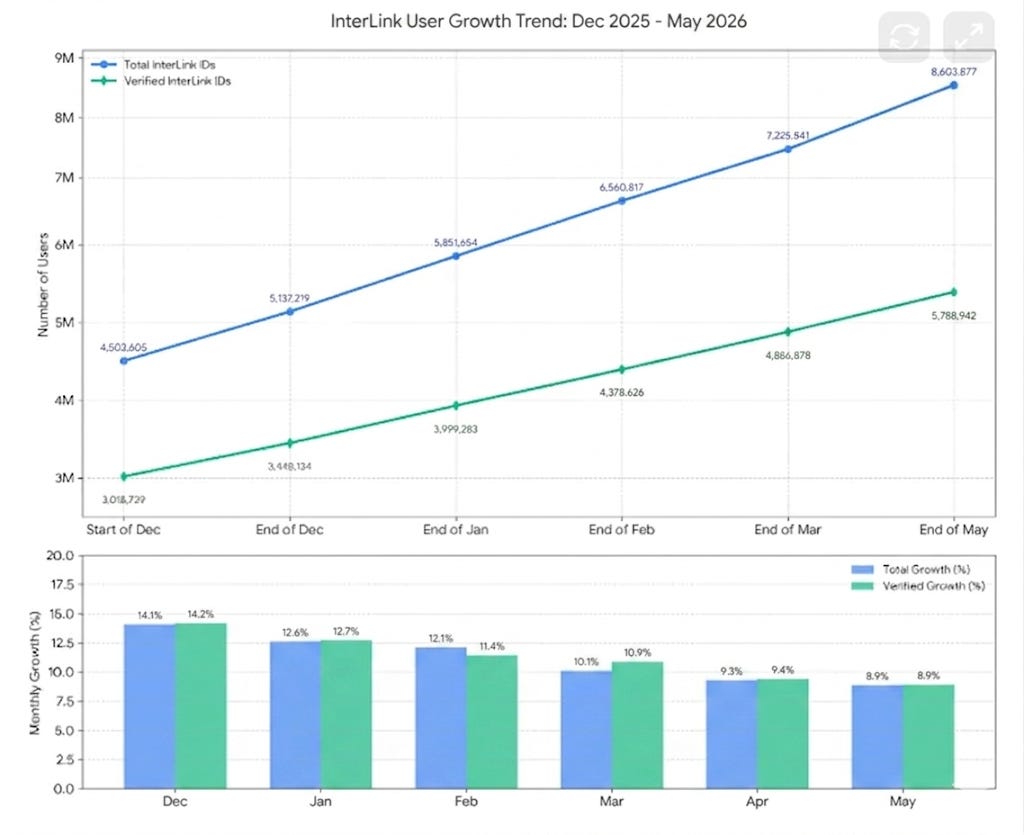
For the sixth consecutive month, total user growth and verified user growth moved in near-perfect alignment. At 8.6 million registered participants, the network is approaching a scale at which most ecosystems begin to show strain. InterLink has not.
Daily Active Users reached 4,988,812 — representing 58.0% of total IDs. In a network this size, that figure does not emerge from passive onboarding. It reflects a system where participation carries weight, and where weight has been made measurable.
📋 Monthly Briefing
If April was the month InterLink crossed from architecture into execution, May was the month it decided what that execution would mean — permanently.
The decisions made in May were not operational. They were constitutional. Tokenomics were submitted to governance and returned as law. The chain earned a name. The economy placed its first brick.
The Blueprint Goes Public
May began with the release of the InterLink Foundation Whitepaper v1.0 on May 4 — not a technical specification, but a declaration of scope.
The whitepaper introduced the Business Token as a new category of economic instrument. Not equity, not yield, not utility. A protocol-enforced, commerce-driven asset whose demand originates from real-world transaction volume and is mechanically converted into on-chain buy pressure through the AMM.
No existing financial vocabulary accurately describes it. That gap is the point.
On May 7, InterLink published its clearest competitive positioning to date. The engineering load of one billion verified users is not a marketing target — it is a structural requirement. Throughput without deterministic finality is a feature.
Finality with throughput is infrastructure. McKinsey, BCG, and Citi GPS have all reached the same conclusion about tokenized real-world assets. Most chains have none of the three requirements natively. InterLink was designed with all three as non-negotiable.
The Rules Are Set — By the Network
On May 8, KV confirmed what the architecture had always implied: once the Open Mainnet launches, mining ends. Only Validators will produce blocks.
The Validator consensus structure followed on May 10.
Block proposal rotates by stake weight. Two-thirds approval moves a block to Lock, then Finalize. Deterministic finality in three to five seconds. Slashed amounts are burned — not redistributed, not sent to a treasury. Permanently removed from supply. The protocol enforces the rules. The market allocates the capital.
What came next was more consequential still. On May 15, KV confirmed the ITLG-to-ITL staking ratio would be determined entirely through DAO voting. DAO Proposals #16 and #17 went live on May 22 — options generated by machine learning models trained on network data and economic simulations. The analysis was data-driven. The decision belonged to the community.
By May 27, Option 2 — Balanced Growth — was selected.
The conversion framework now spans from 1.125 ITLG per 1 ITL at five-year maximum lock, to 160 ITLG per 1 ITL at zero lock. Once confirmed, the schedule is written permanently into a smart contract. It cannot be changed by anyone, including the team.
Proposal #17 upgraded the Recovery Burning Mechanism: cumulative mining replaces the strict streak requirement, and one recovery ticket now clears all burn records at its tier simultaneously.
The community chose. The protocol follows.
The Chain Proves It Works — Then Gets Faster
On May 18, BitFlip launched on the Taj Mahal Testnet — the first dApp running on real InterLink Chain infrastructure. Bitcoin price prediction, fully on-chain, no off-chain middleware, no centralized resolver, no manual intervention. Every round opens, locks, and settles directly on the chain. It held without exception.
On May 26, the upgrade from sequential to parallel transaction execution was completed. TPS increased by up to five times. Finality time decreased further.
The chain is faster than it was thirty days ago — and the recruitment of engineers with Ethereum Foundation and Solana Foundation experience signals that the ceiling is not considered final.
The Economy Places Its First Brick
On May 28, ITLX Wallet launched Mobile Top-Up — the first real-world payment service on InterLink infrastructure.
Phone number, package selection, payment in USDC or USDT across Ethereum, Base, Avalanche, Arbitrum, and Polygon. Native inside the app. No browser. No redirect. Settled on-chain.
Phone credit is one of the most universally needed payment actions on the planet. The choice to start here was not accidental. It is the payment use case with zero barriers to relevance — and it proved that ITLX functions as payment infrastructure, not just a wallet.
Hours later, KV published the announcement that closed the month: InterLink Seoul Private Mainnet Version 6.0, coming in June 2026.
The name is a tribute to the Korean community — and to the principle that a nation built on ideals, not bloodlines, has no limits. Version 6.0 will activate ITLG staking on the DAO-approved formula, begin distributing ITL, launch hundreds of dApps, formally introduce the Transaction-Backed Digital Assets Protocol with patent filings, and open Payment Points for real-world commerce. Post-quantum signature experiments begin within this version.
“This is the most important milestone in the history of InterLink.”
🧾 Overall Assessment
May reflects a system that did three things simultaneously — and ensured that none of them could be undone.
It wrote the rules.
The staking framework, ratified by community vote and encoded into immutable contracts, is now the financial constitution of the ecosystem. It will govern circulating supply, protocol liquidity, and long-term scarcity for years.
It proved the infrastructure.
Not in projection. The Taj Mahal Testnet ran a real dApp without failure. ITLX processed real payments across multiple chains. Parallel execution delivered a 5x TPS increase. The chain is measurably faster and more capable than it was thirty days ago.
It named the next chapter.
“InterLink Seoul” is not a product name. It is a statement of identity — that this network was built around a shared ideal, not a shared starting point.
✔︎ Tokenomics moved from proposal to protocol — encoded, immutable, community-ratified.
✔︎ The chain moved from testnet demonstration to real payment settlement.
✔︎ The next phase was named, scheduled, and described in full.
What April built, May decided. What May decided, June will activate.
May 2026 “The month InterLink wrote the rules — and named what comes next.”
If you’d like to support my research, you may use my Interlink invitation code below. It also unlocks an instant mining boost ✚︎ Welcome Bonus for new users.
InterLink Referral Code: 905079415
Wallet Invitation Code : HSVZZPEJ (75% Commission Rebate)
❓ New to InterLink?
For a 🔗step-by-step guide, start with the pinned post at the top of my blog — Done.T Insight✨.
You don’t need capital. You just need five minutes.
📚 Done.T’s Related Insights
InterLink Is No Longer Describing What It Will Build. It Is Describing What It Has Built.

For most of InterLink’s existence, the community has been reading about what is coming. Mainnet is coming. Validators are coming. Real-world payments are coming.
Is It Too Late to Join InterLink? Here's What the Numbers Actually Say

There’s a question that stops most people before they even start. “I’ve heard about InterLink — but isn’t it already too late?”
🔎 Search “Done.T Insight” on Google for real data & analysis.
Disclosure: This post contains referral links and reflects my personal research and experience. It is provided for informational purposes only and does not constitute financial advice.