

Viewed in the context of the Foundation’s official launch, the accompanying post reads less like a routine announcement and more like a structural declaration.
This was not a standard roadmap update. It was a manifesto — one that challenges the underlying assumptions of how blockchains are built, secured, and distributed.
To understand where InterLink may be headed, we must look beyond the code and examine the architecture it is attempting to define.
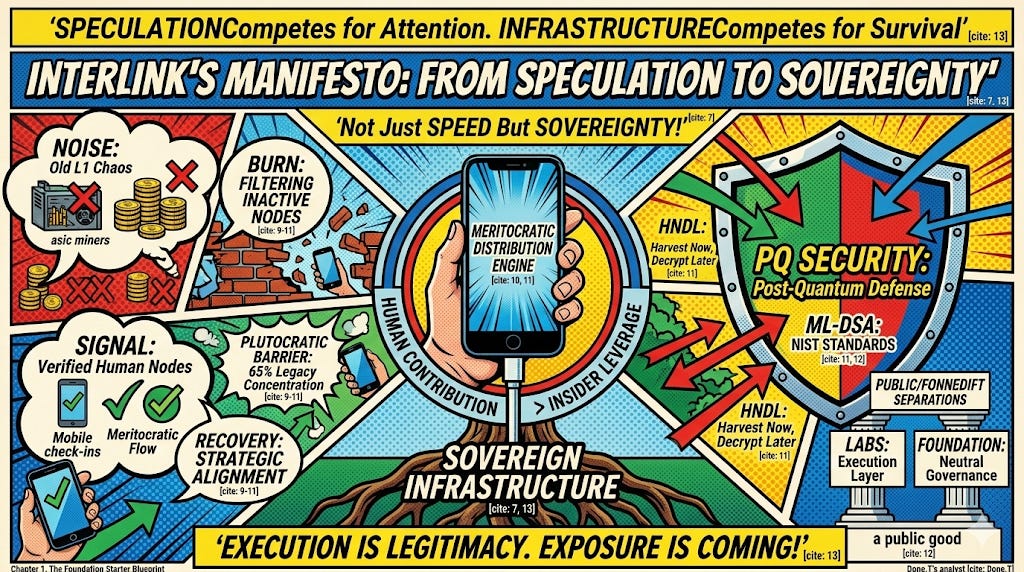
⚔️ The Battlefield Shift: From Speculation to Sovereignty
The document frames the current market transition as “Institutional Era 2.0.” To the casual observer, this might sound like marketing jargon, but the distinction is vital.
Institutional Era 1.0 was characterized by exposure.
It was the age of Bitcoin ETFs, Grayscale trusts, and the struggle for regulatory clarity. It was about getting “old money” into “new assets.”
Institutional Era 2.0, however, is about Infrastructure.
In this new phase, institutions are no longer just looking for price action; they are looking for systems that can host national-scale payment rails and sovereign-grade assets. This requires:
Structural Trust: Systems that cannot be manipulated by a handful of insiders.
Security Longevity: Protection against threats that don’t even exist yet.
Neutrality: A foundation that functions as a global public good.
InterLink isn’t just launching a token;
it is bidding to become the base layer for this transition.
🧱 Identifying the Adversary: The Plutocratic Barrier
One of the most provocative claims in the InterLink statement is the naming of the “Plutocratic Barrier.”
It cites Messari’s 2026 Crypto Theses, noting that over 65% of legacy L1 token supplies are concentrated within private investor circles. This is a direct critique of the industry’s status quo.
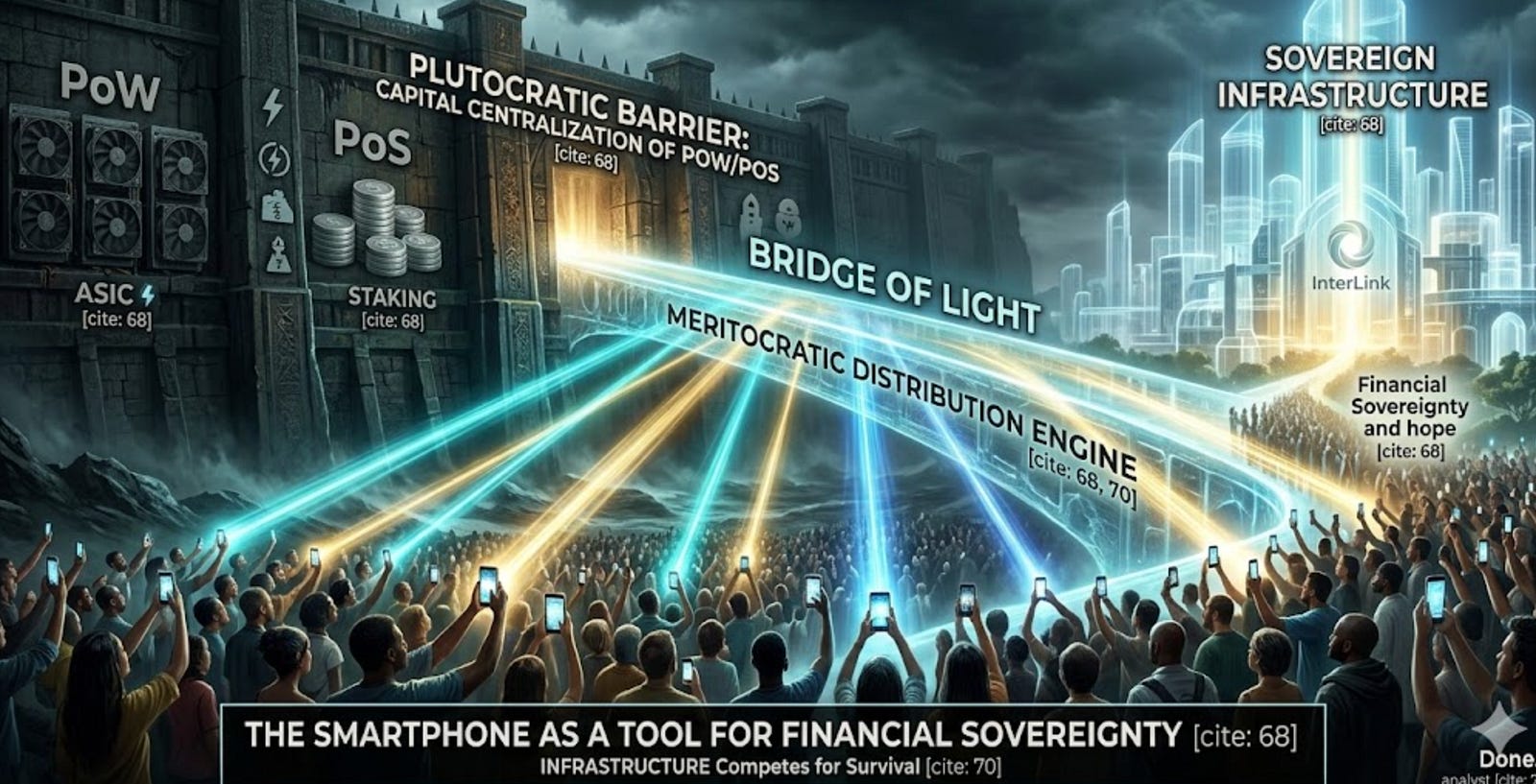
Proof-of-Work (PoW), while secure, inevitably centralizes through capital intensity. Only those who can afford massive ASIC farms and cheap electricity can participate.
Proof-of-Stake (PoS) often rewards early-mover leverage, where the “rich get richer” by simply holding large stakes, creating an insider-weighted ecosystem.
InterLink’s proposal — a Meritocratic Distribution Engine — is a strategic pivot. By linking ownership to Human Contribution and mobile-centric verification, InterLink is attempting to democratize the network’s value.
This is especially relevant for emerging economies, where mobile penetration is high but capital for expensive mining rigs is scarce.
InterLink is turning the smartphone into a tool for financial sovereignty.
🛡️ The Security Signal: Procurement Over Hype
For most retail investors, terms like “Lattice-Based Signatures” or “ML-DSA” are white noise.
But for a Chief Information Security Officer (CISO) at a major bank or a government agency, these are procurement requirements.
The threat of “Harvest Now, Decrypt Later” (HNDL) is real.
Adversaries are already collecting encrypted data today, waiting for the arrival of Cryptographically Relevant Quantum Computers (CRQC) to crack it in the future.
By implementing NIST-finalized Post-Quantum Standards today, InterLink is making a bold claim: We are building for the next thirty years, not the next thirty days.
This isn’t “hype vocabulary” — it is the language of sovereign-grade security.
🏛️ Governance as a Functional Separation
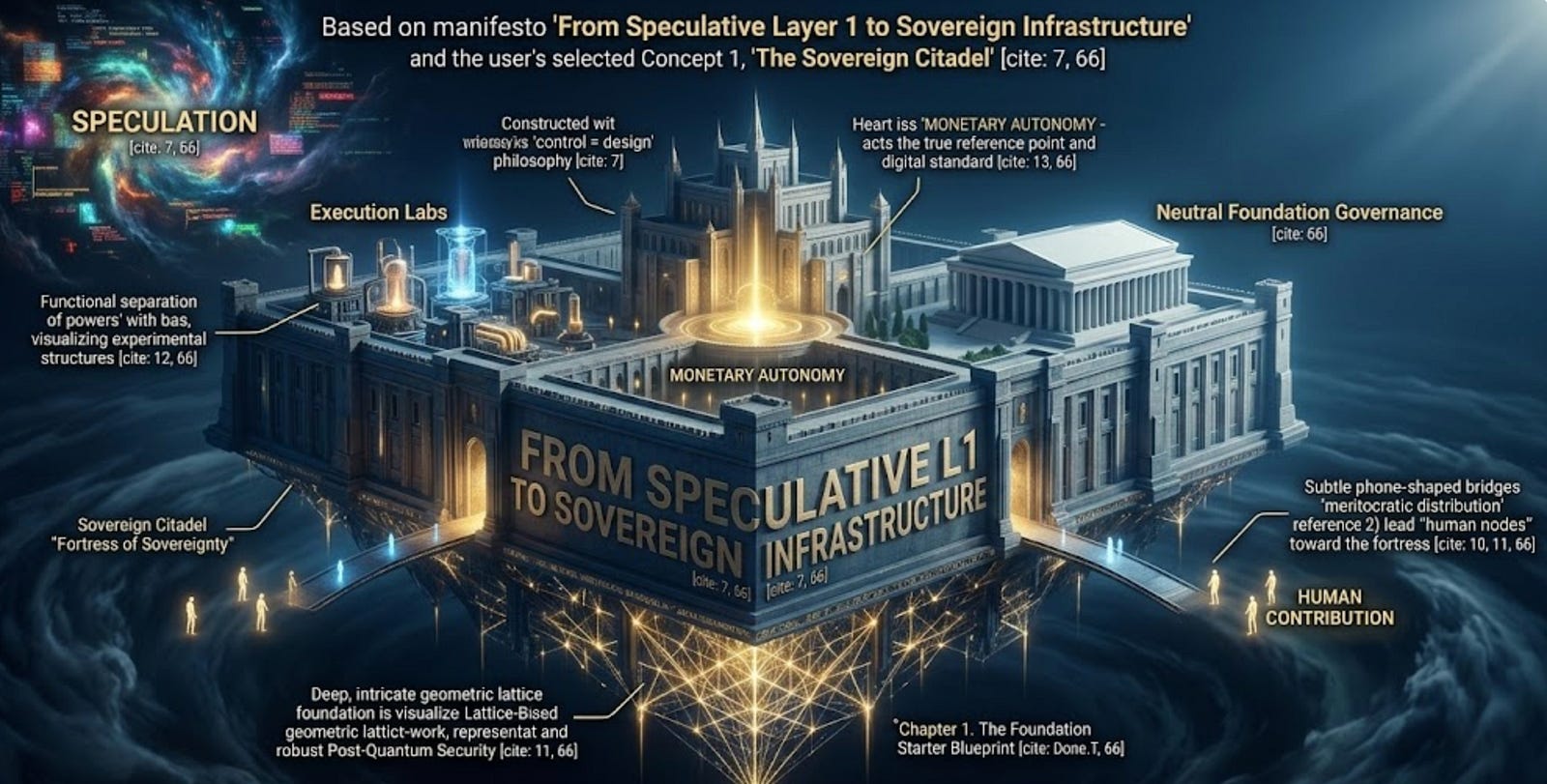
In many projects, “decentralized governance” is a decorative layer used to satisfy regulators. In the InterLink ecosystem, it appears to be a functional design choice.
By separating the Execution layer (Labs) from the Neutral Governance layer (Foundation), the project mimics the separation of powers found in stable democratic or institutional frameworks.
In practical terms, this means the Foundation oversees strategic direction, audits ecosystem activities, and ensures that resources tied to the InterLink Token are deployed toward initiatives that strengthen the network.
This separation ensures that the protocol remains a Global Public Good, neutral and accessible to all, rather than a tool for a single corporate entity.
For global institutions, this “separation of concerns” is a prerequisite for adoption. It provides a level of predictability that a centralized “startup culture” simply cannot offer.
🔄 The Tradeoff: Architecture vs. Velocity
Markets typically reward velocity — speed, hype, and immediate liquidity.
Architecture, on the other hand, is often ignored until something breaks.
InterLink’s declaration suggests a willingness to accept a fundamental tradeoff.
They are prioritizing the “slow” work of building resilient, future-proof structures over the “fast” work of manufacturing short-term retail hype.
This distinction is critical to understand:
InterLink is not trying to win the fastest L1 race; it is trying to define the Sovereign Infrastructure category.
Speculation competes for attention.
Infrastructure competes for survival.
🏁 The Verdict: Execution is the Only Legitimacy
A declaration of intent is only as good as its execution.
For InterLink’s vision to hold, the “Architectural Sovereignty” must withstand the pressures of the real world.
Can the Post-Quantum integration maintain performance at scale?
Will the Distribution Fairness truly resist “whale” manipulation?
Can the Foundation remain neutral when faced with massive liquidity events?
If these conditions are met, we are witnessing a reclassification of what a blockchain can be.
If they fail, this declaration becomes just another piece of well-written marketing.
The stakes are high, and the design is ambitious.
InterLink has laid out the battlefield.
Now, the world watches to see if the architecture can survive the exposure.
Exposure is coming.
If you’d like to support my research, you may use my Interlink invitation code below. It also unlocks an instant mining boost ✚︎ Welcome Bonus for new users.
InterLink Referral Code: 905079415
Wallet Invitation Code : HSVZZPEJ (75% Commission Rebate)
❓ New to InterLink?
For a 🔗step-by-step guide, start with the pinned post at the top of my blog — Done.T Insight✨.
You don’t need capital. You just need five minutes.
📚 Done.T’s Related Insights
InterLink’s Constitutional Split: Execution, Liquidity, and Governance

InterLink did not just announce a new feature or a routine roadmap update. It announced something far more fundamental: a division of powers.
Is It Too Late to Join InterLink? Here's What the Numbers Actually Say

There’s a question that stops most people before they even start. “I’ve heard about InterLink — but isn’t it already too late?”
🔎 Search “Done.T Insight” on Google for real data & analysis.
Disclosure: This post contains referral links and reflects my personal research and experience. It is provided for informational purposes only and does not constitute financial advice.