

InterLink just crossed 9 million users.
That number matters — but not for the reason most people think. It isn’t a trophy. It’s a signal. A network of 9 million participants approaching Open Mainnet is no longer a project in development. It’s infrastructure on the verge of activation. And when infrastructure activates, what it was actually built for becomes visible.
What InterLink was built for is becoming visible now. The name is IBTE — InterLink Business Token Exchange.
Not Another Token Exchange
The announcement describes IBTE as a marketplace where Business Tokens can be listed, discovered, and traded. That framing is accurate, but it undersells the architecture beneath it.
At the core of IBTE is the Transaction-Backed Digital Assets Protocol — a framework for creating digital assets backed by real economic activity. Products. Services. Users. Transactions. Revenue. Not speculation about future value, but tokenization of present activity.
This is a structural claim, not a marketing one. A business token under this protocol isn’t issued and then disconnected from the business that created it. It remains tethered — to operations, to users, to verifiable onchain behavior. The token lives or dies with the business it represents.
That distinction changes everything about what an exchange built on top of it means.
Traditional exchanges — NYSE, Nasdaq — became powerful because they connected companies with capital, investors, and market visibility. IBTE aims to do something similar for Web3, but the mechanism is different.
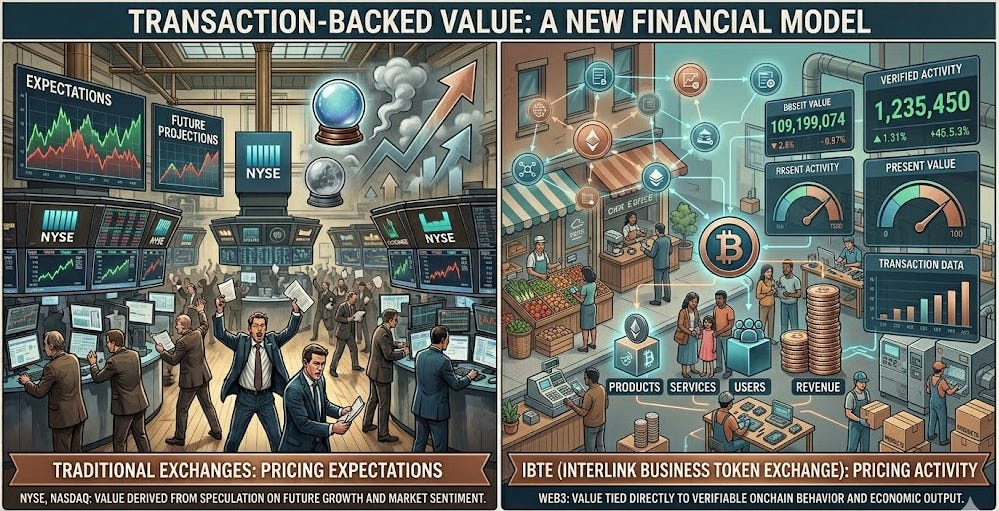
Traditional stock exchanges price expectations. IBTE, if the protocol holds, prices activity.
The Pattern That’s Been Building
Here is where the lens needs to shift.
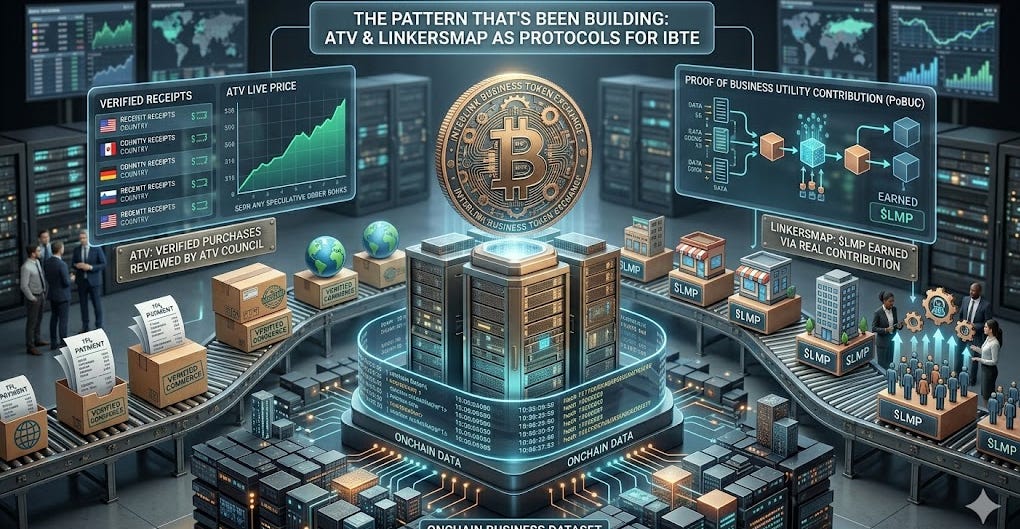
ATV and LinkersMap didn’t appear alongside IBTE by coincidence. They are not parallel features in a product roadmap. Look at what they actually do inside the InterLink ecosystem, and a structural pattern emerges: both were already generating the exact kind of onchain business data that IBTE is designed to price.
ATV — the Average Transaction Value — is InterLink’s real-world transaction verification layer. Participants submit ITL payment receipts — actual purchases, with delivery records attached — into the ATV system.
The ATV Council reviews every submission. Fabricated receipts are rejected outright. Only verified commerce passes through. What accumulates isn’t engagement metrics. It’s a live dataset of what ITL actually buys across global markets — transaction by transaction, country by country.
The output is the ATV Live Price: evidence of real purchasing power that no order book can manufacture.
LinkersMap operates on a parallel but distinct logic. Its Business Token, $LMP, is governed by Proof of Business Utility Contribution — PoBUC.
$LMP is not mined. It is not distributed freely. It is earned exclusively through real contribution to LinkersMap’s business activity. The token is a direct measure of what has already been built — not a claim on projected value.
The structural logic connecting both is the same: neither token can be manufactured through speculation. ATV demands verified receipts. $LMP demands verified business activity.
Both are assets anchored to demonstrated reality — exactly what IBTE’s Transaction-Backed Digital Assets Protocol requires.
This is not coincidence. This is architecture.
What Their Business Tokens Actually Do Inside IBTE
When IBTE goes live, ATV’s Business Token and $LMP won’t simply be listed on a new exchange. They will enter that exchange having already done something that most tokens haven’t: they will arrive with verifiable histories.
ATV's BT enters IBTE carrying something most tokens don't have: a verified transaction history. Its price discovery won't just reflect speculative demand — it will reflect the market's judgment of what aggregated, real-world ITL purchasing activity is actually worth.
For anyone trying to assess ITL's genuine utility beyond exchange speculation, ATV's BT is the signal. It can't be faked. That's the point.
$LMP enters IBTE differently. Its value is tied directly to merchant transaction volume on LinkersMap. As more businesses onboard, as more customers pay in ITL, as more PoBUC events fire — $LMP’s onchain activity compounds.
On IBTE, that means $LMP functions as something closer to a revenue-correlated asset than a speculative one. The market can look at transaction data and make an informed call.
This is what the IBTE announcement means when it says the exchange may become “the place where the market can discover which businesses are building real value in the InterLink ecosystem.”
ATV and LMP are already the answer to that question. IBTE is the venue where the market learns to ask it.
The Larger Picture
NYSE and Nasdaq didn’t just create trading venues. They created a shared language for valuing companies — a grammar of capital that the entire modern economy learned to speak.
InterLink is attempting something structurally parallel for Web3 business activity. IBTE isn’t just where tokens trade. It’s where the market learns to value onchain business operations.
And when that grammar takes hold, the projects that already speak it fluently — ATV, LinkersMap — will have an advantage that latecomers cannot easily replicate.
9 million users crossing into Private Mainnet isn’t the milestone. It’s the starting line.
The real question is what gets built on the other side of it. IBTE is the answer InterLink is already assembling — piece by piece, protocol by protocol, token by token.
The convergence isn’t coming. It’s already here.
If you’d like to support my research, you may use my Interlink invitation code below. It also unlocks an instant mining boost ✚︎ Welcome Bonus for new users.
InterLink Referral Code: 905079415
Wallet Invitation Code : HSVZZPEJ (75% Commission Rebate)
❓ New to InterLink?
For a 🔗step-by-step guide, start with the pinned post at the top of my blog — Done.T Insight✨.
You don’t need capital. You just need five minutes.
📚 Done.T’s Related Insights
Why You Don't Need to Be a Crypto Expert to Participate in Tokenization

We are moving toward a world where real economic activity runs on blockchain infrastructure.
Wall Street Is Watching the RWA Market. InterLink Is Building It.

BlackRock sees it. McKinsey quantified it. Fidelity, Franklin Templeton, and a growing roster of institutional giants have all positioned Real World Asset tokenization as the defining investment frontier of this decade.
🔎 Search “Done.T Insight” on Google for real data & analysis.
Disclosure: This post contains referral links and reflects my personal research and experience. It is provided for informational purposes only and does not constitute financial advice.