

Revelation is not infrastructure.
That part is clear.
What is not clear — and far more important —
is what it would take to change that.
🔗 [Part 1: When an Experiment Becomes Infrastructure]
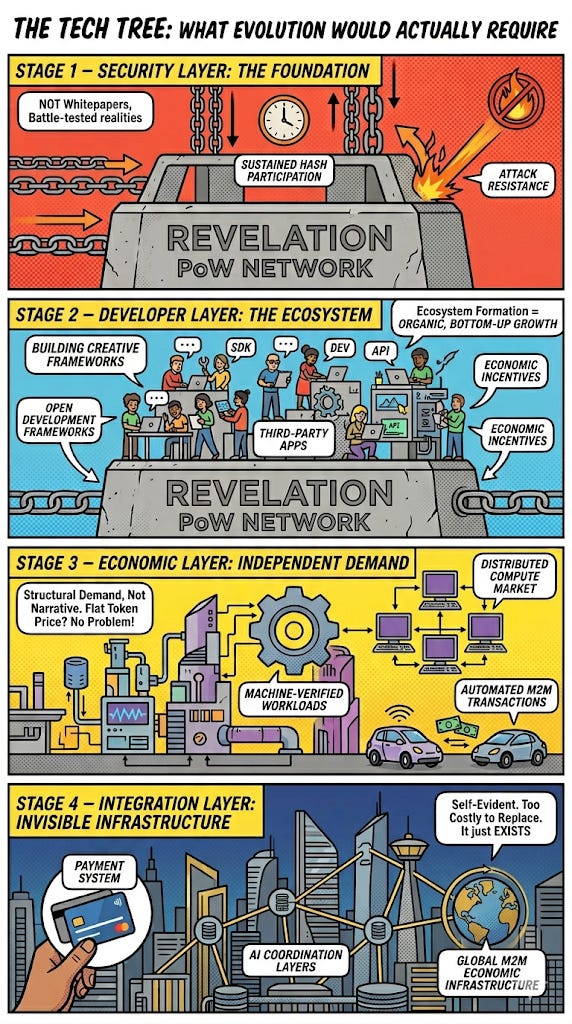
The Tech Tree: What Evolution Would Actually Require
If Revelation were to mature into a true infrastructure layer, its development would likely need to pass through four distinct stages — each one a prerequisite for the next.
Stage 1 — Security Layer
Nothing else is possible without this foundation. A durable PoW network must first demonstrate sustained hash participation, meaningful attack resistance, and predictable issuance mechanics — not as theoretical properties, but as observable, battle-tested realities.
Security at this level isn’t proven through whitepapers. It’s proven through time and adversarial pressure. This stage is unglamorous. It is also non-negotiable.
Stage 2 — Developer Layer
Infrastructure without builders is a protocol. Infrastructure with builders is an ecosystem. The transition between these two states requires open development frameworks, accessible toolkits, and economic incentives that make building on Revelation more attractive than building elsewhere.
The signal to watch here isn’t funding announcements. It’s the moment when third-party developers begin creating tools and applications that the core team didn’t design or anticipate. That emergence — organic, bottom-up, slightly chaotic — is what ecosystem formation actually looks like.
Stage 3 — Economic Layer
At this stage, the protocol begins generating demand that exists independently of speculation. Machine-verified workloads. Distributed compute markets. Automated machine-to-machine transactions.
The specific applications matter less than the underlying logic: persistent economic activity that would continue even if the token price were entirely flat. Demand that is structurally generated, not narratively sustained.
Stage 4 — Integration Layer
True infrastructure eventually becomes invisible.
Systems are built on top of it, processes depend on it, and the question of replacing it stops being interesting because the answer is obviously too costly.
At this stage, Revelation would not be competing for attention. It would simply be present — embedded in payment systems, in AI coordination layers, in machine-to-machine economic infrastructure — in ways that make its removal genuinely disruptive. This is the stage at which infrastructure status becomes self-evident rather than argued.
Each stage is necessary. None is sufficient alone. And the path between them is long enough that honest assessment requires distinguishing between what Revelation is now and what it would need to become.
The Human-Machine Pairing: Theoretical, But Worth Thinking Through
One structural possibility that deserves attention — with appropriate caution — is a complementary architecture between InterLink and Revelation.
InterLink is fundamentally oriented around human verification. Its Human Node system, its health-based qualification mechanics, its consensus structure — all of it is designed to answer a specific question: who is acting, and are they qualified to act?
Revelation, by contrast, is oriented around machine participation and Proof-of-Work. Its implicit question is different: what work was performed, and was it valid?
These are not competing questions. They are adjacent questions about different layers of the same problem. If they were ever to become interoperable — technically and economically — the resulting structure could answer something neither can answer alone:
accountable machine economies, where human identity and machine work are both verifiable within a shared system.
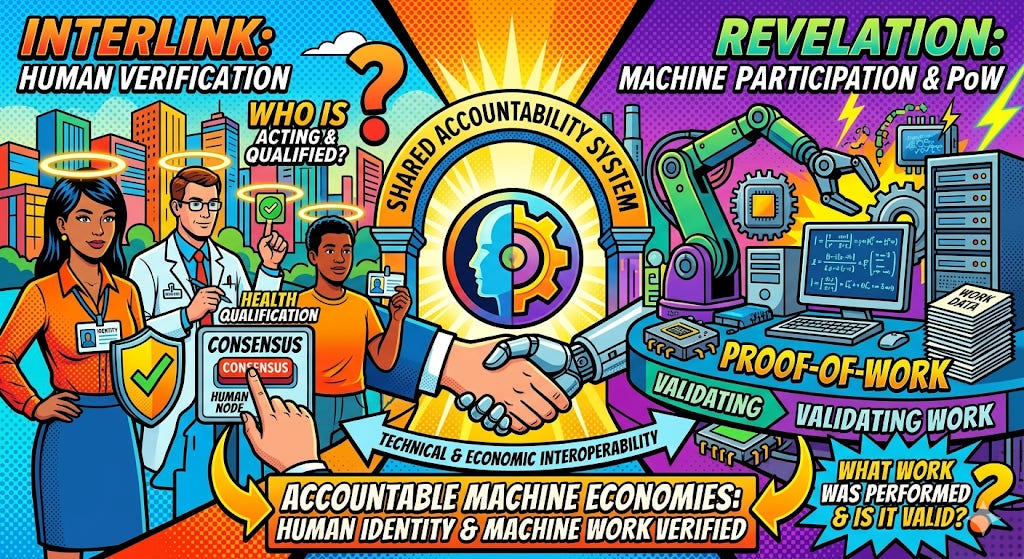
That pairing would be genuinely differentiated. It would address a problem that no existing infrastructure fully solves.
The honest assessment, however, is that this remains theoretical. There is currently no technical bridge, no shared economic dependency, no active development pathway connecting the two systems. The architecture is conceptually elegant. It is not yet real.
Noting this possibility is appropriate. Treating it as a present reality would be a mistake.
Infrastructure — or an Infrastructure Illusion?
Many early-stage protocols appear to be infrastructure. The visual language is similar: decentralization, foundational claims, technical depth, a compelling story about what comes next.
But appearance and reality diverge significantly at scale, and the gap between them tends to become visible only in retrospect.
The distinction, in the end, is not complex.
Real infrastructure eventually becomes necessary. Everything else remains optional — sometimes permanently.
For Revelation, the decisive variable is not narrative quality. It is adoption trajectory: specifically, whether other systems begin building dependencies on Revelation in ways that would make its removal costly.
That shift — from interesting to necessary — is the one that has historically defined infrastructure.
The window for that shift is not infinite. Infrastructure races tend to consolidate around early leaders. The protocols that become defaults do so relatively quickly, and challengers who arrive after that consolidation face compounding disadvantage.
This doesn’t mean Revelation cannot succeed. It means that the timeline for moving through the four stages described above is not indefinite.
Until the question “do other systems require this?” has an affirmative answer, Revelation should be understood as what it currently is: a potential infrastructure experiment operating in a hypothesis stage.
History shows that most such experiments remain experiments. A small number do not — and those that don’t tend to generate the asymmetric returns that make the category worth examining in the first place.
Which side Revelation ends up on is genuinely unknown. What is known is that the answer will not be determined by the quality of the story. It will be determined by the architecture that gets built — or doesn’t — beneath it.
Infrastructure rarely announces itself.
It becomes visible only after systems begin to depend on it.
Source code referenced in this analysis:
🔗 Github repository
If you’d like to support my research, you may use my Interlink invitation code below. It also unlocks an instant mining boost ✚︎ Welcome Bonus for new users.
InterLink Referral Code: 905079415
Wallet Invitation Code : HSVZZPEJ (75% Commission Rebate)
❓ New to InterLink?
For a 🔗step-by-step guide, start with the pinned post at the top of my blog — Done.T Insight✨.
You don’t need capital. You just need five minutes.
📚 Done.T’s Related Insights
Liquidity Was Never Meant to Come From Commerce. Until Now.

There is an assumption so deeply embedded in modern finance that most people never think to question it:
The Compliance Code Hidden Inside InterLink's Verification System

InterLink calls it verification. The regulatory references inside it suggest something else entirely.
🔎 Search “Done.T Insight” on Google for real data & analysis.
Disclosure: This post contains referral links and reflects my personal research and experience. It is provided for informational purposes only and does not constitute financial advice.