

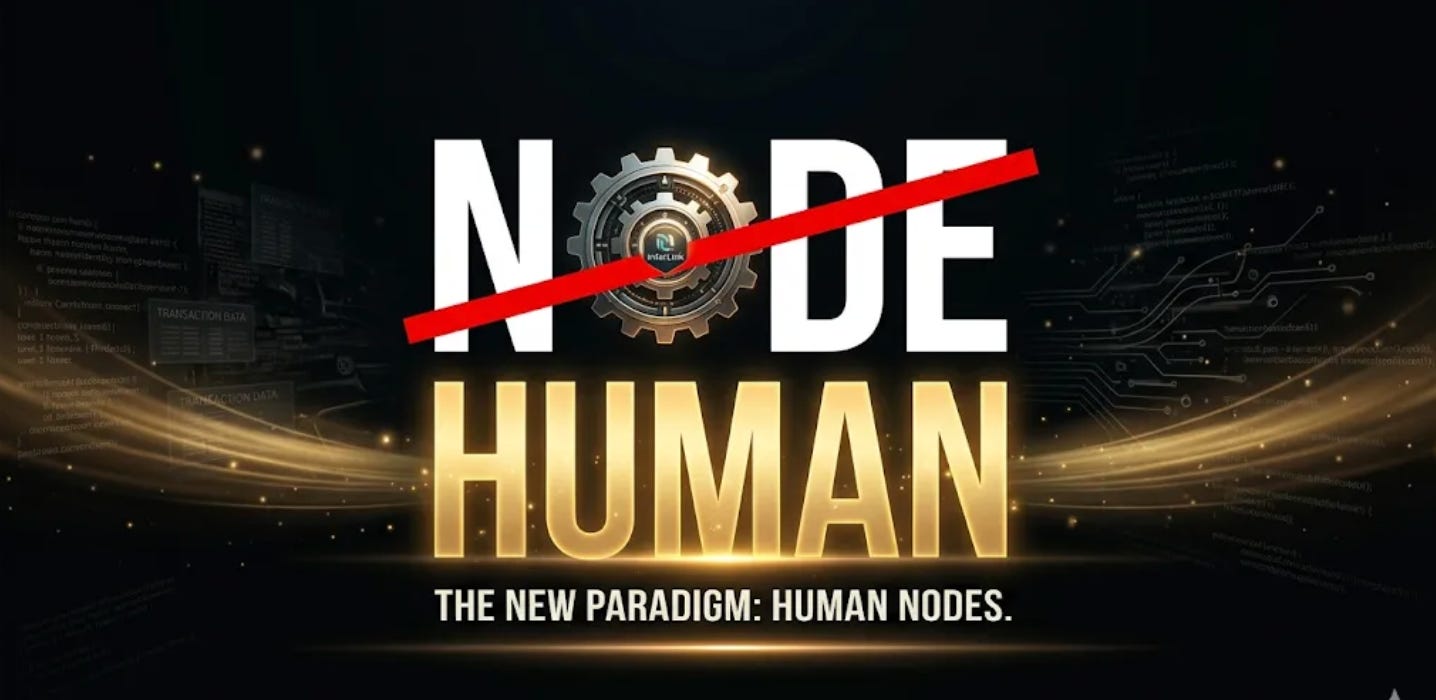
Most people think they understand what a “node” is.
To the average observer, a node is a server, a computer, or a machine humming away in a sterile data center. This assumption feels natural because, for more than a decade, it has been practically true.
But it has never been conceptually correct.
To understand what InterLink is building with Human Nodes, we must first correct a long-standing misunderstanding:
What is a node, Really?
📜 The Original Definition We Forgot
Strip away the metal and silicon, and the definition becomes surprisingly simple.
A node is an independent participant that validates, propagates, and enforces the rules of a network.
Historically, there are three core requirements:
Independence 🧍: Operating as a distinct entity.
Validation 🛂: Defining what is considered “valid”.
Influence 🗳️: Contributing to the finality of consensus.
Notice what is missing.
There is no mention of CPUs, GPUs, or server racks. A node was never defined by what it is made of. It was defined by the role it plays.
🖥️ Why Machines Won (For Now)
Machines didn’t become nodes because they were essential. They became nodes because, at the time, they were the only viable option.
They became nodes because, at the time, they were the only viable option.
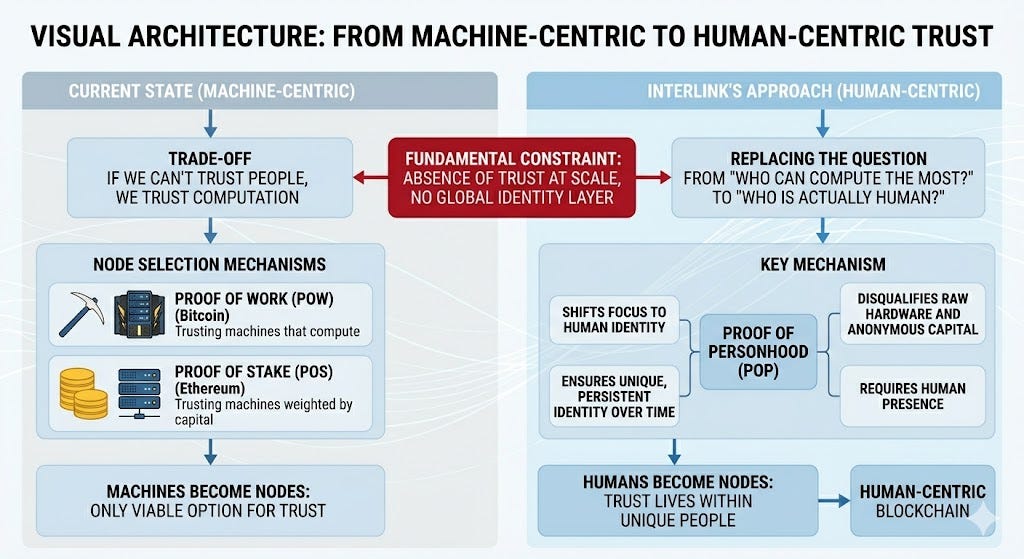
Early blockchain networks faced a fundamental constraint: The absence of trust at scale. There was no global identity layer and no way to verify human behavior without centralized intermediaries.
So, the industry made a strategic tradeoff:
If we can’t trust people, we will trust computation.
This decision gave us the familiar models we see today:
Proof of Work (PoW): Trusting machines that compute (Bitcoin).
Proof of Stake (PoS): Trusting machines weighted by capital (Ethereum).
Machines didn’t become nodes because they were ideal. They became nodes because trust had nowhere else to live.
🔄 InterLink: Replacing the Question
InterLink doesn’t try to optimize the old, machine-centric question: “Who can compute the most?”
Instead, it replaces it with something much more profound:
Who is actually humam?
By shifting the focus to “Proof of Personhood (PoP)”, the network disqualifies raw hardware and anonymous capital. Neither can prove presence, nor persist as a single, unique identity over time.
Only humans can.
🔀 The Architecture of the Split
This is where the InterLink architecture creates a new paradigm. It separates the functions that traditional blockchains bundled together.
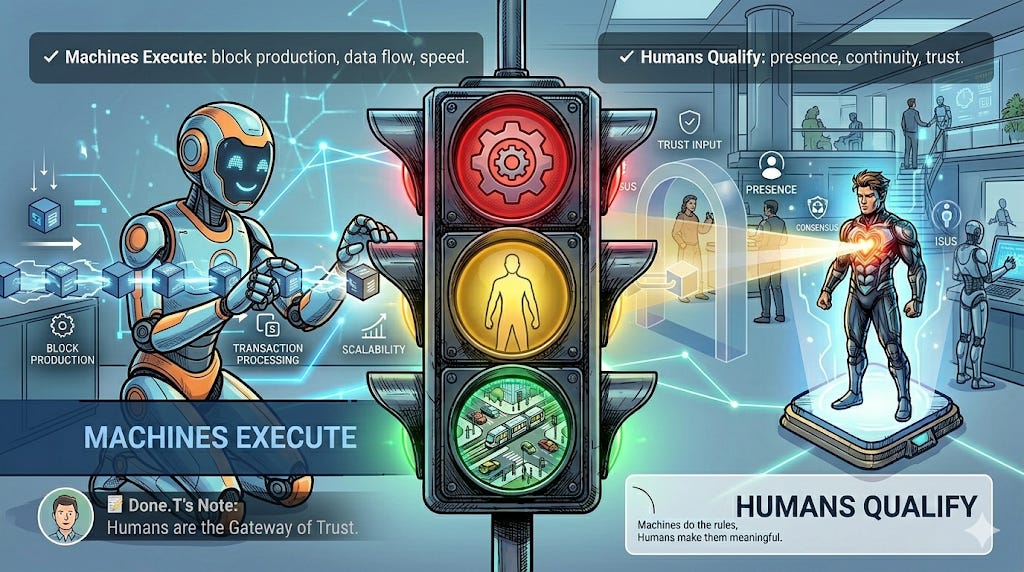
✔️ Machines Execute: They handle block production, transaction processing, and scalability.
✔️ Humans Qualify: They provide the presence, continuity, and trust input required for consensus.
Machines execute.
Humans qualify.
📝 Done.T’s Note
Humans are not replacing machines. We are stepping into the one role they cannot fulfill: the ‘Gateway of Trust’.
🚦 A Simple Analogy: Traffic Lights
Think about a traffic light at a busy intersection 🚥.
You don’t control the timing. You don’t decide when it turns green. You don’t personally enforce the law.
Yet, the city remains orderly because you — and thousands of others — consistently behave as expected. The system doesn’t rely on your individual judgment of every rule. It relies on your predictable participation.
Human Nodes work the same way.
You don’t execute consensus algorithms or produce blocks. But every single day, you quietly prove something a machine never can:
You exist.
You are a unique, verified identity.
You are present across time, not just in a single burst of energy.
Human Nodes don’t decide the rules;
they make the rules meaningful.
🔍 What Humans Actually Validate
This is the key shift. A Human Node is not a judge; it is evidence. It is not evidence of a single transaction, but evidence of human continuity.
When millions of these human signals accumulate, the network answers a question no blockchain could solve before:
“Who deserves to be included as a real participant in this economy?”
🏁 Where This Leads Next
Being recognized as a Human Node is just the entry point. In InterLink, entry is human, but trajectory is earned.
What happens after entry depends on your behavior, your consistency, and your time.
That is where the system becomes uncomfortable — and infinitely more interesting.
🔜 Coming Next in Part II
If everyone can be a Human Node, why won’t everyone be treated equally?
If you’d like to support my research, you may use my Interlink invitation code below. It also unlocks an instant mining boost ✚︎ Welcome Bonus for new users.
InterLink Referral Code: 905079415
Wallet Invitation Code : HSVZZPEJ (75% Commission Rebate)
❓ New to InterLink?
For a 🔗step-by-step guide, start with the pinned post at the top of my blog — Done.T Insight✨.
You don’t need capital. You just need five minutes.
📚 Done.T’s Related Insights
From Invisible to Measurable: The Economic Architecture Behind InterLink's Human Credit System

Most crypto systems reward what they can count. Hash rate. Transaction volume. Wallet size. These are legible variables — easy to measure, easy to game.
Zero-Capital Tokenization: How InterLink Creates Value Without Investment

Tokenization is one of those words that sounds important but rarely gets explained.
🔎 Search “Done.T Insight” on Google for real data & analysis.
Disclosure: This post contains referral links and reflects my personal research and experience. It is provided for informational purposes only and does not constitute financial advice.