

In Part I, we redefined what a node actually is.
It is not a machine, nor is it a server. It is an independent participant whose role is to influence the rules of the network.
🔗LINK [Redefining the Node #1]
That clarification leads to a natural next question:
If humans don’t validate transactions or produce blocks, how do they actually participate in consensus at all?
The answer lies in something most people underestimate:
Their behavior over time.

🚨 The Button Was Never the Point
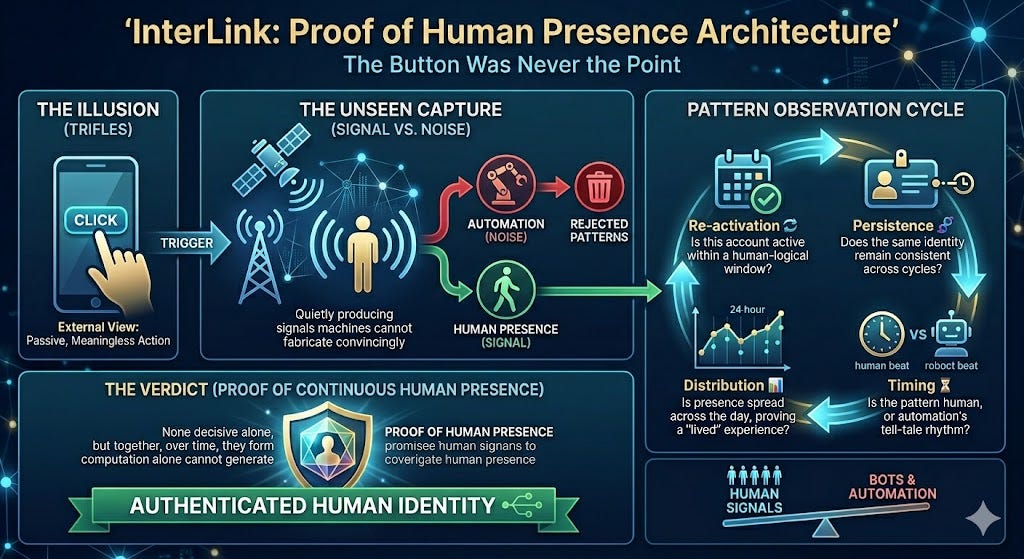
From the outside, participation in InterLink looks trivial. You open the app, you press a button, you close it.
It feels passive — almost meaningless.
But the button was never the mechanism; it was merely the trigger.
What the system actually records is not the click itself, but the context surrounding it.
📡 The Signal vs. The Noise
Each interaction quietly produces signals that machines cannot fabricate convincingly.
The network is not just counting clicks; it is observing patterns:
Re-activation 🔄: Is this account active again within a human-logical window?
Persistence 🧬: Does the same identity remain consistent across cycles?
Timing ⏳: Is the interaction pattern human, or is it the tell-tale rhythm of automation?
Distribution📊 : Is the presence spread across the day, proving a “lived” experience?
None of these signals are decisive on their own. But together, over time, they form something computation alone cannot generate: Proof of continuous human presence.
🕒 Why Time Beats Automation
A single verification can be faked. A single action can be scripted.
But time is expensive.
Automation excels at repetition, but it fails at patience. This is why InterLink does not look for snapshots. It looks for patterns.
Being human is not a moment.
It is a pattern.
🫀 Liveness: The True Meaning of Six Pulses
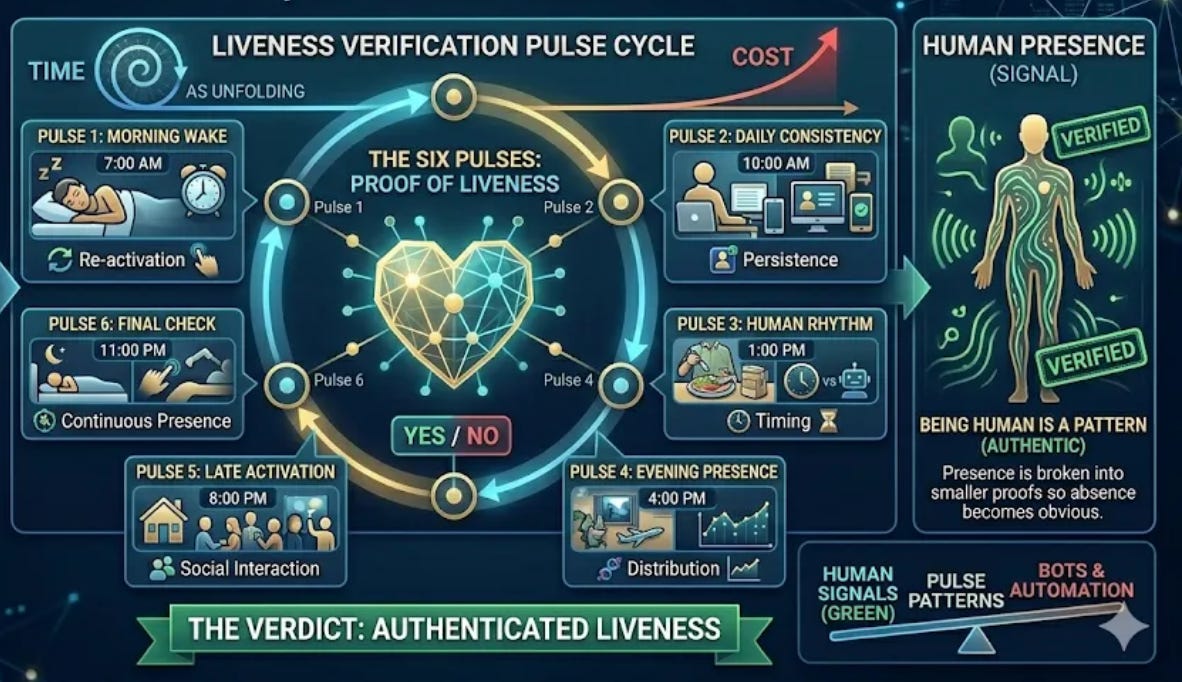
The idea of multiple daily interactions — the “Six Pulses” — is often misunderstood as a play for higher rewards or simple engagement.
In reality, its purpose is Liveness.
Each pulse answers a simple, fundamental question:
“Is this participant still here?”
Not once, not occasionally, but repeatedly across time.
Presence is broken into smaller proofs so that absence becomes obvious and automation becomes prohibitively costly.
🧱 Two Layers of Consensus: The Architecture of Truth
At this point, the InterLink structure becomes clear. The network operates with two distinct consensus layers:

Machines decide what happens.
Humans decide who counts.
👣 Entering Consensus Without Voting
Here is the critical shift in perspective: You don’t vote on blocks or approve transactions.
You play a more fundamental role:
establishing the undeniable human presence that fuels the network’s consensus.
Once human presence becomes measurable, consensus no longer needs to assume “trustlessness” at every single layer.
We can finally trust the network because we can trust the humans behind it.

🧾 A Definition, Completed
A Human Node is a verified human identity whose repeated, time-distributed behavior is used as an input to network consensus.
Only humans can persist this way.
🔜 Coming Next in Part III:
Entry can be universal. Outcomes cannot.
If every participant enters as a Human Node, why does the system still separate them later?
If you’d like to support my research, you may use my Interlink invitation code below. It also unlocks an instant mining boost ✚︎ Welcome Bonus for new users.
InterLink Referral Code: 905079415
Wallet Invitation Code : HSVZZPEJ (75% Commission Rebate)
❓ New to InterLink?
For a 🔗step-by-step guide, start with the pinned post at the top of my blog — Done.T Insight✨.
You don’t need capital. You just need five minutes.
📚 Done.T’s Related Insights
From Invisible to Measurable: The Economic Architecture Behind InterLink's Human Credit System

Most crypto systems reward what they can count. Hash rate. Transaction volume. Wallet size. These are legible variables — easy to measure, easy to game.
Zero-Capital Tokenization: How InterLink Creates Value Without Investment

Tokenization is one of those words that sounds important but rarely gets explained.
🔎 Search “Done.T Insight” on Google for real data & analysis.
Disclosure: This post contains referral links and reflects my personal research and experience. It is provided for informational purposes only and does not constitute financial advice.