

In Part I, we redefined what a Node truly is.
In Part II, we accepted that human behavior, not computation, provides the signals for social consensus.
Now comes the part most systems avoid saying out loud:
Equality at entry does not mean equality over time.
If everyone is a Human Node, why won’t everyone be treated equally?
🚪 The Illusion of Permanent Equality
At first glance, InterLink looks radically fair — and it is.
One human, one node
No hardware advantage (No GPU farms 💻)
No capital advantage (No private whales 🐳)
No hidden whitelists
Everyone enters the network through the same door. But here is the misconception:
Many people assume equality is a permanent state.
It isn’t.
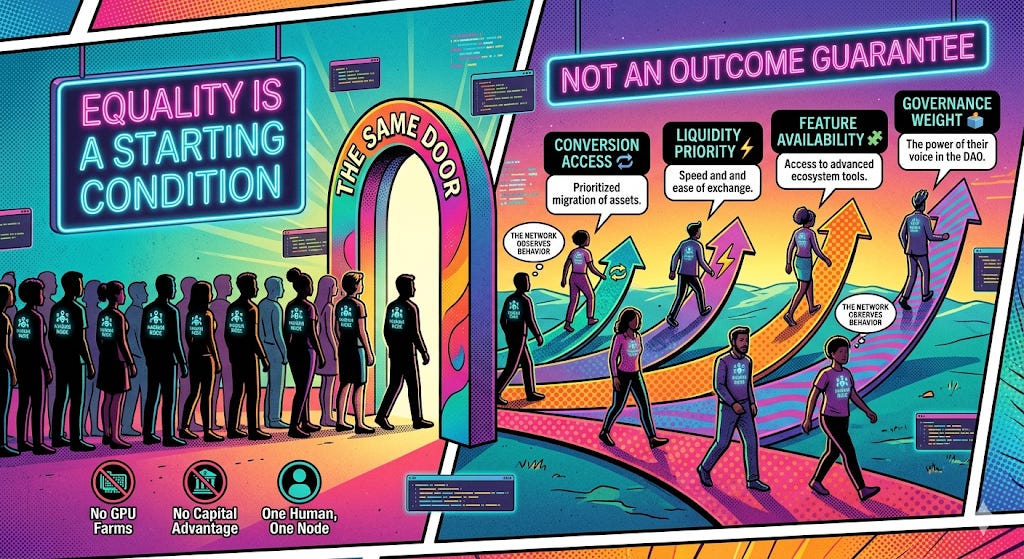
Equality is a starting condition, not an outcome guarantee.
InterLink guarantees equal entry, but it does not guarantee an equal trajectory. This distinction is intentional; it is the safeguard of the network’s value.
📊 What the Network Actually Observes
Once inside, the network stops looking at your identity and starts observing your behavior over time.
Without commentary or public judgment, differences naturally begin to emerge in:
Conversion Access 🔁: Priority for migrating assets.
Liquidity Priority ⚡: The speed and ease of exchange.
Feature Availability 🧩: Access to advanced ecosystem tools.
Governance Weight 🗳️: The relative power of your voice in the DAO.
There are no announcements, no public labels, and no superficial rankings. Just a quiet, data-driven divergence.
And that divergence is not a bug — it is the system working as intended.
⚠️ Why Absolute Equality is Dangerous
Here is the paradox most people miss:
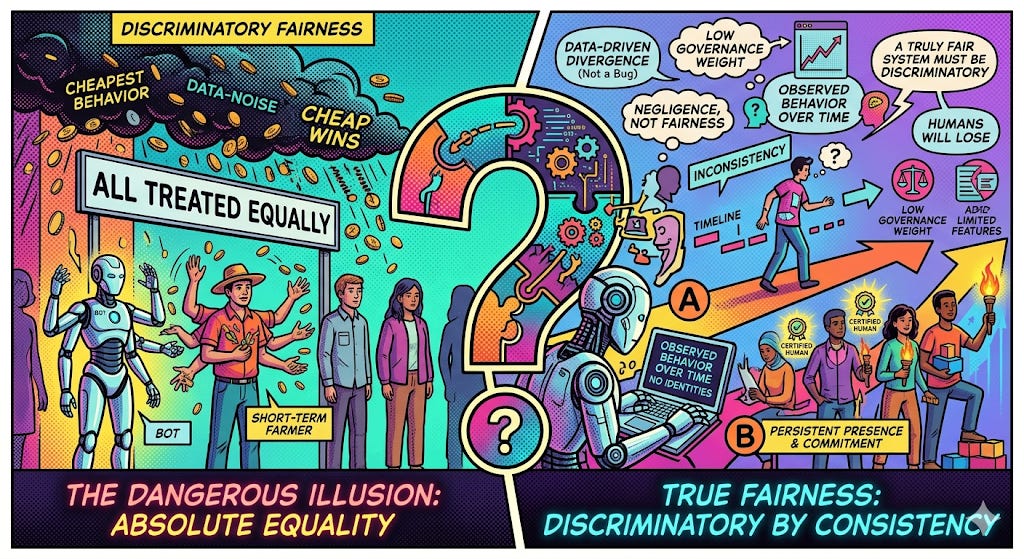
A system that refuses to distinguish behavior eventually rewards the wrong behavior.
Consider what absolute, permanent equality would imply 🤔
Bots and humans treated as equals.
Short-term farmers and long-term contributors treated as equals.
Inconsistent presence and persistent presence treated as equals.
That isn’t fairness. That is negligence.
A truly fair system must be discriminatory — not by identity, but by consistency.
If the system cannot tell the difference between a bot and a committed human, the “cheapest” behavior will always win, and the humans will lose.
🕸️ HCS: The Invisible Infrastructure of Trust
This is where mechanisms like the Human Credit System(HCS) operate. Not as a reward engine, not as a leaderboard, and certainly not as a gamified target.
HCS acts as background weighting.
It doesn’t decide who you are; it adjusts how much the system trusts your continuity.
📝 Done.T’s Note
HCS is deliberately invisible because visibility invites manipulation. The moment a score becomes the target, it loses its meaning as a measure of truth.
HCS is infrastructure, not a trophy.
🧭 The Philosophy: Reality is Not Flat
InterLink is not optimizing for hype, speed, volume, or excitement. It is optimizing for one thing:
Sustained, verifiable human presence.
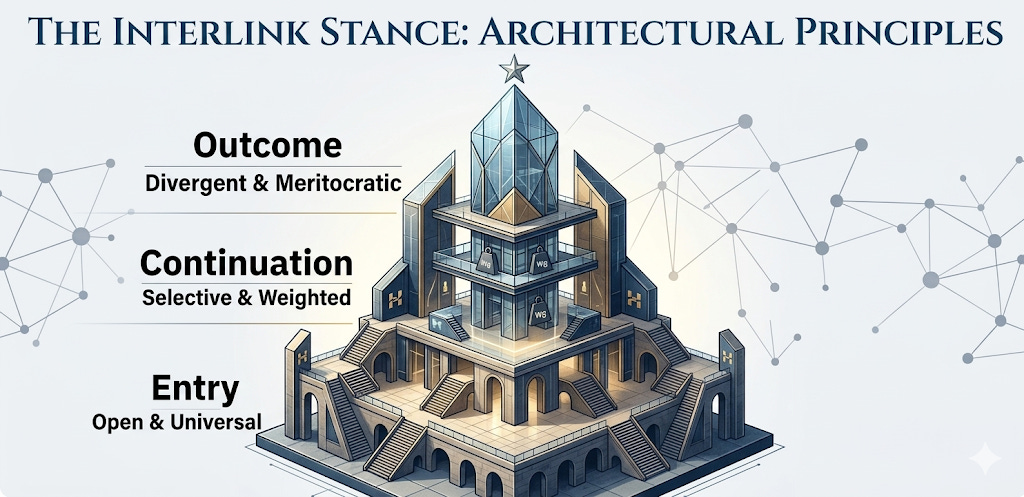
This structure exists because reality is not flat. Some participants provide more stability and trust to the network than others.
A system that ignores this reality will eventually collapse under its own lack of integrity.
🏁 Final Synthesis: The Core Truth
To collapse this entire three-part journey into one definitive truth:
Part I: A node was never meant to be a machine. It is an identity.
Part II: Equality was never meant to be permanent. It is a starting condition.
Part III: Trust is not assigned — it is accumulated. It is a trajectory.
Being a Human Node proves that you exist. Remaining a trusted Human Node proves how you exist.
The system responds to your continuity — without apology.
InterLink did not promise equality forever.
It promised fairness grounded in time.
If you’d like to support my research, you may use my Interlink invitation code below. It also unlocks an instant mining boost ✚︎ Welcome Bonus for new users.
InterLink Referral Code: 905079415
Wallet Invitation Code : HSVZZPEJ (75% Commission Rebate)
❓ New to InterLink?
For a 🔗step-by-step guide, start with the pinned post at the top of my blog — Done.T Insight✨.
You don’t need capital. You just need five minutes.
📚 Done.T’s Related Insights
From Invisible to Measurable: The Economic Architecture Behind InterLink's Human Credit System

Most crypto systems reward what they can count. Hash rate. Transaction volume. Wallet size. These are legible variables — easy to measure, easy to game.
Zero-Capital Tokenization: How InterLink Creates Value Without Investment

Tokenization is one of those words that sounds important but rarely gets explained.
🔎 Search “Done.T Insight” on Google for real data & analysis.
Disclosure: This post contains referral links and reflects my personal research and experience. It is provided for informational purposes only and does not constitute financial advice.