

For most digital assets, price formation begins and ends in the same place:
Speculation.
Tokens rise when demand increases, and demand increases when investors “bet” on future appreciation. In this legacy model, price is largely detached from real economic activity. Value flows from narrative, not production.
But what happens if a digital asset’s value is mechanically hardwired to real commerce?
This mechanism sits at the center of InterLink’s Revenue-Backed Digital Assets architecture — an idea introduced in its recent economic roadmap, but one whose implications most observers have not yet fully recognized.
It is a design that most readers have passed over, but it represents a fundamental shift in how we define “value” in Web3.
🏛️ The Structural Flaw in Modern Tokenomics
In most crypto ecosystems, the connection between network usage and token value is fragile.
A token might offer governance or utility, but its market price is determined on external exchanges, moving independently of the network’s actual productivity.
The “Real Economy” and the “Token Economy” run on parallel tracks, rarely touching. InterLink’s architecture is designed to merge these two tracks into a single, high-velocity engine.
If the mechanism functions as intended, usage and value stop diverging.
🪴 Businesses as Living On-Chain Assets
At the center of the architecture lies a premise that most readers overlook:
businesses themselves can exist as digital assets.
Instead of abstract utility tokens, a merchant operating within the InterLink ecosystem can tokenize their business — issuing a digital asset tied directly to their commercial performance.
This is not “legal equity” in the traditional sense; it is a Digital Economic Representation.
Once a business is tokenized on-chain, its valuation is no longer determined primarily by speculation. It becomes a matter of architecture.

⚙️ The 5% Engine: Turning Volume into Value
Most tokens are Demand-Backed: they need more buyers than sellers to survive.
InterLink proposes a Revenue-Backed model.
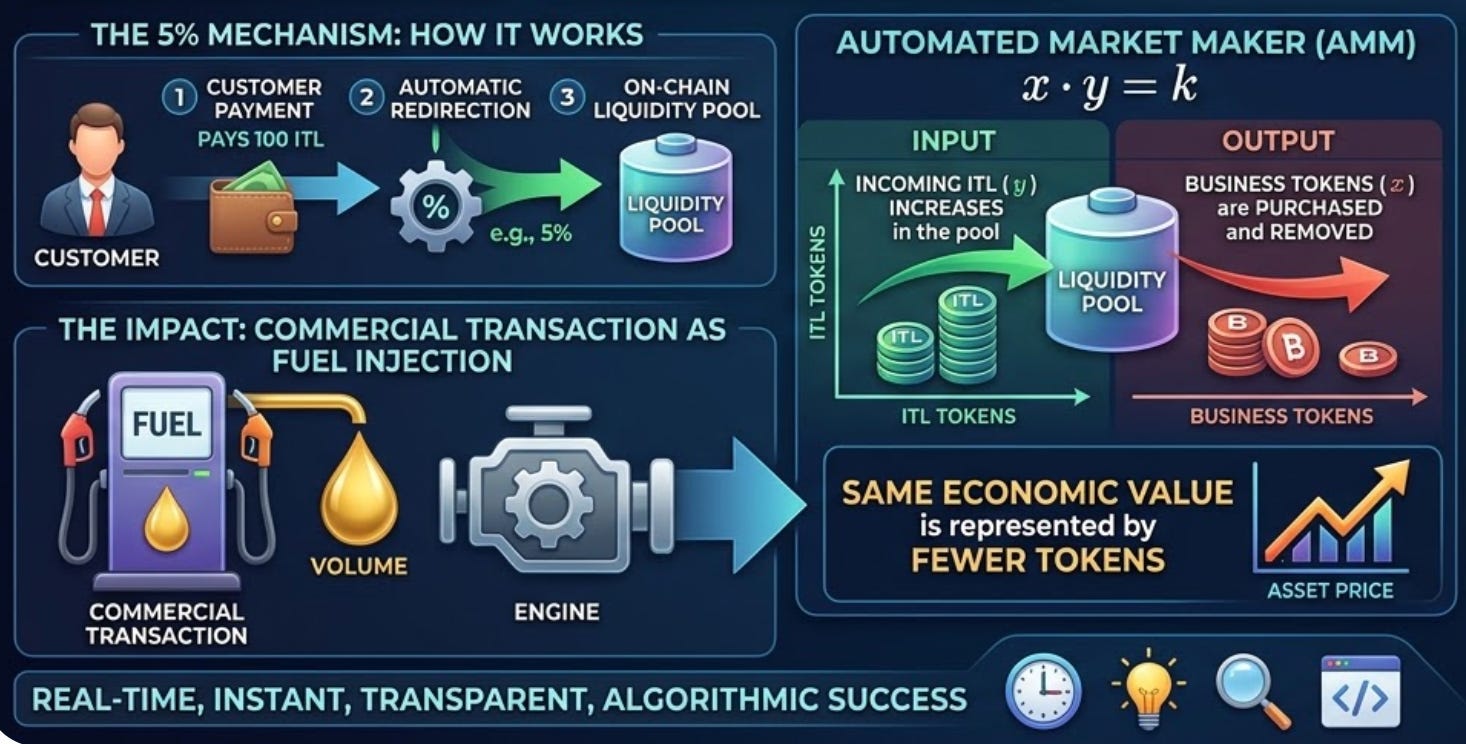
When a payment is executed — say, a customer pays 100 ITL for a service — the protocol automatically redirects a portion (e.g., 5%) into an on-chain liquidity pool. This isn’t just a fee; it is a protocol mechanism that turns transaction volume directly into token demand.
Through an Automated Market Maker (AMM) following the constant-product formula 𝑥 · 𝑦 = 𝑘:
Incoming ITL ( 𝑦 ) increases in the pool.
Business Tokens ( 𝑥 ) are purchased and removed from the pool.
So the same economic value must now be represented by fewer tokens — which naturally pushes the token price upward.
In this system, every commercial transaction is a fuel injection. It doesn’t just settle a debt; it compounds the asset’s floor price.
🔄 The Feedback Loop of Productivity
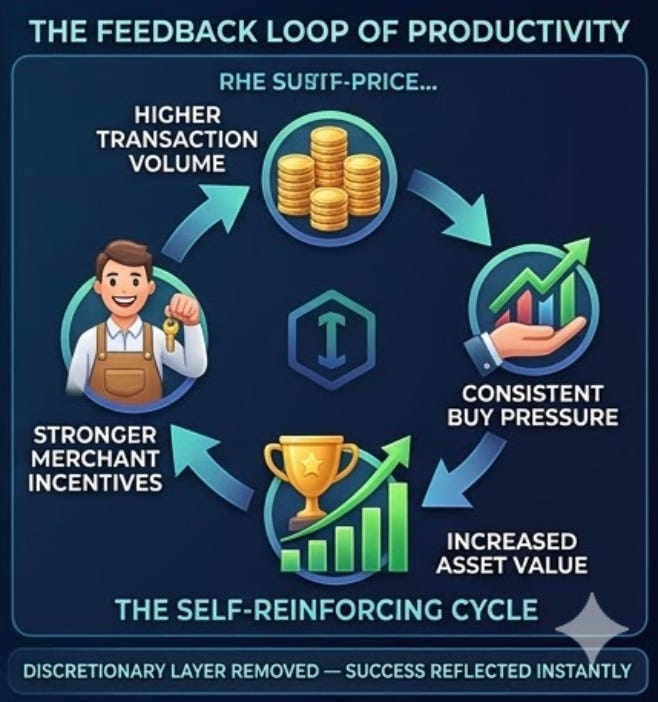
This creates a self-reinforcing cycle that traditional finance can only dream of:
Higher Transaction Volume → Consistent Buy Pressure.
Increased Asset Value → Stronger Merchant Incentives.
Stronger Incentives → More Economic Activity.
Unlike traditional buyback programs that rely on board meetings and quarterly reports, InterLink’s buybacks are instant, transparent, and algorithmic.
The “discretionary layer” is removed.
Success is reflected in the asset price in real-time.
⚓ The Hidden Anchor: Why ITL is the Real Story
While most observers are focused on the “Business Tokens,” the true structural weight lies beneath the surface.
Every single business token in this architecture exists within a dedicated liquidity pair:
BusinessToken / ITL.
As the ecosystem scales — from dozens to thousands of merchants — every buyback mechanism routes through ITL. Every liquidity pool is denominated in ITL.
As the ecosystem expands, ITL increasingly functions as the settlement layer beneath thousands of productive businesses — transforming from a simple payment currency into the coordination engine of a digital economy.
The 5% mechanism is the spark. ITL is the fuel.
🌄 From Speculation to Productivity
Digital Equity proposes a world where digital assets behave less like speculative bets and more like economic representations of real-world productivity.
InterLink is building a system where value isn’t “guessed” — it’s earned through every cup of coffee sold, every service rendered, and every transaction settled.
If the architecture functions as intended, this would represent a shift from a narrative-driven token economy to one grounded in measurable economic productivity.
And that is the part most observers are not yet looking at closely enough.
🔜 In the Next Part:
The Business Token is the visible layer. But structurally, it may be the secondary story.
In Part 2, we will examine why the settlement layer — ITL itself — is the most consequential design choice for the future of global finance.
Source:


If you’d like to support my research, you may use my Interlink invitation code below. It also unlocks an instant mining boost ✚︎ Welcome Bonus for new users.
InterLink Referral Code: 905079415
Wallet Invitation Code : HSVZZPEJ (75% Commission Rebate)
❓ New to InterLink?
For a 🔗step-by-step guide, start with the pinned post at the top of my blog — Done.T Insight✨.
You don’t need capital. You just need five minutes.
📚 Done.T’s Related Insights
Zero-Capital Tokenization: How InterLink Creates Value Without Investment

Tokenization is one of those words that sounds important but rarely gets explained.

🔎 Search “Done.T Insight” on Google for real data & analysis.
Disclosure: This post contains referral links and reflects my personal research and experience. It is provided for informational purposes only and does not constitute financial advice.