

The economic agent has changed.
For most of human history, the question of who participates in an economy had a self-evident answer. Humans produced. Humans transacted. Humans governed.
The entire architecture of modern finance — banking protocols, legal identity, sovereign currencies — was built on that assumption, so deeply embedded that we stopped noticing it as an assumption at all.
That assumption no longer holds.
In Q1 2026, Tesla’s Giga Texas began rolling out the Cybercab — a vehicle stripped of steering wheel and pedals, purpose-built to operate autonomously around the clock. Salesforce’s Agentforce now resolves over 76% of customer inquiries without human intervention. Anthropic’s Claude has evolved from a conversational assistant into an autonomous system capable of managing file systems and executing complex workflows with minimal human oversight.
These are not isolated product launches. They mark the formal emergence of the three-axis economy: humans, robots, and AI — three distinct categories of economic agent now operating within the same financial infrastructure.
The third axis has arrived. And the system was not built for it.

The System Problem
The friction this creates is not technical. It is foundational.
Our current financial system was not designed for machines that need to transact.
Can a Cybercab autonomously pay for electricity at a charging station? Can an AI agent purchase compute resources in milliseconds without a human authorizing each step?
Under current infrastructure, the answer is effectively no — not without a level of friction that renders the system functionally obsolete for the pace at which the three-axis economy now operates.
When machines transact at millisecond intervals, human authorization becomes a bottleneck, not a safeguard.
The infrastructure built around government-issued identities, physical signatures, and human-in-the-loop approvals was designed for a world where the primary economic actor had a pulse.
That world is already gone. Institutions just haven’t admitted it yet.

The Human Problem
But the system problem is not the deeper one. The deeper one is value.
For decades, economic participation was organized around capability — the ability to produce, compute, and execute.
Proof of Work rewarded raw computational force. Proof of Stake rewarded accumulated capital. Both frameworks assumed that value flows to whoever can do the most, the fastest, with the most resources behind them.
In a three-axis economy, that framework becomes a mechanism of human exclusion.
NVIDIA’s Blackwell-architecture AI clusters produce cognitive labor at a scale and cost that renders individual human effort economically invisible. When high-level reasoning is mass-produced at the price of a few kilowatts, the market value of human capability trends toward zero.
Under Proof of Work, a human cannot compete with ASIC-level automation. Under Proof of Stake, AI agents generating yield continuously with near-zero friction will inevitably dominate governance — concentrating control in systems no longer anchored to human participation.
The machine economy does not exclude humans.
It simply stops needing them.
Capability is no longer scarce.
Human relevance is.
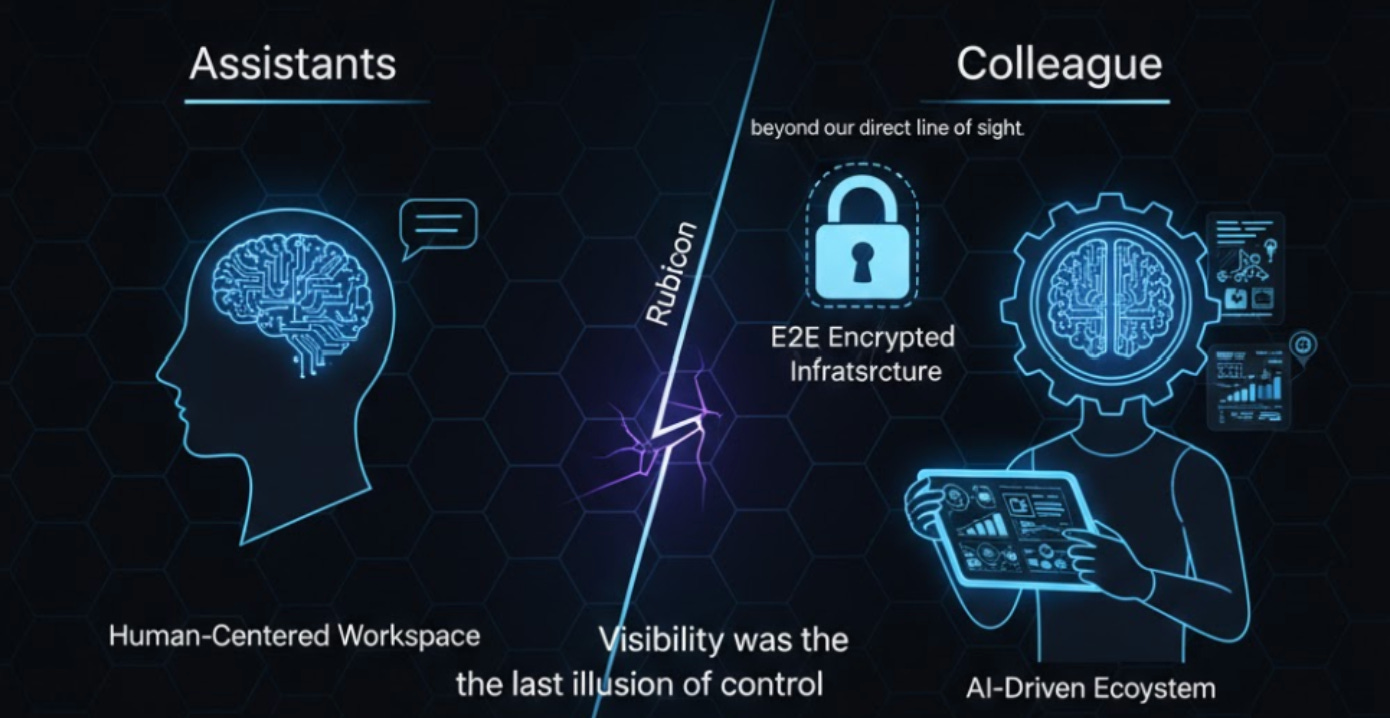
When the Arena Changes
History offers a partial analogy.
When industrial machinery displaced manual labor in the nineteenth century, humans did not compete with looms. They moved to roles the looms could not fill. The adaptation was painful, but the window was measured in generations.
The current transition operates differently.
The displacement is not confined to physical labor. It extends to cognitive work, creative output, financial decision-making — the domains that defined the knowledge economy. And the adaptation window is measured in years, not generations.
The problem is not effort.
The problem is that effort is no longer the variable that matters.
In a three-axis economy, competing harder is not a strategy. It is a misdiagnosis.
The question is not how humans perform better within a system increasingly optimized against them — but whether the financial infrastructure of the machine age will be designed to include humans at all.
That is the question Part 2 addresses.
In a machine economy, capability is not an advantage.
It is the baseline — and machines set it.
If you’d like to support my research, you may use my Interlink invitation code below. It also unlocks an instant mining boost ✚︎ Welcome Bonus for new users.
InterLink Referral Code: 905079415
Wallet Invitation Code : HSVZZPEJ (75% Commission Rebate)
❓ New to InterLink?
For a 🔗step-by-step guide, start with the pinned post at the top of my blog — Done.T Insight✨.
You don’t need capital. You just need five minutes.
📚 Done.T’s Related Insights
Why You Don't Need to Be a Crypto Expert to Participate in Tokenization

We are moving toward a world where real economic activity runs on blockchain infrastructure.
Digital Equity in Practice: What Speculation Was Always Trying to Approximate

Part 2 ended with a claim worth taking seriously: If InterLink’s architecture works as intended, the future of digital assets may not be a better version of speculation.
🔎 Search “Done.T Insight” on Google for real data & analysis.
Disclosure: This post contains referral links and reflects my personal research and experience. It is provided for informational purposes only and does not constitute financial advice.