

In Part 1, we observed a quiet conclusion.
Bitcoin Revelation — an experimental attempt to re-enforce the original principles Bitcoin under modern conditions — stopped debating rules and began enforcing them.
Consensus was frozen.
The specification became canonical.
🔗[Bitcoin Revelation & the Rules of 2009]
But it also exposed a harder question — one most systems postpone:
If the rules are truly final, how far can they survive once the environment stops cooperating?
In modern distributed systems, environmental failure no longer means hardware collapse. It means connectivity failure.
This is where Bitcoin Revelation v0.3.3 begins.
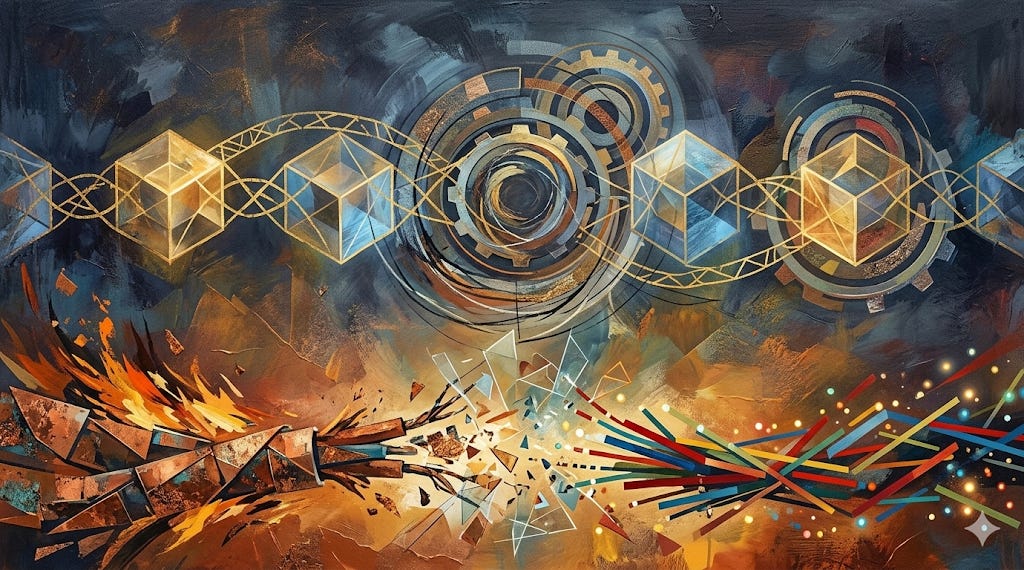
✅ A Shift in Assumptions: Validity Over Connectivity
v0.3.3 is not an “upgrade” in the modern sense. It does not promise higher throughput, better UI, or venture-backed growth.
Instead, it removes a dependency most modern systems quietly assume:
stable, institutional internet.
The README for v0.3.3 repeats a narrow set of principles with unusual insistence:
Permissionless & Peer-to-peer (P2P)
No trusted seeds & No checkpoints
Offline-capable (store-and-forward)
Then, it draws a line that feels almost confrontational:
“Connectivity affects speed, not validity.”
This is a structural statement.
It asserts that a system’s legitimacy must not depend on continuous access or network goodwill.
If your decentralization collapses when the cables are cut, it was conditional all along.
🧭 Reframing P2P: Where Does Your Truth Live?
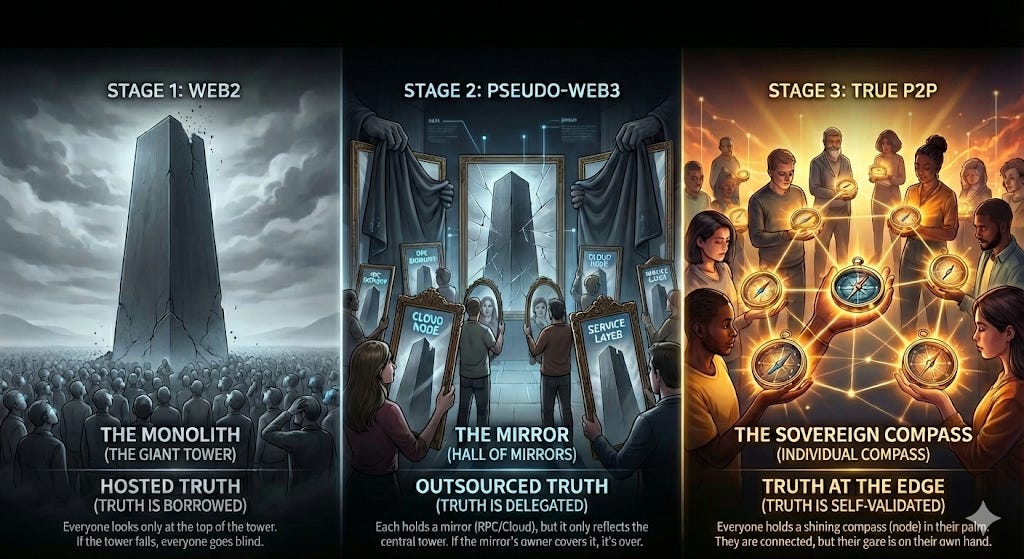
In Web3 discourse, “Peer-to-Peer” is often treated as mere architecture. But P2P is not about how machines communicate; it is about where judgment resides.
In Web2, truth is hosted. In much of today’s Web3, truth is outsourced — to RPC endpoints, cloud nodes, or service layers that quietly reintroduce trust.
Most “decentralized” apps are just prettier leashes; they stop working the moment a provider’s API goes down.
True peer-to-peer systems relocate judgment back to the edge:
Each node independently validates all data.
Consensus is local and voluntary — you choose the rules you enforce.
There is no recovery mechanism and no authority to appeal to.
This is the condition that makes decentralization meaningful.
If a participant cannot independently verify the state of reality without asking for permission, their participation is merely symbolic.
🏠 The Terminal as a Sanctuary
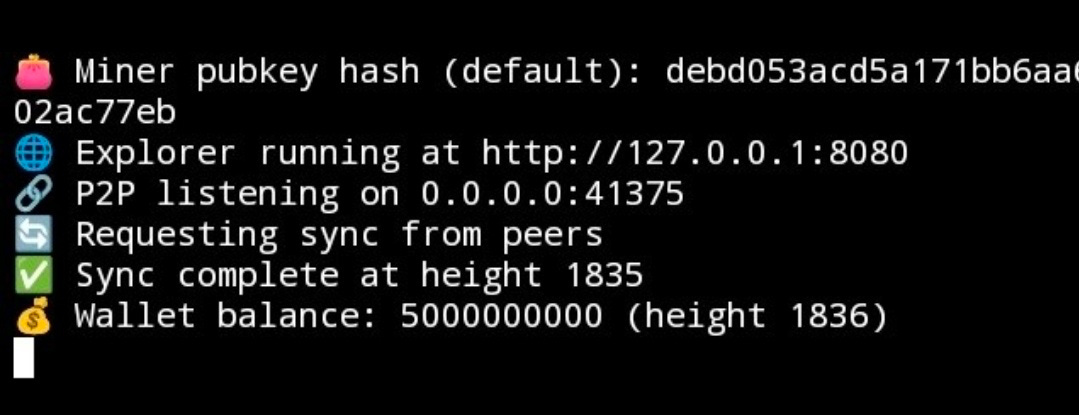
Look at the terminal view of a running node.
There is no onboarding flow. No abstraction layer. Just a local node initializing at 127.0.0.1:8080.
This interface represents the smallest operational unit of sovereignty: a system that can still decide without asking.
When you see “Sync complete at height 1835” on your own screen, you aren’t looking at a dashboard. You are looking at a private source of truth that no central authority can edit or switch off.
The terminal is not sovereign because it is isolated. It is sovereign because it enforces the same frozen rules and history as every other node, even if it has to do so in the dark.
🌱 Survival Under Fracture: Why This Matters Now
In 2009, P2P was a necessity because Web3 didn’t exist. In 2026, the environment has reversed.
Web3 exists, but it is deeply infrastructural and fragile.
Bitcoin Revelation revisits these roots not for nostalgia, but for “survivability”.
✔︎ Infrastructure Independence 🕊️:
In regions with unstable connectivity — from rural India to urban Nigeria — disconnection cannot be treated as exclusion. v0.3.3 ensures that value systems remain interpretable even when access is intermittent.
✔︎ Systemic Rupture 💥:
When institutions pause — due to natural disasters or state-imposed shutdowns — rules must persist. Peer-to-peer systems promise resilience not through “uptime,” but through independence.
🏁 Conclusion: When Infrastructure Fails, Time Remains
If a system requires permission, it is temporary.
If it requires constant connectivity, it is conditional.
Bitcoin Revelation removes the conditions. By stripping away 17 years of accumulated assumptions, the project has planted a fixed standard.
What remains is not convenience, but endurance.
When authority fragments and networks degrade, time continues.
If the world goes dark tomorrow, will your wealth remain valid, or will it simply vanish with the servers?
Source code referenced in this analysis:
🔗 Github repository
If you’d like to support my research, you may use my Interlink invitation code below. It also unlocks an instant mining boost ✚︎ Welcome Bonus for new users.
InterLink Referral Code: 905079415
Wallet Invitation Code : HSVZZPEJ (75% Commission Rebate)
❓ New to InterLink?
For a 🔗step-by-step guide, start with the pinned post at the top of my blog — Done.T Insight✨.
You don’t need capital. You just need five minutes.
📚 Done.T’s Related Insights
Why the Capability Economy Is Collapsing- The Rise of the Three-Axis Economy

The economic agent has changed.
When Machines Earn and Spend: The Settlement Layer Nobody Built

CES 2026 did not simply showcase better hardware. It exposed a structural debt we have been postponing.
🔎 Search “Done.T Insight” on Google for real data & analysis.
Disclosure: This post contains referral links and reflects my personal research and experience. It is provided for informational purposes only and does not constitute financial advice.