

Let’s be clear about something before we go further.
ATV is not an official InterLink Core Team release. There is no ICT announcement behind it. What you are looking at is something rarer and, in some ways, more interesting — a framework being built independently by a former InterLink Global Leader and a widely followed independent voice in the community. They didn’t wait for a mandate. They started designing.
That alone is worth paying attention to.
The Problem They’re Responding To
Token valuation in crypto has a structural flaw that almost everyone accepts without questioning it. Price comes first. Utility follows.
The market decides what something is worth before anyone has actually used it for anything real, and that speculative premium becomes the baseline everyone builds on.
ATV is a direct response to this. Not a price prediction. Not a target. A reorientation of the question itself.
Instead of asking what ITL should be worth, ATV asks what ITL is already worth inside real exchanges of goods and services.
The formula is straightforward:

What comes out is not a forecast.
It is a reading.
The Blueprint: What the Formula Actually Says
Think of it this way. If you can buy a Big Mac with 1 ITL today, and tomorrow it takes 0.5 ITL to buy the same thing, the implied value of ITL just doubled — not because a trader moved the price, but because the transaction said so.
That is the logic ATV is built on. USD/ITL is not assigned. It is earned through what people actually exchange.
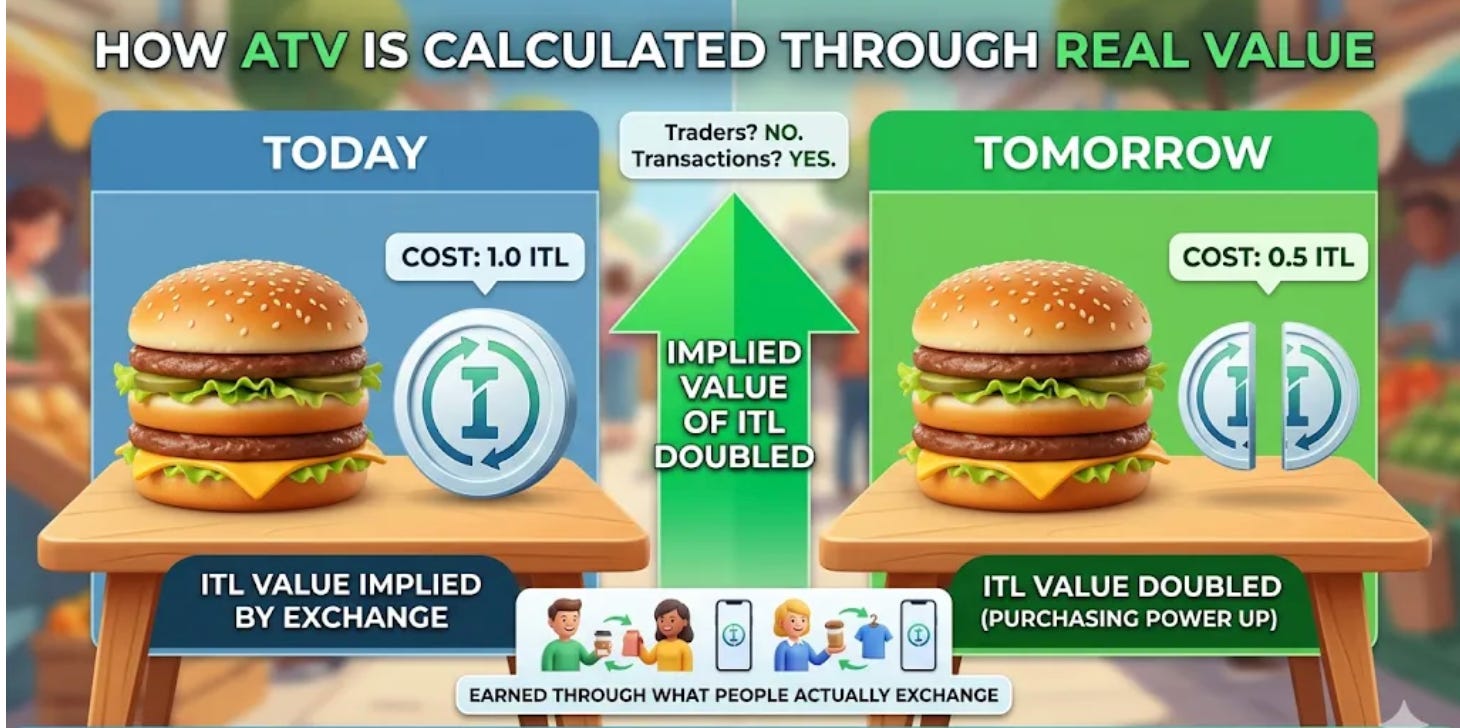
For this number to mean anything, three conditions have to hold simultaneously.
Real transactions must exist — actual exchanges settled in ITL, not simulated. Those transactions must be submitted with verifiable proof. And they must pass through the ATV Council, a validation layer that filters manipulation before data enters the aggregate.
Remove any one of those conditions and the output is not a valuation. It is an assumption dressed in math. This is what separates ATV from models like Pi Network’s GCV, where social agreement produces the number.
ATV requires evidential agreement — verified economic activity, recorded and validated.
One asks for consensus.
The other asks for proof.
The People Behind It
Coach Joel — @Joel_Dupalco — built the intellectual architecture. A former InterLink Global Leader, he published the foundational framework: the formula, the rationale, the governance model. It is a serious document, internally consistent and aware of its own limitations.
Then Vyx — @VyxCrypto629 — began building the infrastructure. The ATV website is live. A transaction submission form exists. The Council is recruiting its first three board members. Vyx is also a widely followed independent voice in the ecosystem, which means the reach behind this initiative is not small.
Nicolas Bernard joined the Core Team alongside Vyx. Three people are now running this as an organized operation — with a website, a governance structure, and a public-facing recruitment pipeline.
This is no longer a whitepaper.
It is an institution in early formation.

The Missing Piece
Here is the part that honest analysis cannot skip.
ATV needs real transaction data to function, and that data is not yet flowing at meaningful scale. The submission form exists. The Council is forming. But the raw material the framework depends on is not established.
And the risks are not trivial — early data sets are vulnerable to sample bias, Council centralization creates a single point of validation failure, and without sufficient transaction volume, the ATV number reflects a narrow slice of activity rather than genuine ecosystem-wide behavior.
Without transaction flow, ATV is not early. It is undefined.
Where It’s Coming From
What makes this moment significant is that the conditions for resolving the data problem are being built from a separate direction entirely.
InterLink Foundation has opened Payment Point applications for merchants. The Visa Card is live. The Taj Mahal Testnet has achieved deterministic finality under 2.3 seconds. V5.1 brings vITLG on-chain for the first time.
None of this was built for ATV. But all of it feeds ATV —
when merchants transact in ITL and those exchanges are recorded on-chain, the data the formula needs starts to exist as fact, not assumption.
The Chicken and Egg problem does not disappear. But the egg is being laid from a different nest.
What This Means If It Works
If real transaction data begins flowing and aggregating through ATV, ITL would carry an implied value derived from actual economic activity. Not what traders think it’s worth. What people actually paid for things using it — verified, recorded, on-chain.
A listed price on a property means nothing until someone actually buys it. Asking prices can sit for years, disconnected from what the market will bear.
ATV works in the opposite direction — the transaction happens first, and the value follows from it.
That is a number a regulated desk can reference. One that survives a market downturn because it is grounded in something that happened, not something predicted.
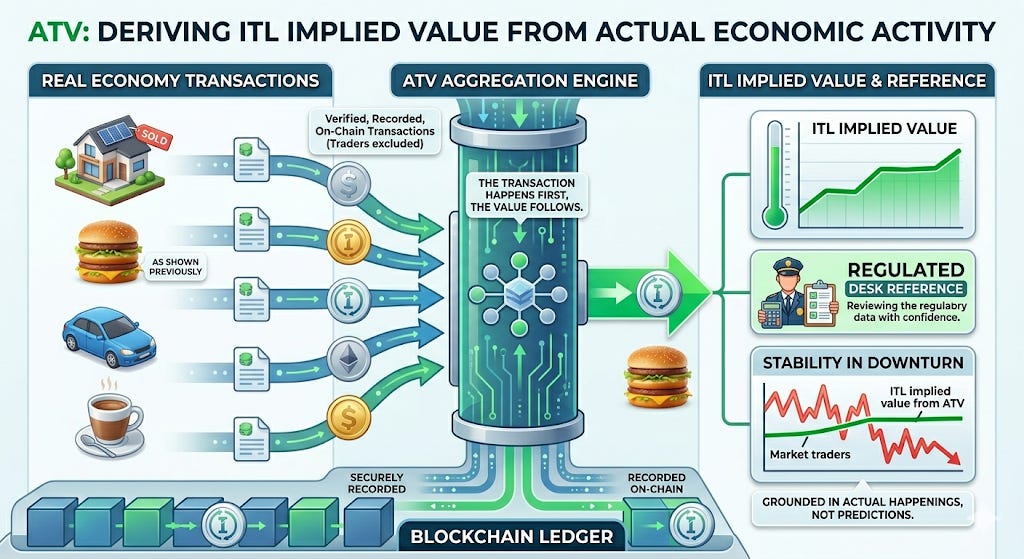
That is what the architects are designing toward. A value signal the ecosystem earned, not one the market assigned.
The Outline Is Visible. The Building Continues.
ATV is not finished. The data layer is not established. The ICT has not officially adopted it. These are facts, not criticisms.
What is also a fact: two of the deeply embedded people in the InterLink ecosystem designed an alternative valuation framework from first principles and began building the infrastructure to make it real — before being asked, before official backing, before the market arrived to judge it.
ATV is not a valuation model.
It is a claim about where value is allowed to come from.
Whether the market accepts that claim depends entirely on what the data says when it finally arrives.
If you’d like to support my research, you may use my Interlink invitation code below. It also unlocks an instant mining boost ✚︎ Welcome Bonus for new users.
InterLink Referral Code: 905079415
Wallet Invitation Code : HSVZZPEJ (75% Commission Rebate)
❓ New to InterLink?
For a 🔗step-by-step guide, start with the pinned post at the top of my blog — Done.T Insight✨.
You don’t need capital. You just need five minutes.
📚 Done.T’s Related Insights
When the Chain Goes Live, the Stakes Change: What V5.1 Is Actually Saying

There is a category difference between a protocol that adds features and a protocol that begins operating. Feature releases expand what a system can do. Operational releases change what the system is.
The Tech Tree of Infrastructure: What Bitcoin Revelation Would Actually Need to Become

Revelation is not infrastructure.
🔎 Search “Done.T Insight” on Google for real data & analysis.
Disclosure: This post contains referral links and reflects my personal research and experience. It is provided for informational purposes only and does not constitute financial advice.